
Paul Whitmore sat at the edge of his bed that morning, holding the invitation in his hands longer than necessary.
The paper was cream-colored, the handwriting neat and careful:
Mabel’s 80th Birthday.
Saturday, 5:00 p.m.
You will come, Harry. No excuses this time.
He smiled faintly. Only his sister Mabel could order him to attend her party and make it sound like a warm embrace. They’d been close once. Closer than most siblings, especially after both their spouses died within a year of each other. But the years had thinned the visits to occasional phone calls, and even those were rare.
He wanted to see her again. Really see her.
The drive should have been easy. He’d taken that route dozens of times: down Highway 13, left at Buttermilk Road, then four miles to her little white house with green shutters and a porch sagging under the weight of geraniums.
The first leg was uneventful — golden leaves spinning down through the sunlight, the radio quietly playing Pink Floyd tunes, his coffee cooling in the travel mug. The smell of autumn pressed in through the open window, and for a while, Paul felt younger, steadier on the wheel.
Then came the turn.
Or rather, it didn’t.
Where Buttermilk Road should have cut sharply left, there was nothing but an unbroken wall of pine and oak. Paul slowed, frowning. Maybe they’d moved the road? But how could you move a road?
He drove on, certain he’d see it around the next bend. When it didn’t appear, he doubled back, scanning for the green-and-white street sign, for the leaning mailbox at the corner, for anything.
They were gone.
He turned down another road instead, one he didn’t recognize. The asphalt narrowed and cracked, weeds pushing through in jagged seams. The trees leaned over it, branches scraping the roof in dry whispers.
The radio sputtered — a burst of static — then silence.
A faint unease crept in, like realizing the house was too quiet after hearing someone in the next room. Paul gripped the wheel even tighter, following the ribbon of road as it twisted deeper into the woods. He kept expecting to pass another car, or a farmhouse, or at least a power pole. There was nothing.
It occurred to him — with a sudden chill — that the last thing he remembered seeing was the gas station outside Milford. How long ago was that? An hour? Two? The sunlight looked wrong now, dim and strained, the way it did before a storm, though the sky was an unbroken slate gray.
At the next fork, he turned right. Then left. Then right again. Each turn felt like an attempt to circle back, but the roads didn’t seem to obey anymore. They narrowed to one lane, then to dirt, hemmed in by trees whose trunks were black and slick, as though the rain had been falling for days.
In the corner of his eye, something moved. He glanced to the shoulder and saw… not deer. Not anything he knew. Tall, too tall, with narrow, jointed limbs, their heads cocked at angles no human neck could manage. They stood in pairs, just beyond the tree line, watching him pass.
He blinked. When he looked again, they were gone.
The air inside the car had grown heavy and damp. Paul’s chest ached with each breath. He reached for his phone, but the screen was dead black, refusing to light.
His gas gauge had fallen dangerously below a quarter tank.
Panic was starting to creep through the cracks of his reason when the trees abruptly parted. In the clearing ahead stood a single farmhouse. The white paint had faded to gray, the porch sagged wearily, the windows were dark. As he rolled closer, a lone porch light flickered on, casting a weak yellow glow.
Paul stopped in the dirt drive. He stared at the house. It wasn’t Mabel’s, but something about it tugged at his memory; the way the shutters hung askew, the way the steps sagged to the left.
The screen door creaked open.
A woman stepped onto the porch. Her hair was white, her dress plain, her skin pale under the porch light. And she was smiling in a way that made Paul’s stomach twist; too wide, too steady.
“You’re late, Paul,” she said.
Her voice was Mabel’s. But not quite.
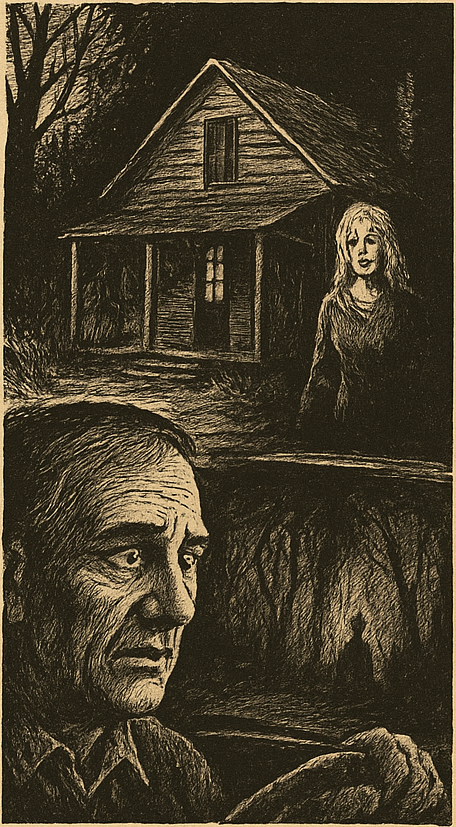
Behind him, the road he’d come from was gone, replaced by a dense wall of trees. The figures stood there now, unmoving, their long shadows spilling forward like ink across the clearing.
The porch light pulsed, brighter for a moment, then dimmed, as though it were breathing.
Paul reached for the door handle. He couldn’t remember if he meant to open it or lock it.
Mabel, or the thing wearing her voice, tilted her head. “Come inside. We’ve been waiting for you.”
And Paul, feeling the weight of the years settle on him like a shroud, stepped out into the cold.
****
Mabel Whitmore stood on her porch the next morning, watching fog curl low over the fields. She’d set an extra place at the table last night, kept the coffee hot until midnight. But Paul never came.
The sheriff found nothing. No skid marks, no sign of a breakdown, no Paul. Just the faint smell of exhaust on Meadow Lane, and a single black feather lying in the gravel, too long to belong to any bird Mabel had ever seen.
That night, she dreamed of someone knocking at her door. When she opened it, there was no one there — only the whisper of her name, drifting in from the dark.
*****
And, you know I mustn’t neglect the obligatory shameless self-promotion. New Yesterdays is available through the following links: Books-A-Million, Barnes & Noble, and Amazon as well as your favorite bookshops. The Audiobook is available from Libro.fm, as well as Amazon.



 olbigjim
Terrific , Jim. You’ve creeped me out for the rest of the day. 😀
LikeLiked by 1 person
Thanks, John! My work here is done.
LikeLiked by 1 person
Naw. Keep it up.
LikeLiked by 1 person
Bushwa! I’m so glad I read this during the daytime, Jim. As someone who used to get lost nearly every time I went to a place to which I didn’t go frequently… Well, I jumped right in. Great writing. Hugs.
LikeLiked by 1 person
Thank you a hundred thousand times, Teagan!
LikeLiked by 1 person
Fascinating, Jim! 😲
LikeLiked by 1 person
Thank you, Tim!
LikeLiked by 1 person