A Piedmont Porchlight Story
There are certain things a man doesn’t expect to find in his morning mail.
A letter from the Internal Revenue Service is one. A notice that his automobile warranty has expired is another, particularly when the automobile in question has been sitting on blocks behind the garage since the Eisenhower administration.
But a bill for his own funeral?
Well, that’s something else altogether.
I discovered this particular unpleasantness on a Monday morning in October, shortly after finishing my second cup of coffee at the Coffee Cup.
I’d been running Magnolia Mortuary for enough years to know that death was a reliable business, though not one I particularly encouraged. Folks had a tendency to misunderstand an undertaker who appeared overly enthusiastic about his work.
I once told a fellow that business was picking up.
He asked whether I meant the funeral business.
I told him I certainly hoped so, because the alternative was considerably worse.
Anyway, I was sitting behind my desk, sorting through the morning mail, when Walter P. Hensley appeared in my office doorway.
Walter had taken over the night desk following Clifford Monk’s death earlier that month. He’d previously worked at the Piedmont Hotel, where he’d developed an extraordinary talent for keeping records and an equally extraordinary inability to mind his own business.
I liked him immediately.
He reminded me of Clifford, though I hadn’t yet decided whether that was comforting.
“Morning, Mr. Wright.”
“Morning, Walter. Anything interesting happen last night?”
“No, sir.”
“Nobody called?”
“No, sir.”
“Nobody died?”
“Not that I noticed.”
“Well, that’s encouraging.”
Walter handed me a cream-colored envelope. “This came for you.”
I examined it. There was no postage stamp. No return address. Just my name written across the front in a fine, old-fashioned hand.
Mr. Jim Wright Magnolia Mortuary Piedmont, Alabama
“Who brought it?”
“Don’t know, sir.”
“Found it in the mailbox?”
“No, sir. On your desk.”
I looked at him. “On my desk?”
“Yes, sir.”
“Well, who put it there?”
Walter considered the question. “That’s the part I was hoping you could tell me.”
Now, Walter had already worked for me long enough to know that I wasn’t particularly fond of mysteries before breakfast.
I found myself wishing Clifford were still around. He’d have had something to say about the whole business, though it probably wouldn’t have been particularly helpful.
I missed that about him.
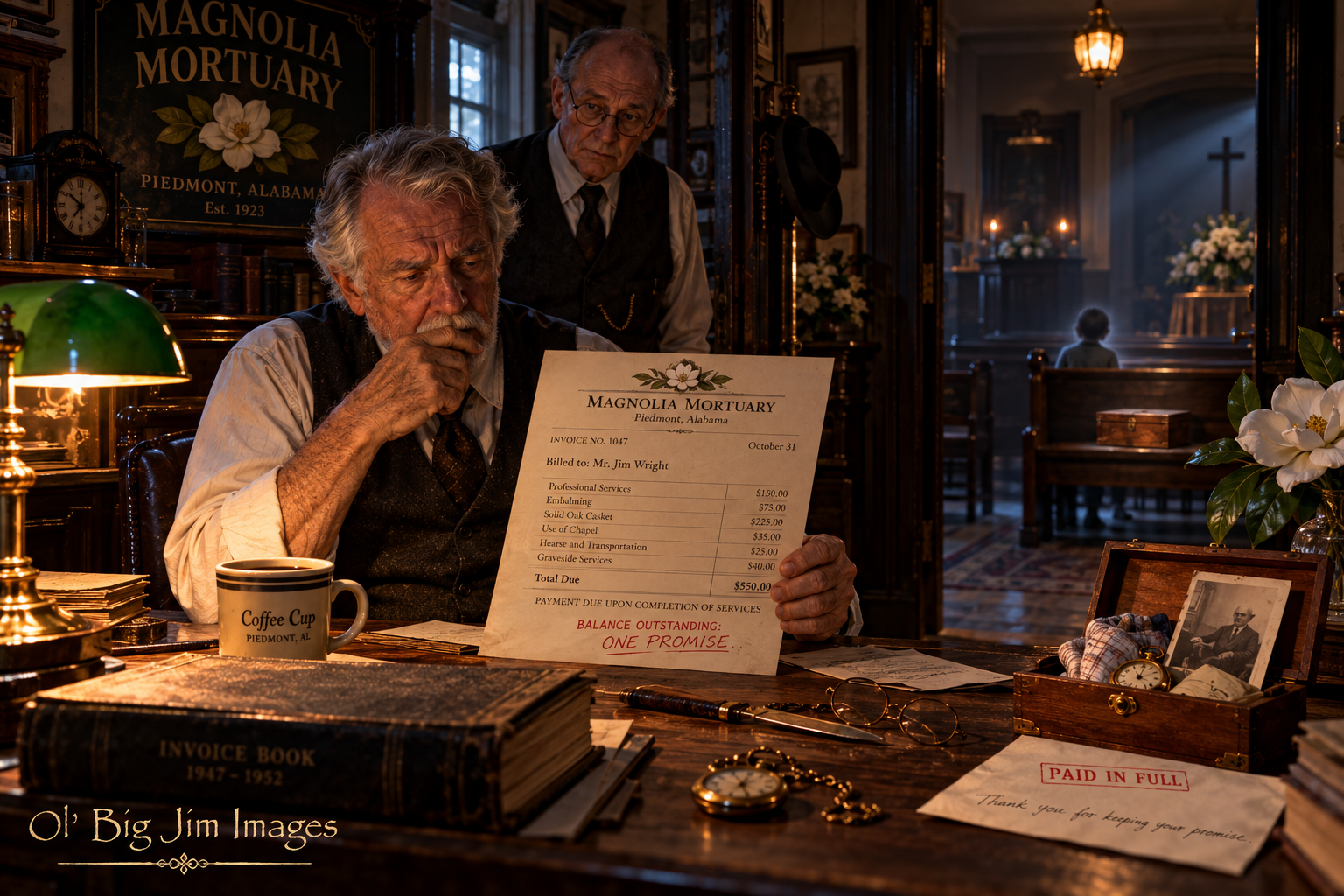
I slit the envelope with my letter opener. Inside was a single sheet of heavy ivory paper. At the top, printed in handsome black lettering, were the words:
MAGNOLIA MORTUARY
Beneath that was an itemized invoice. I recognized the stationery immediately. It was ours.
Or rather, it had been ours.
We’d stopped using that particular invoice form years earlier.
I adjusted my spectacles and began reading.
MAGNOLIA MORTUARY
Piedmont, Alabama
INVOICE NO. 1047
October 31
Billed to: Mr. Jim Wright
| Professional Services | $150.00 |
| Embalming | $75.00 |
| Solid Oak Casket | $225.00 |
| Use of Chapel | $35.00 |
| Hearse and Transportation | $25.00 |
| Graveside Services | $40.00 |
| Total Due | $550.00 |
PAYMENT DUE UPON RECEIPT
I stared at it.
Then I read it again.
“Walter?”
“Sir?”
“Have you been drinking?”
“No, sir.”
“Well, somebody has.”
I handed him the invoice.
He studied it carefully. “Looks like one of ours.”
“It is one of ours.”
“Who’s it for?”
“Me.”
Walter looked at the paper.
Then at me.
Then back at the paper.
“Well,” he said, “that’s unfortunate.”
“Unfortunate? Walter, somebody’s sent me a bill for my own funeral!”
“Yes, sir.”
“And you call that unfortunate?”
“Would you prefer something stronger?”
I took the invoice back.
“Walter, if I ever receive a bill for my own funeral, I expect a little more concern from my employees.”
He nodded.
“Yes, sir. I’ll try to remember that.”
The first thing that bothered me was the price.
Five hundred and fifty dollars.
Now, I’ve always considered myself a reasonably economical man, but even I knew that was a bargain.
“Solid oak casket for two hundred and twenty-five dollars,” I muttered. “I’d like to know where they found that.”
Walter was standing beside the filing cabinet.
“Maybe it’s used.”
I looked at him.
“Walter, there are certain things in this business that we do not sell secondhand.”
“Yes, sir.”
“And caskets are pretty far up on that list.”
“Yes, sir.”
I examined the invoice again.
The second thing that bothered me was the date.
October thirty-first.
Six days away.
Now, I wasn’t particularly superstitious, but I didn’t appreciate somebody scheduling my funeral without consulting me.
Especially on Halloween.
“Walter, check the old invoice books.”
“Which ones?”
“All of ’em.”
“That’s a considerable number of books, Mr. Wright.”
“Then you’d best get started.”
He disappeared into the records room.
I sat back in my chair and considered the possibilities.
Somebody was playing a practical joke.
That seemed the most reasonable explanation.
Curtis Pope was capable of it, although his humor generally involved other people’s hairlines and marital difficulties.
Mr. Blackwelder might have been responsible, but he’d been acting peculiar lately, particularly whenever somebody mentioned shadows.
And Earl Pritchett?
Well, Earl could barely balance his own checkbook. I doubted he could manufacture a convincing funeral invoice.
I was still considering suspects when Walter returned. He was carrying a large ledger bound in cracked black leather.
“Found something.”
He placed it on my desk and opened it to a page near the middle.
There, in faded blue ink, was an entry for invoice number 1047.
The handwriting matched the bill.
So did the amounts.
So did the services.
Now, there’s no sense pretending that made any kind of ordinary sense.
The receipt was dated October thirty-first, 1949.
I wasn’t born until 1955.
Yet there it was, bearing my signature in handwriting I’d have recognized anywhere.
And I remembered making that promise.
I remembered the boy, the rain, and the little wooden box.
What I couldn’t understand was how I could remember something that had happened six years before I was born.
“Magnolia Mortuary wasn’t even called Magnolia Mortuary in 1949.” Back in those days, Piedmont was served by Roebuck in Jacksonville. Roebuck Funeral Home was upstairs over the furniture store that shared the name.
“No, sir.”
“And I wasn’t running it.”
“No, sir.”
“Then how in God’s name is my name in that book?”
Walter adjusted his spectacles. “That’s what I was hoping you’d explain.”
I was beginning to suspect that Walter enjoyed his work more than was strictly necessary.
The ledger contained one additional detail.
Beside my name, in a narrow column reserved for special instructions, somebody had written:
Family requests no viewing.
Now, I don’t object to closed-casket funerals. They’re perfectly respectable arrangements.
But I do object to somebody deciding that I shouldn’t be viewed while I’m still available for inspection.
“Walter, get me the telephone.”
He brought it over.
“Who’re you calling?”
“The sheriff.”
“About what?”
“Somebody trying to bury me.”
Walter nodded.
“Reckon he’d want to know.”
I dialed the sheriff’s office.
Sheriff Lyle Booker answered on the third ring.
“Booker.”
“Lyle, this is Jim Wright.”
“Morning, Jim. Anybody dead?”
“Not yet.”
“Well, that’s good.”
“Depends on who you ask.”
I explained the invoice. There was a long silence.
Then Lyle said, “You sure you ain’t dead?”
“Lyle, if I was dead, would I be calling you?”
“Well, Jim, that’s sort of the question, ain’t it?” I could hear the subtle grin in his voice. I hung up. Some conversations just ain’t worth finishing.
By lunchtime, the invoice had acquired a second peculiar quality.
It wouldn’t stay where I put it.
I placed it inside the ledger. An hour later, it was on my desk.
I locked it in the bottom drawer. When I returned from the chapel, it was lying beside my coffee cup.
I folded it and put it in my coat pocket. Five minutes later, Walter brought it to me from the front counter.
“Found this.”
“Where?”
“Under the guest register.”
I stared at him. “Walter, are you moving that paper around?”
“No, sir.”
“Are you sure?”
“Yes, sir.”
“Because if you’re playing some sort of joke, I want you to know that I am rapidly losing my appreciation for it.”
Walter looked genuinely offended. “Mr. Wright, I’ve never joked about a man’s funeral.”
“Well, there’s a first time for everything.”
“Not this time, sir.”
He returned to his desk. I looked down at the invoice. A new line had appeared beneath the total. It hadn’t been there that morning.
I was certain of it.
BALANCE OUTSTANDING: ONE PROMISE
I read it three times. Then I called Walter back. “Did you see this?”
He looked at the paper. “Yes, sir.”
“Was it there before?”
“No, sir.”
“What do you make of it?”
Walter considered the question. “Looks like somebody owes somebody something.”
“Thank you, Walter. Your powers of observation continue to astonish me.”
“Yes, sir.”
Now, I have made a goodly number of promises in my life.
Some I kept.
Some I forgot.
And one or two I made while holding a fishing rod and believing the fish on the other end was considerably bigger than it turned out to be.
But I couldn’t remember promising anybody a funeral. At least, not one I hadn’t already provided.
That evening, after Walter had taken over the night desk, I went down to the records room.
I found the old ledger and examined the page again.
The entry for invoice 1047 was still there.
But beneath my name, where the special instructions had been, somebody had written something new.
He said he would remember.
I stood there for a long time.
There are words that can stir up memories a man thought he’d buried.
Those five did exactly that.
I remembered a rainy October afternoon many years earlier. A little boy standing beneath the porch of Magnolia Mortuary. He couldn’t have been more than ten or eleven.
His clothes were wet. His shoes were muddy. And he was holding a small wooden box against his chest.
I’d been young then, still learning the trade. The boy had asked whether I could bury somebody for him.
“Who is it?” I’d asked.
“My granddaddy.”
I remembered looking at the box. It was much too small for a man. “Where’s your granddaddy, son?”
The boy had looked down. “In here.”
I hadn’t understood. Not at first.
Then he’d opened the box.
Inside was a pocket watch.
A folded handkerchief.
And a photograph of an elderly man sitting in a rocking chair.
The boy explained that his granddaddy had died years earlier, somewhere far from Piedmont. Nobody had brought him home. Nobody had held a funeral. And the boy had decided that wasn’t right.
“Everybody ought to have somebody to tell ’em goodbye,” he’d told me.
I remembered kneeling beside him. “You’re right about that.”
“Can you do it?”
“Well, son, I reckon we can arrange something.”
“How much’ll it cost?”
I looked at the little wooden box.
Then at the boy.
“Not a penny.”
He’d stared at me.
“You promise?”
“I promise.”
And then…
Well.
That’s where the memory stopped. I couldn’t remember the boy’s name. Couldn’t remember whether we’d held the service. Couldn’t even remember what became of the little wooden box.
But I remembered the promise.
And suddenly, the invoice didn’t seem quite so funny.
I went upstairs. Walter was reading an old issue of Casket & Sunnyside behind the night desk.
“Walter?”
“Sir?”
I started to ask whether he remembered a little boy who’d come to Magnolia Mortuary carrying a wooden box.
Then I caught myself.
Walter had only been working here a few weeks. He couldn’t possibly remember that.
Clifford might have.
For a moment, I found myself looking toward the chair where Clifford used to sit, expecting to see him with his spectacles halfway down his nose and that magazine spread across his knees.
Funny how a man can be gone and still occupy so much space.
“Something you needed, Mr. Wright?” Walter asked.
I shook my head.
“No, Walter. Just thinking about something.”
“Anything I can help with?”
“Not unless you’ve figured out how to ask a dead man a question.”
Walter considered that. “No, sir. Haven’t had occasion to try that one yet.”
“Well, let’s hope you never do.”
I turned toward my office. Behind me, Walter cleared his throat.
“Mr. Wright?”
“Yes?”
“Was there something you wanted to ask Mr. Monk?”
I stopped. “How’d you know I was thinking about Clifford?”
Walter looked mildly puzzled. “Well, sir, you were looking at his chair.”
I glanced back. Walter’s chair was empty.
And for just a moment, I could have sworn I saw an old issue of Casket & Sunnyside lying open on the seat.
Then Walter stepped back into view from the filing cabinet, carrying a stack of correspondence.
“Something wrong, Mr. Wright?”
“No,” I said.
But I don’t think I sounded particularly convincing.
I went back to my office.
The invoice was waiting on my desk.
This time, there was another line.
SERVICE INCOMPLETE.
I sat down.
“All right,” I said aloud. “I remember.”
The room was quiet.
“I remember the boy.”
Nothing happened.
“I remember the promise.”
The clock above the mantel ticked.
“But I don’t remember what I did about it.”
From somewhere in the building came the faint sound of a door opening.
Then closing.
I stood.
“Walter?”
No answer.
I walked into the hallway. The lights were burning softly, as they always did at night. At the far end, the chapel doors stood open.
I was certain I’d closed them earlier. I approached. Inside, the chapel was empty.
Except for a small wooden box resting on the front pew.
I recognized it immediately. Dark wood. Brass hinges. A little scratch across the lid. The same box the boy had carried through the rain.
I picked it up.
It was heavier than I remembered.
Inside were the pocket watch, the handkerchief, and the photograph.
And beneath them, folded into a small square, was a piece of paper.
I opened it.
It was a receipt.
MAGNOLIA MORTUARY PAID IN FULL
The date was October thirty-first, 1949.
The signature at the bottom was mine.
I stared at it.
Now, there’s no sense pretending that made any kind of ordinary sense. In 1949, six years before I was born, I might add, I was nowhere near old enough to be running a funeral home.
And yet the handwriting was unmistakably mine. Beneath the signature was one final sentence. Thank you for keeping your promise. I looked toward the back of the chapel. For a moment, I thought I saw somebody sitting in the last pew.
A small figure.
A boy, perhaps.
Then the overhead light flickered.
And the pew was empty.
The next morning, Walter found me asleep in my office chair. The invoice lay on the desk. Across the bottom, in faded blue ink, somebody had stamped:
ACCOUNT SETTLED.
Walter picked it up. “Well,” he said, “that’s good.”
I opened one eye. “What’s good?”
“Looks like you got your bill paid.”
“Walter, if you ever mention that bill again, I’ll personally arrange for you to spend the rest of your natural life working the night shift.”
He considered that.
“Already do, sir.”
I closed my eye. “Then I’ll think of something worse.”
He went back to the front desk.
I sat there for another few minutes, listening to the quiet sounds of Magnolia Mortuary waking up around me.
The telephone rang. A car passed outside. Somewhere in the chapel, the old organ began playing softly.
Nothing unusual.
Nothing alarming.
Just another morning in Piedmont.
Then I noticed the envelope. It was slid under the invoice. Cream-colored.
No stamp.
No return address.
Across the front, in that same fine handwriting, were two words:
Clifford Monk
I looked toward the hallway.
Walter was humming to himself behind the desk.
I picked up the envelope.
For a long moment, I considered opening it.
Then I slipped it into the bottom drawer and turned the key.
Some things, I decided, are better left unopened.
Particularly before breakfast.
And especially when you work in the funeral business.
⁂