Well, y’all, the Good Book, it tells a fine story, but it tends to leave out the grit and the foolishness that makes a tale worth the tellin’. It tells you about a fella named Barabbas, mentions he was coolin’ his heels in the hoosegow, and that the crowd chose him over a certain carpenter from Nazareth. But it never tells you why. It never tells you what kind of man would make a whole city holler for his freedom. I happen to be in the way of knowin’, because Barabbas’ great-great-grandnephew twice removed settled over in the next county, and the family stories, they travel just as well as the family silver.
First off, Barabbas weren’t no common thief or murderer. That’s way yonder too simple. Barabbas was an entrepreneur. A visionary, you might say, with a particular talent for liberatin’ things from their rightful owners. He was in prison not for killin’ a man, but for what you might call a prophetic disagreement with a Roman tax collector.
See, Barabbas had this donkey. A fine, sturdy animal named Nebuchadnezzar, on account of its stubborn nature and its tendency to bray at inconvenient times. One afternoon, this Roman fellow, a man named Flavius with a nose so high in the air he could drown in a light rain, comes along and claims Nebuchadnezzar is a Roman donkey, on account of the road it was standin’ on bein’ a Roman road.
Barabbas, being a man of logic and property rights, attempted to explain the fundamental flaw in the man’s argument. Flavius, being a man with a sword and very little patience, attempted to explain the fundamental flaw in Barabbas’ skull. Things escalated. Words were exchanged, then shoves, then a well-aimed rock, and then, in the confusion, Nebuchadnezzar, feeling the spirit of the moment, kicked Flavius squarely in the nether regions. The Roman fell backward into a cart of figs, which then overturned, causin’ a scene of such biblical proportions that Barabbas was clapped in irons for “incitin’ a riotous fruit incident.”
So, there he sat, in a Jerusalem jail, plannin’ his next venture, which involved a scheme to sell genuine holy water to tourists (it was just well-water with a sprig of mint in it). He figured he had another six months of contemplation before his case came up.
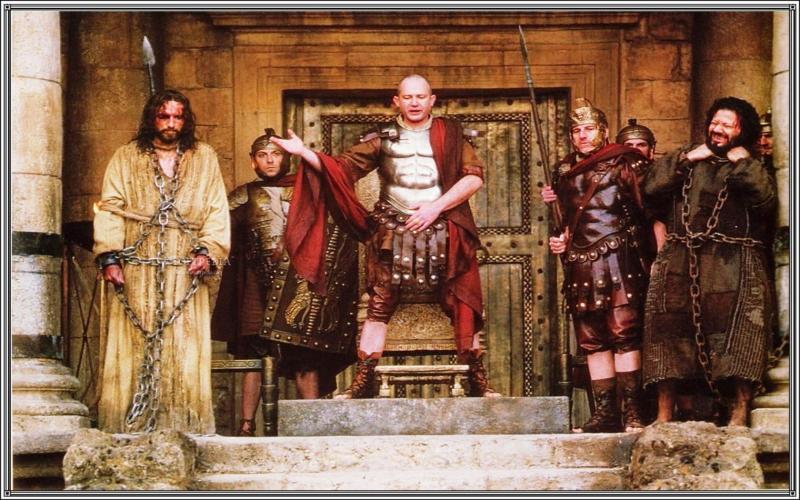
Then the crowd started roarin’ outside. It wasn’t the usual grumblin’ about taxes or the price of figs. This was a new and different kind of roar. A bloodthirsty, holiday roar. The guards drug him out, and there stood Pontius Pilate, lookin’ like a man who’d just been told his in-laws were stayin’ at his house for a month.
Pilate, a politician to his core, decided to let the folks decide. “We got this Jesus feller,” he said, gesturing to a quiet-looking man, “and we got this Barabbas feller, who… well, he’s here. Which one of ‘em is gonna get the Passover pardon?”
The crowd, bein’ a crowd, didn’t think. They just roared. They knew Barabbas. He was the one who’d sold them a “miraculous” mule that could find water (it just had a habit of walking toward any well within five miles). He was the one who’d organized the “unofficial” camel races outside the city gates. He was an entertainer. A character. This other feller was just tellin’ ‘em to be nice to each other, which was all fine and good, but it ain’t much of a show.
So, they roared for Barabbas. And just like that, he was a free man.
Now, here’s the part the Bible leaves out. What does a man do after bein’ spared from crucifixion by a bloodthirsty mob? Most men would run for the hills and thank their lucky stars. Not Barabbas. He was an opportunist, over and above all.
He walked out of that courthouse, blinked in the sun, and saw the crowd still millin’ about, all worked up and full of energy. He saw the crosses being prepared on the hill. And he saw a business opportunity.
He went straight to the market, bought up every last scrap of wood, every nail, and every length of rope he could find. Then he set up a cart right in the path leadin’ to Golgotha.
His sign was simple: “Crucifixion Supplies – Last Minute Deals!” He sold small wooden crosses to folks who wanted to remember the day. He sold little vials of vinegar to the morbidly curious. He sold “Official Nails of the Occasion” to tourists. His bestseller was a little wooden bird on a string he called the “Golgotha Dove,” which he claimed would bring you good luck.
Business was boomin’. He was makin’ more money in one afternoon than he had in a year of donkey-liberatin’.
He was just finishin’ up a sale to a wealthy merchant when a shadow fell over him. It was Jesus, being led toward the hill, carryin’ his own cross. He stopped, looked at Barabbas’ boomin’ little enterprise, and looked at Barabbas himself, who was countin’ his coins.
Barabbas stopped, looked at the man who had taken his place, and felt a peculiar pang of something he couldn’t quite name. T’weren’t guilt. Not really. It was more like… professional courtesy.
He reached into his pocket, pulled out a small, whittled fish, one of his first attempts at carvin’, and handed it to him. “For the road,” Barabbas said with a shrug. “Looks like you’re in for a bit of a trek.”
Jesus took the small wooden fish, looked at it, and then at Barabbas, and gave him a small, sad smile. Then he continued on his way.
Barabbas watched him go, shrugged, pocketed his coins, and hollered at the crowd, “Get your commemorative thorns! Only two denarii! A real bargain!”
Some men are made for history. And some men, well, some men are just made for the souvenir business. And there ain’t no law that says a man can’t be both.
⁂
New Yesterdays can be found at: Books-A-Million, Barnes & Noble, and Amazon, as well as your favorite bookshops. The Audiobook is available from Libro.fm, as well as Amazon.


 olbigjim