
There are many types of Alabama rain, and I have lived long enough under southern skies to know each variety by temperament alone. There is the polite sort of rain that taps gently on windowpanes like a neighbor who only needs to borrow a cup of corn likker. There is the confused drizzle that cannot decide if it wants to be fog or precipitation. There is the summer downpour that arrives as a tantrum and leaves as a steam bath.
And then there is the other kind.
The one that comes at you like you owe it money.
Now, I do not pretend to know what I did to provoke the heavens, but on that particular March day, it seemed the Almighty had checked His accounting ledger and found me personally responsible for somethin’ that must have happened during the Eisenhower administration. Because the sky opened in a manner that can only be described as vengeful.
The first warning arrived in the form of a single, heavy drop that struck the porch rail with the sound of a small stone. It was the kind of raindrop that makes a man look up slowly, like he is confirmin’ whether the Lord is throwin’ pebbles at him to get his attention. I stepped outside, sniffed the air like a seasoned weather prophet, and muttered, “Well, that’s odd.”
It was odd for exactly seven seconds.
Then the entire sky collapsed.
Not opened.
Not poured.
Collapsed.
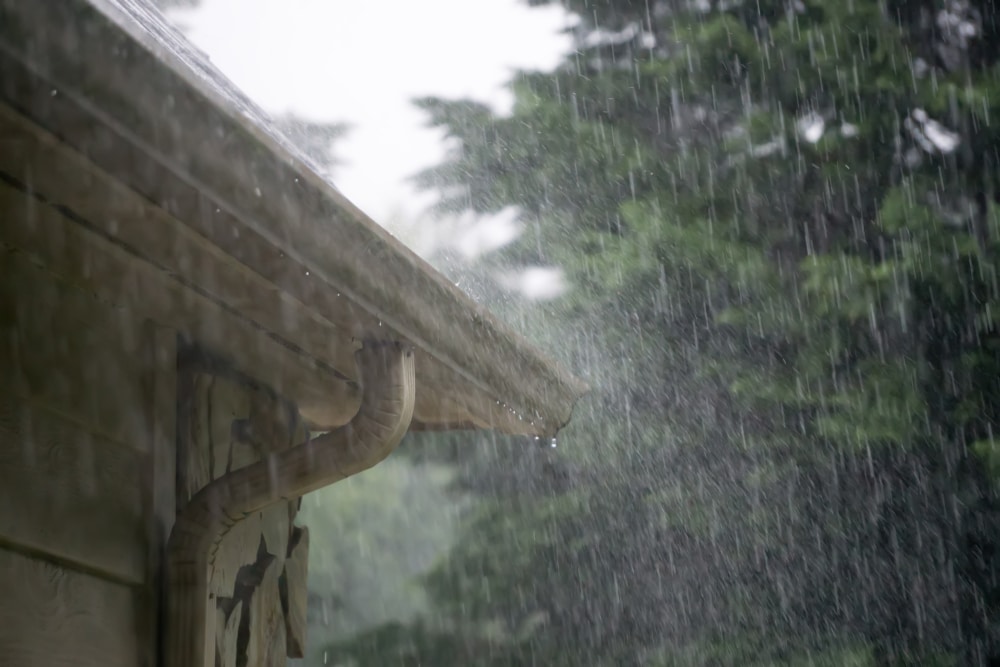
Water fell in sheets so thick I could not even see the cotton mill down the street, and that building is hard to miss on the clearest day God ever painted. Lightning cracked so close it rattled the dishes in the cabinet. Thunder followed with such enthusiasm that the windows trembled like nervous chihuahuas.
I thought that was the worst of it, but the storm had merely warmed up.
A gust of wind came howlin’ from the east, whipping tree limbs like they had insulted its mother. The gutters overflowed in less than a minute. My yard turned into a reenactment of the Great Flood. A river formed along the side of my house, complete with rapids, eddies, and what I swear was a crawdad ridin’ the wave with an expression of pure alarm.
I attempted to make my way around the house to check the drainage pipe, but the storm was not havin’ it. The rain hit me sideways, upward, backward, and in one instance, I believe it came at me diagonally. I have never before been attacked by airborne water from four directions at once. It felt less like weather and more like a coordinated assault.
My hat blew clean off my head and disappeared into the storm as though it had been drafted for military service. My shirt clung to me like a desperate cat. Mud splashed up to my knees. The wind roared so loud I had to shout my own complaints just to hear them.
Then came the insult on top of injury.
A leak.
Right over the kitchen table.
A single drop of water plopped squarely into my coffee, and I stood there in disbelief as the ceiling gave a second drip out of spite. It was like the storm discovered it had missed a spot and corrected the oversight with gusto.
By the time the squall burned itself out, the yard was a swamp, the porch was slick as oiled glass, and I was standin’ in the doorway lookin’ as if I had attempted to wrestle the storm into submission and lost two out of three rounds.
I finally stepped inside, drippin’ mud and indignation.
The faucet in the kitchen sink gave a small drip of its own, and I said aloud, “Don’t you start with me.”
Later that evening, a neighbor told me their yard got barely a sprinkle. Another said the rain passed right over their roof, gentle as a sigh.
So, I stand by my conclusion:
That storm did not hit Piedmont.
It hit me.
And it did not do so accidentally.
No sir.
That particular raincloud carried a personal grudge, and I will go to my grave convinced of it.
New Yesterdays can be found at: Books-A-Million, Barnes & Noble, and Amazon, as well as your favorite bookshops. The Audiobook is available from Libro.fm, as well as Amazon.



 olbigjim