
The creak of Curtis’ knees as he stood from his armchair sounded louder than the morning news. At seventy-two, the world outside his bay window seemed to accelerate daily, leaving him stranded on a quiet island of routine. His grown children called dutifully, voices tinged with the distracted warmth reserved for museum pieces. His grandchildren, vibrant galaxies of energy and screens, spoke a language of acronyms and apps he couldn’t decipher. Even the corner bakery, where he’d bought the same bread loaf for forty years, now had a touchscreen ordering system that beeped impatiently at his hesitation.
Curtis felt like a ghost haunting his own life. His opinions on the weather, the state of the roads, the price of coffee were met with polite nods that swiftly turned elsewhere. His hands, once skilled at fixing leaky faucets and refinishing furniture, now trembled slightly, and replacements were cheaper and faster ordered online. He was a relic, a dusty old encyclopedia in the age of search engines.
Bright and early one crisp Tuesday morning, the feeling crystallized into a sharp ache. He stood in the fluorescent glare of the bustling supermarket, fumbling with a self-checkout machine. A young woman with a manager’s badge materialized. “Need a hand, sir?” Her smile was professional, but her eyes were already scanning the lengthening line behind him. She scanned his items with swift efficiency, her fingers dancing over the screen. “There you go,” she chirped, handing him the receipt. Her tone was kind, but it carried the unspoken message: Let me handle this, it’s easier for everyone. He felt so unnecessary.
Later, sorting through the attic – a task born of restless irrelevance – Curtis unearthed an old, ornate mantel clock. It had belonged to his grandfather, a master cabinetmaker. Curtis remembered its resonant chime filling his childhood home. Now, it was silent, covered in a shroud of dust, its intricate brass gears frozen. He’d always meant to fix it, but life, work, family just got in the way. So, it had just sat, waiting. Like him.
He carried it downstairs, the weight substantial in his arms. He cleared a space on his workbench in the garage; a space mostly used for storing garden tools these days. He found his old leather toolkit; the leather was dried and cracked but the brass latches still gleamed. As he carefully opened the clock’s back panel, a complex world of tiny cogs, springs, and levers greeted him. Dust motes danced in the slanting afternoon light.
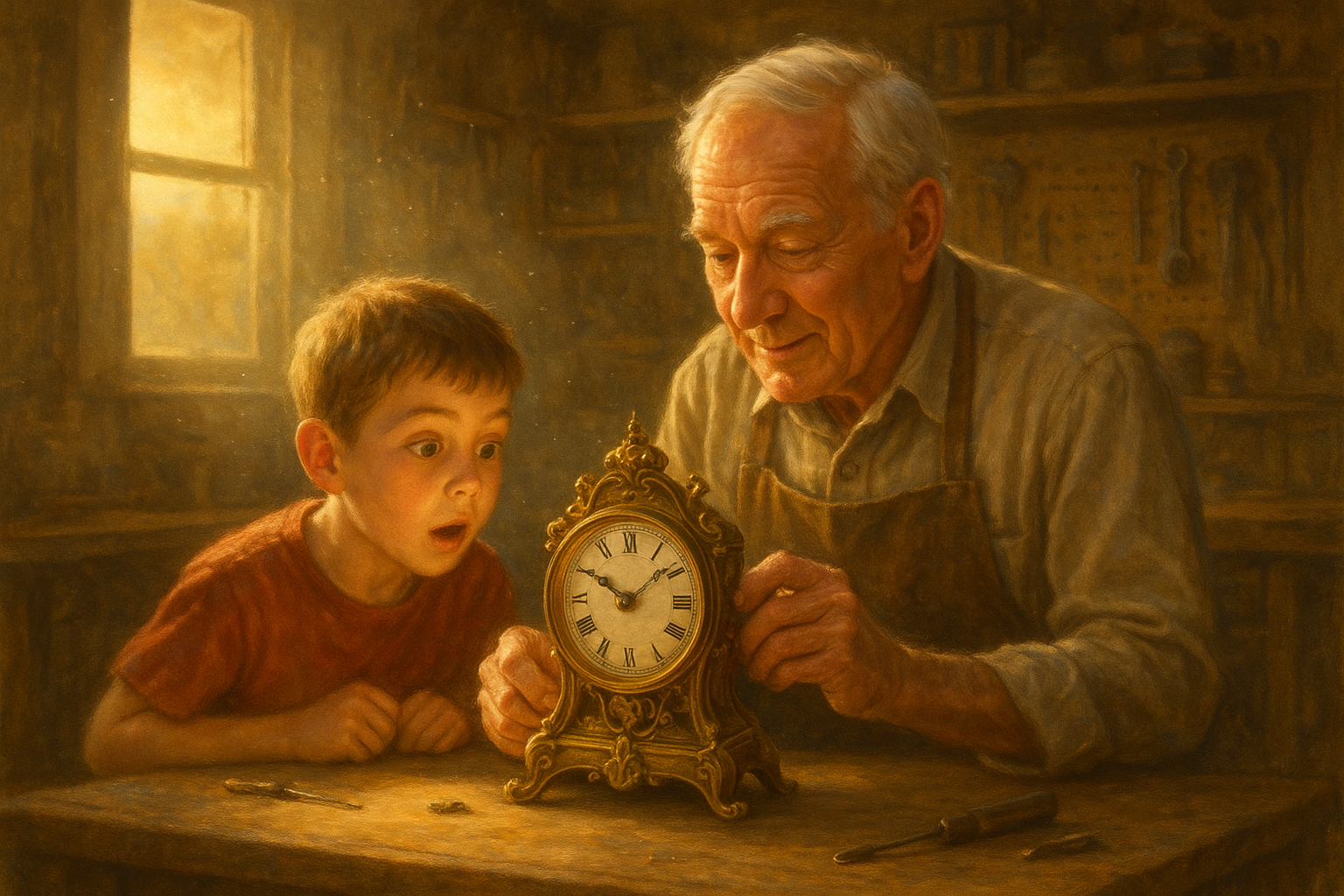
He remembered his grandfather’s voice, patient and steady: “See, Curtis? Each piece has its place. Nothing is irrelevant. Find the broken tooth, the bent spring, the gummed-up pivot.”
Hours dissolved. Curtis’s world narrowed to the delicate mechanism. His trembling fingers, frustrating at first, found a familiar steadiness as he cleaned decades of grime with a tiny brush dipped in solvent. He identified a broken mainspring tooth and a pivot point crusted solid. Using miniature files and oil, he worked with a focus he hadn’t felt in years. The frustration of the supermarket, the ache of feeling unseen, melted away, replaced by the tactile puzzle before him.
Just as he was reassembling the final gear train, the garage door rattled open. Leo, his ten-year-old grandson, burst in, cheeks flushed from biking. “Pop! Mama said you were out here…” He trailed off, eyes wide, drawn to the guts of the clock spread across the bench. “Whoa! What’s that?”
“It’s your great-great-grandfather’s clock,” Curtis said, his voice raspy from disuse. “It’s broken.”
Leo edged closer, fascinated. “Can you fix it?” The question held genuine curiosity, not the polite dismissal Curtis was used to hearing.
“I’m trying to, son,” Curtis murmured. He showed Leo the tiny parts, explaining the broken tooth, the stiff pivot. Leo watched, utterly absorbed, asking surprisingly perceptive questions. “Why does that gear turn that one?” “What makes the ding sound?”
Curtis found himself explaining escapements and pendulum physics, his words flowing easily. He handed Leo a tiny brush. “Here, help me clean this little cog. Gently now.” Leo’s tongue peeked out as his small fingers worked with intense concentration.
Finally, Curtis lowered the last brass plate into place and secured it. He carefully wound the clock. A tense silence filled the garage. Then, a soft, hesitant tick… tick… tick began. It grew stronger, steadier. Curtis held his breath. The minute hand jerked forward. It was working.
Leo gasped, a sound of pure wonder. “You did it, Grandpa! You fixed it!” His eyes shone with unadulterated admiration. “No, son, we fixed it!”.
Curtis set the hands to the correct time. As the small brass hammer struck the chime rod for the first time in decades, a clear, sweet ding resonated through the garage. The sound seemed to vibrate in Curtis’s own chest.
He looked at Leo’s awestruck face, then down at his own grease-smudged hands. The irrelevance he’d carried like a stone felt lighter. He hadn’t conquered the digital world or regained the spotlight of his prime. But in this dusty garage, illuminated by his grandson’s wide eyes and the steady heartbeat of a resurrected clock, Curtis found something vital: a connection. His hands, his knowledge – passed down, then seemingly forgotten – still held value. They could still mend something broken, still create wonder in a new generation.
The clock chimed again, marking the hour. Curtis placed a hand on Leo’s shoulder. “Tell you what,” he said, a warmth returning to his voice he hadn’t heard in years, “tomorrow, I’ll show you how to oil the gears. Every clock needs to be looked after.” Leo nodded eagerly, already captivated by the intricate, ticking world his grandfather had unlocked. The irrelevance hadn’t vanished, Curtis knew, but it had receded, replaced by the quiet, resonant chime of purpose found in unexpected places. He was still here. And for now, that was enough.
*****
And, you know I mustn’t neglect the obligatory shameless self-promotion. New Yesterdays is available through the following links: Books-A-Million, Barnes & Noble, and Amazon as well as your favorite bookshops. The Audiobook is available from Libro.fm, as well as Amazon.



 olbigjim
Nice story, Jim. It’s good that Curtis was able to fix the clock and Leo got to see it happen.
LikeLiked by 1 person