
Well, y’all, I shall tell you a story, but you must pardon me if I tell it plain, for the truth of it is sad enough without any frills or lace. It concerns a man named Abner, though most folks had forgotten that was his name. They just called him “The Captain.”
He wasn’t a real captain, you understand, not of a steamboat nor an army. His vessel was a flat-bottomed skiff, and his war was a long-lost one, fought somewhere deep inside himself. He was a big man, or had been once, but the years had winnowed him down like a cliff face worn by the river. His mind, you see, had begun to wander off from him, leaving his body behind like an empty house.
The Captain had one fixed idea, a single piece of driftwood he clung to in the shifting current of his thoughts. He was waiting for a sign. A sign from his wife, Eleanor. The trouble was, Eleanor had been buried these ten summers past in the graveyard up on the hill.

Every morning, regular as the sunrise he could no longer quite recall, the Captain would shuffle down to the post office. Old Tom, the postmaster, would look up from his sorting, and the same exchange would take place.
“Anything for me, Tom?” the Captain would ask, his voice rough as a rusty hinge. “From Eleanor?”
Tom, who had a heart softer than he let on, would peer into the old man’s hopeful, clouded eyes and say, “Not today, Captain. But the river’s runnin’ high. Mail’s likely delayed.”
The Captain would nod, a solemn, understanding nod. “The river,” he’d echo. “Yes. It does get contrary.” And he’d turn and make his way to the bench outside the mercantile, where he’d sit and watch the world go by, looking for his sign.
His children, good folks who lived upstate, had tried to take him away. “Papa,” his daughter had pleaded, her eyes bright with tears, “come live with me. We’ll take care of you.”
But the Captain had just looked at her, a stranger with a familiar face, and said, “I can’t leave, child. Eleanor wouldn’t know where to find me.” And the sheer, unassailable logic of that, from the country he now lived in, broke her heart clean in two. So, they let him be, paying for his room at the boarding house and hoping for the best.
The sign he was looking for wasn’t defined. It could be anything. A certain bird singing a particular tune. A cloud shaped like a heart. A letter that never came. He was like a man trying to read a map in a language he’d forgotten, squinting at every landmark for a clue.
One afternoon, a terrible thunderstorm blew in from the west. The sky turned the color of a bruise, and the rain came down in sheets. The townsfolk scurried inside, battening down hatches. But when young Billy Jenkins dashed past the mercantile, he saw the Captain still on his bench, soaked to the bone, staring up at the raging sky with a look of desperate, hopeful attention.

“Captain!” Billy yelled over the wind. “You’ll catch your death! Come inside!”
The old man turned, water streaming from the brim of his hat. “I can’t, son,” he shouted back. “This might be it! This might be the sign!”
Billy, strong and kind, finally persuaded him to take shelter in the doorway of the bank. The Captain sat on the cold stone step, shivering, his eyes never leaving the stormy heavens. He watched the lightning claw at the hills, and he listened to the thunder grumble like a snoring giant.
After the storm passed, leaving the world washed clean and dripping, a magnificent double rainbow arched across the sky, one end of it seeming to touch the very spire of the graveyard on the hill.
The Captain stood up, his joints creaking. He looked at that rainbow, a bridge of impossible colors, and a slow, beautiful smile spread across his weathered face. It was a smile of pure, unburdened recognition.
“Well, I’ll be,” he whispered, his voice full of wonder. “There it is.”
He walked back to his boarding house, hung his wet coat by the fire, and went to bed with a peace they hadn’t seen on him in years. He never woke up.
The town doctor said it was pneumonia, brought on by the chill. And I suppose that was true, in its way. But the folks who knew the story, they understood different. The Captain hadn’t died from the rain. He’d died from finally getting the letter he’d been waiting for. It was a sign, you see, written in lightning and sealed with a rainbow, a summons he couldn’t ignore. And he went to his rest as easy as a man going home after a long, long journey, certain at last of his welcome.
*****
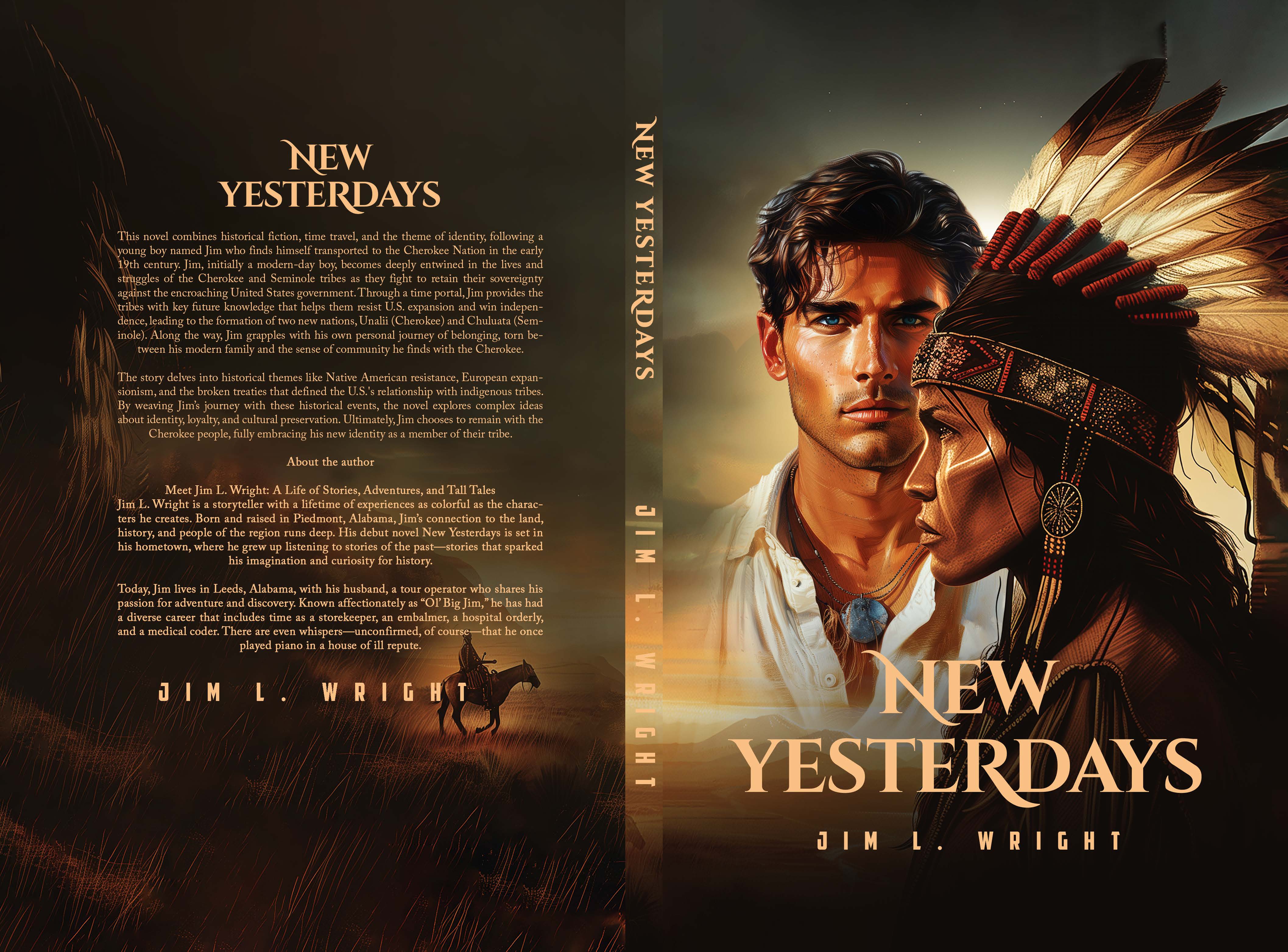
And, you know I couldn’t possibly neglect the obligatory shameless self-promotion. New Yesterdays, a very nice Christmas stocking stuffer, is available through the following links: Books-A-Million, Barnes & Noble, and Amazon as well as your favorite bookshops. The Audiobook is available from Libro.fm, as well as Amazon.


 olbigjim
What is amazing about your writing, I have to read every word…it truly entraps me.
LikeLiked by 1 person
Thank you so much, Karla! You’re a treasure!
LikeLiked by 1 person