
Mangled Fairy Tales
Well now, I’ve served in palaces, courthouses, two respectable funerals, and one wedding where the bride’s uncle attempted to stab the preacher, so I don’t claim to be easily surprised. If you work near important people long enough, you learn that dignity is mostly starch, distance, and somebody else holdin’ the door.
But I will say this for the Emperor: that man could make foolishness look like a higher art form.
He had coats for mornin’, coats for evenin’, coats for thinkin’ about lunch, coats for acceptin’ compliments, and one little blue velvet number he wore when he wanted people to believe he understood agriculture. He changed clothes more often than a nervous widow changes subjects. If there was a mirror in the room, he treated it like a trusted advisor.
My job was simple. I carried things. Trains, cloaks, gloves, ceremonial cushions, little velvet boxes with nothin’ in them but meaning. A palace servant must learn to hold items with solemnity, whether the item deserves it or not. I have carried a jeweled sword no sharper than a spoon and a royal proclamation that misspelled “kingdom” twice.
So, when two strangers arrived claimin’ they could weave cloth invisible to fools and men unfit for office, I knew right off we was in for trouble.
Not because I believed them. Lord, no. I have been poor all my life, and poverty gives a person excellent eyesight. Rich folks may be fooled by silk, but poor folks know fabric when it ain’t there.
The trouble was that their lie had manners.
It bowed. It flattered. It came dressed in technical language. They didn’t say, “We have no cloth.” They said, “This extraordinary textile may be perceived only by those of intelligence and proper station.” Which is palace talk for “If you disagree, everybody will look at you sideways.”
The Emperor heard this and lit up like a chandelier in a thunderstorm.
“Marvelous,” he said.
Whenever a ruler says “marvelous” before askin’ the price, somebody honest is about to suffer.
The strangers were given a workroom, six bolts of the finest thread, three bags of gold, and more privacy than any two criminals have a right to expect. They set up looms and started throwin’ empty shuttles back and forth with the confidence of men who had discovered the government budget.
I passed by their door on the second day and saw them bendin’ over plain air.
“Careful with that silver thread,” one said.
“Mind the pattern,” said the other.
There was no pattern. There was no thread. There was only two grown men performin’ industry at furniture.
But the Prime Minister came to inspect it, and that is when the true miracle occurred.
He stepped into the room as a man with power. He came out as a man who had seen a ghost and decided to compliment it.
“Exquisite,” he said, pale as buttermilk. “Delicate. Subtle.”
Subtle was right. It was the subtlest cloth I ever didn’t see.
After that, the whole palace caught the disease. Ministers came in one by one, stared at the empty looms, and described colors that would have embarrassed a sunset. One claimed to see crimson. Another praised the gold embroidery. A third admired the little green birds along the hem, which was brave, considerin’ there weren’t even a hem.
By supper, the invisible cloth had become the finest fabric in the world, according to every man too frightened to admit he was lookin’ at a table.
Now you may ask why I didn’t speak up.
That’s prob’ly because you’ve never depended on palace wages.
Truth is a noble thing, but it don’t pay the rent unless you are a prophet, and prophets generally eat locusts and get murdered outdoors. I had a mother with rheumatism, a sister with five young’uns, and a room over a bakery that smelled beautiful but still cost money. A servant must choose his principles carefully. Some principles can be shouted. Others must be folded small and kept in a pocket till conditions improve.
So, I kept my mouth shut.
The Emperor, however, couldn’t keep his clothes on.
The day came for the fitting. I was summoned along with three dressers, two valets, one chamberlain, and a page boy who looked young enough to still believe officials knew what they were doin’. The swindlers entered carryin’ their arms out before them, draped with nothin’ and actin’ winded by the weight of it.
“Your Majesty,” they said, “behold.”
The Emperor beheld.
There is a silence that falls when one man sees nothin’ and realizes everybody else is waitin’ for him to call it beautiful. I watched it settle over him like dust.
His eyes went from the empty hands, to the ministers, to the mirror, then back to the empty hands. For one blessed second, I thought he might save us.
Then vanity leaned over and whispered in his royal ear.
“Splendid,” said the Emperor.
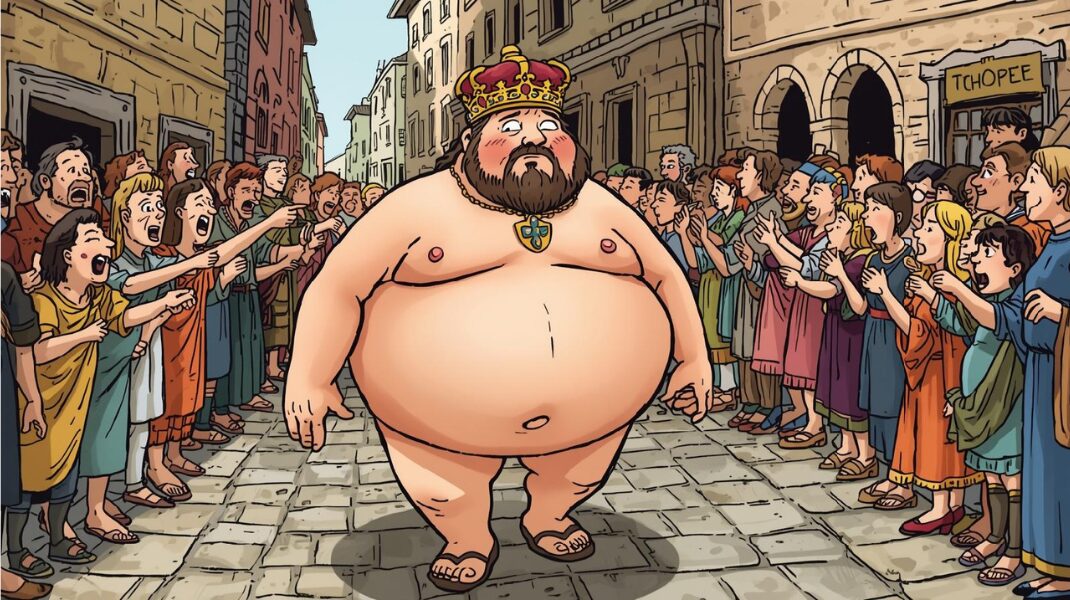
And that was that.
They undressed him down to what charity allows me to call the essentials. Then those two thieves began dressin’ him in air.
They lifted an invisible sleeve. He inserted an arm.
They fastened invisible buttons. He held still.
They adjusted an invisible collar. He raised his chin.
One of them stepped back and said, “The train is magnificent.”
That is how I entered history.
Because the chamberlain turned to me and said, “You. Carry the train.”
I looked at the floor.
There weren’t no train to be seen.
Now there’s moments in a man’s life when the soul rises up and says, “No farther.” Mine rose, looked around the room at fifteen armed guards and a king nekkid as a jaybird, and sat back down.
“Yes, sir,” I said.
I bent at the waist, gathered two careful handfuls of atmosphere, and lifted.
If you have never carried an invisible royal train, let me tell you the main difficulty: there ain’t no weight to help you lie. A real train pulls at the shoulders. It drags. It catches on corners. It gives a man something to blame. Air offers no assistance. You have to invent the burden yourself and make your face believe it.
So, there I was, walkin’ backward with my hands full of nothin’, tryin’ to appear honored by it.
The Emperor turned before the mirror.
The court sighed.
The swindlers smiled.
And every sensible thought in the room crawled under the carpet and begged not to be named.
Then came the parade.
All along the street, people had gathered in their Sunday clothes to watch their ruler pass by, dressed in a rumor. Nobody wanted to be the first to fail the test. That’s the cleverness of wicked people: they don’t always force you to lie. Sometimes they just make honesty expensive.
The Emperor stepped out, bare as a peeled onion and twice as proud.
The crowd cheered.
“Beautiful!” cried a woman.
“What workmanship!” shouted a man who owed taxes.
“I see the blue!” said another.
There was no blue. There was a breeze, and His Majesty was sufferin’ it.
I walked behind him, carryin’ the train. Children stared. Dogs looked confused. One old grandmother squinted so hard I feared she’d injure herself.
Then a little child, standin’ near the fountain, said in a voice clear enough to split marble:
“But he ain’t got nothin’ on.”
The world stopped.
Not right away, mind you. First, there was the little shuffle everybody does when truth enters a public place without permission. Heads turned. Fans paused. Ministers stiffened. I kept hold of the train, though by then I felt it had lost much of its ceremonial value.
The child’s mother clapped a hand over his mouth and looked like she’d just given birth to treason.
But the words had already escaped.
They ran through the crowd faster than fire in dry grass.
“He ain’t got nothin’ on.”
“He ain’t dressed.”
“There ain’t no clothes.”
And then, because people are strange creatures, everybody began laughin’.
Not at once. At first, it was a cough here and a snort there. Then a woman bent double. Then a guard lost his battle with dignity. Then the whole street shook with it.
The Emperor heard.
He knew.
Any man would have known. There are compliments, and there is laughter; a body can tell the difference.
For a moment, his shoulders dropped. I saw him plain then, not as Majesty, not as Sovereign, but as a middle-aged fool standin’ in sunlight regrettin’ several purchasin’ decisions.
Then he lifted his chin and kept walkin’.
I will give him this: he finished the parade.
That may be pride. It may be courage. It may be that when a man has already shown the kingdom his knees, turnin’ around don’t improve the matter.
I followed behind, still carryin’ nothin’, because nobody had relieved me of duty.
The swindlers, naturally, were gone by supper.
They took the gold, the thread, and possibly one silver candlestick from the workroom. The ministers wanted them arrested, but there was some difficulty in writin’ the charge. “Theft” was plain enough. “Embarrassin’ the Emperor into public nakedness” was harder to phrase without implicatin’ the entire government.
The child was not punished. His mother cried for three days anyhow, which is what mothers do when their children survive honesty.
As for me, I kept my position. In fact, the chamberlain said I had displayed remarkable composure under unusual textile conditions. That’s palace language for “You lied gracefully, and we appreciate it.”
But I learned somethin’ that day.
A kingdom can be held together by laws, taxes, armies, and roads, but it can also be held together by everybody agreein’ not to mention what they plainly see. That arrangement works surprisingly well until one small child with no salary, no title, and no fear of committees opens his mouth.
Since then, I’ve carried a great many things.
I’ve carried capes of velvet, robes of ermine, banners stiff with gold, and once a ceremonial pillow bearin’ a ring so ugly it deserved jail time.
But whenever I am handed something grand, I give it a little tug.
Just to be sure it’s there.



You tell a great story that keeps readers captivated, Jim.
LikeLiked by 1 person
Thanks very much, Mary! You’ve made my day!
LikeLike
Amazingly fascinating story, Jim!
LikeLiked by 1 person
Thank you kindly, Tim.
LikeLiked by 1 person
You’re welcome, Jim. 😊
LikeLiked by 1 person
So much fun, Jim.
LikeLiked by 1 person
Thanks, John. Can you imagine an entire population going along with such a farce?
LikeLike
Well, electing socialist mayors is right up there. 😀
LikeLiked by 1 person