
Mangled Mythology
First of all, it wasn’t a box.
I realize That’s not the heart of the matter, but when history has spent several thousand years blamin’ you for all human misery, you get to be persnickety about details. It was a jar. A great big sealed jar, heavy as judgment and ugly as a tax collector’s hat.
But “Pandora’s jar” don’t sing, so poets changed it to a box and then blamed me in a neater shape.
That’s been the pattern right from the start.
Somebody else makes the trouble. Somebody else wraps it pretty. Somebody else hands it to a woman with no instructions worth the name. Then when she behaves with the natural curiosity of a person equipped with eyes, fingers, and a working mind, everybody clutches the pearls and reaches for the smellin’ salts.
Let’s review.
I was made, not born. That’s a peculiar start for anybody. Most folks come into the world squallin’ and naked, surrounded by women who know what happened and men tryin’ not to faint. Not me; I arrived as a committee project.
The gods fashioned me themselves, which sounds grand until you remember what gods are like. A god is a person with too much power and no neighbors brave enough to complain.
Hephaestus shaped me from earth. Athena dressed me. Aphrodite gave me beauty. Hermes gave me language, which may have been where matters took a turn. Each god added a gift, and every gift had a hook in it. Beauty, charm, cleverness, grace. They made me lovely the way fishermen make bait lovely.
Then they named me Pandora, “all-gifted,” which is the sort of name people give you when they want credit for the burden.
Why did they make me?
To punish mankind.
Not because mankind had asked for me. Not because I had offended anybody. I didn’t yet exist, which is usually a strong alibi. No, Prometheus had stolen fire from Olympus, and Zeus, bein’ the calm and reasonable sort who chains people to mountains over kitchen improvements, decided the proper response was to invent a woman and send her into marriage with a disaster jar.
This is called divine justice, presumably because “overreaction with thunder” was too long for the temple inscription.
I was given to Epimetheus.
Now, Epimetheus was not a bad man. He was handsome in a slightly unfinished way and kind if you kept decisions away from him. His name means “afterthought,” which should have warned everybody. Prometheus had told him not to accept gifts from Zeus, but Epimetheus looked at me, forgot every warning he had ever received, and said yes with both hands.
Men are always sayin’ women caused the trouble, but have you ever noticed how often the trouble required a man to ignore advice first?
So, there I was, newly made, newly married, newly expected to understand a world nobody had bothered to explain.
And in the corner sat the jar.
Large. Sealed. Ominous.
Naturally, I asked about it.
“What’s in there?” I said.
Epimetheus looked uncomfortable, which was his principal expression whenever thought was required.
“I’m not sure,” he said.
“You’re not sure?”
“Zeus sent it.”
“And you accepted it?”
“Well, he also sent you.”
“That don’t improve the pattern.”
He scratched his head. “We’re not supposed to open it.”
“Why?”
He brightened. “Because we were told not to.”
Now there is a sort of person who finds that answer sufficient. I ain’t never been that kind of person, and I hope not to become one even under pressure from mythology.
If you put a sealed jar in a woman’s house and say only, “Don’t open it,” you haven’t prevented curiosity. You’ve planted it, watered it, and set it in the sun.
Days passed.
I cooked. I cleaned. I learned which fruits were sweet and which insects had personal grievances. I learned that men will explain clouds with great confidence despite knowin’ no more about them than the goats do. I learned that marriage is two people standin’ beside a mystery and disagreein’ about whether to dust it.
The jar remained.
It sat through breakfast.
It sat through supper.
It sat there while Epimetheus slept, snorin’ like a cart draggin’ over stones, entirely untroubled by the fact that we were apparently storin’ divine contraband next to the spare oil.
I tried to ignore it.
I did.
History has not credited me for the hours I spent not openin’ that jar. Nobody builds monuments to restraint unless restraint loses. If I had never touched it, the poets would’ve had to find some other woman to blame for fever and taxes.
But every day I noticed new things.
The seal was thick. The lid was fitted tight. Sometimes, when the house was quiet, I thought I heard somethin’ inside. Not voices exactly. More like a crowded room holdin’ its breath.
I asked Epimetheus again.
“What if there’s something alive in it?”
“There isn’t.”
“You don’t know that.”
“No.”
“Then why are you certain?”
He thought about it and said, “I prefer to be.”
That’s when I began to understand men.
Finally, one afternoon, when the air was hot and still, and Epimetheus was off somewhere inspectin’ his own shadow, I went to the jar.
I didn’t cackle. I didn’t grin wickedly. I didn’t rub my hands together like a woman auditionin’ for a moral lesson. I walked over.
That was all.
The house was quiet.
The jar waited.
I touched the seal.
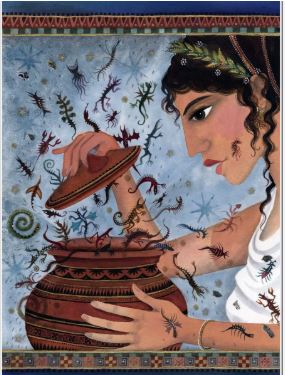
Now I would like to point out that a seal designed by gods ought to withstand one curious finger. If all the woes of humankind can be released by light household investigation, that’s not a woman’s failure. That’s poor divine packaging.
The lid shifted.
Just a little.
Then the whole jar shuddered.
I jumped back.
The lid flew off.
Out came misery.
Not as a metaphor. Not as a poetic breeze. I mean, things came out. Dark, sharp, winged things. Sickness. Labor. Hunger. Envy. Grief. Old age. Worry. Mosquitoes, possibly. Theologians differ on that point.
They swarmed through the room, through the door, through the windows, into the world with the speed of gossip and twice the consequences.
I screamed.
That part also gets left out.
I was not satisfied. I was not proud. I was not standin’ there sayin’, “Well, that answers that.” I was terrified. I grabbed at the lid, slapped at sorrow, ducked under disease, and tried to shove the universe’s troubles back into their container like a woman refoldin’ a fitted sheet.
Epimetheus ran in.
“What did you do?” he cried.
Now there is no phrase in marriage more useless than “What did you do?” when the answer is plain, and the disaster is airborne.
“Help me!” I shouted.
To his credit, he did. Badly, but earnestly. He swung a broom at famine. He tried to sit on despair. He accidentally let out gout.
At last, we slammed the lid back down.
The house was wrecked. The world was changed. I was cryin’, Epimetheus was bleeding from where anxiety had bitten him, and the jar sat quiet again.
Not empty.
Something remained inside.
Small. Soft. Nearly silent.
I leaned close.
“Don’t,” said Epimetheus, which showed poor timing, since his entire policy of not openin’ things had just failed in a spectacular fashion.
But this time I knew.
Not from instruction. Not from gods. From grief.
Some things scratch to escape. Some things wait to be invited.
I lifted the lid again, careful as prayer.
Hope came out.
That’s the part people mention kindly when they are tryin’ to soften the story. They say, “At least Pandora left hope inside,” or “Pandora released hope too,” dependin’ on how generous they’re feelin’. But they still say it like I was the cause of the wound and hope was an accident that fell from my apron.
No.
I opened the jar once out of curiosity.
I opened it again out of mercy.
And if the first act changed the world, the second made it survivable.
You may say I unleashed sorrow. Fine. I was there. I saw it fly. But sorrow had been packed before I touched the lid. Sickness had been loaded. Hunger had been stored. Grief had been sealed and delivered. Those things were not born from my hand. They were inventory.
Ask who filled the jar.
Ask who sealed it.
Ask who sent it.
Ask why the gods, who knew exactly what was inside, gave it to the newest soul on earth and called the outcome justice.
But no, it’s easier to blame the woman who opened the blasted thing than the thunderbolt who mailed it.
So let the poets keep their box if they must. Let them paint me with wide eyes and guilty fingers. Let schoolmasters sigh and say curiosity is dangerous, especially in girls.
I’ve learned better.
Curiosity is only dangerous to people with somethin’ to hide.
And as for hope, that little stubborn thing, I will claim her. She was not Zeus’s mercy. She was not Epimetheus’s wisdom. She was not an accident.
She was the one thing in that jar I chose to release on purpose.



Fascinating post about Pandora, Jim!
LikeLiked by 1 person
Bless her heart, Pandora meant no harm.
LikeLiked by 1 person
I agree, Jim.
LikeLiked by 1 person