
A Piedmont Porchlight Story
Now, I have always maintained that a front porch is one of the most important rooms in a Southern house, even though it generally doesn’t have four walls, a ceiling fan that works properly, or a single piece of furniture anybody would willingly put in the living room.
A porch is where a man goes to think.
Or to avoid thinking.
Or to watch the neighbors doing something that ought to require a permit.
It’s where the world’s problems get discussed, the weather gets criticized, and somebody invariably remembers a funeral from 1957 that has absolutely nothing to do with the conversation at hand.
And if you’ve got a good front porch in Piedmont, Alabama, you’re sitting on something more valuable than you might imagine.
Just ask Vernon Ledbetter.
Vernon was seventy-eight years old, a retired electrician, and the owner of a little white clapboard house on a quiet street not far from downtown.
He’d lived there since 1972.
He’d painted it four times, replaced the roof twice, and threatened to tear down the back steps every spring for twenty-three consecutive years.
His wife, Mildred, had passed away six years earlier.
They’d raised two daughters in that house, neither of whom had stayed in Piedmont. One lived in Huntsville, the other in Atlanta, and both telephoned regularly to ask whether he’d eaten anything besides canned soup.
Vernon considered this an unreasonable intrusion into his private affairs.
“I raised two children,” he told his neighbor. “I reckon I can manage a can opener.”
His neighbor, Mrs. Lucille Abernathy, was not impressed.
“Vernon, you ate cold pork and beans out of the can last Tuesday.”
“Saved washing a dish.”
“You ate ’em with a screwdriver.”
“Clean screwdriver.”
“That’s not the point.”
“Then I don’t reckon you’ve got one.”
Lucille had been trying to improve Vernon for eleven years.
So far, her efforts had produced no measurable results.
But Vernon had one habit that nobody criticized.
Every afternoon, weather permitting, he sat on his front porch.
He had two rocking chairs.
One was his.
The other had belonged to Mildred.
Her chair was painted pale blue, although most of the paint had worn away from the arms. There was a little cushion she’d sewn herself, faded now, with yellow flowers on it.
Vernon hadn’t moved the chair since her death.
He didn’t sit in it.
Didn’t allow anybody else to sit in it, either.
Not because he believed it was sacred.
He simply liked knowing where it was.
And that was the arrangement until a stranger appeared one Wednesday afternoon in November.
The man came walking up the sidewalk at precisely three o’clock.
He was somewhere in his early seventies, neatly dressed in gray trousers, a brown cardigan, and a flat cap pulled low over his forehead.
He carried a walking stick.
Not a fancy one.
Just a straight wooden stick with a rubber tip.
He stopped at the bottom of Vernon’s porch steps.
“Afternoon.”
Vernon looked up from his newspaper.
“Afternoon.”
“Fine porch you’ve got there.”
“Been attached to the house a good many years.”
The stranger smiled.
“Mind if I ask you something?”
“Depends what it is.”
“Would you let me borrow your porch for an hour?”
Vernon lowered his newspaper.
Now, in seventy-eight years, he’d been asked to lend money, tools, automobiles, fishing equipment, and once, during a particularly unfortunate church picnic, his trousers.
But nobody had ever asked to borrow his porch.
“Borrow it?”
“Yes, sir.”
“What’re you gonna do with it?”
“Sit on it.”
Vernon considered that.
“Reckon you could sit on your own porch.”
“Don’t have one.”
“Then sit on somebody else’s.”
“That’s what I’m trying to do.”
Vernon stared at him.
The stranger stared back.
Finally, Vernon folded his newspaper.
“Are you selling something?”
“No, sir.”
“Collecting for something?”
“No.”
“Running for office?”
“Good Lord, no.”
“Well, that’s one point in your favor.”
The stranger smiled.
Vernon looked at the empty rocking chair.
Then at the stranger.
“You got a name?”
“Arthur.”
“Arthur what?”
“Arthur Bell.”
“Where you from?”
“Here and there.”
“That ain’t a town.”
“No, sir. But I’ve lived in several.”
Vernon scratched his chin.
“Why my porch?”
Arthur looked past him toward the front window.
For a moment, something changed in his expression.
Then he said, “It looks peaceful.”
Vernon considered that.
He glanced at Mildred’s chair.
Then at a little wooden kitchen chair standing beside the door.
“Well, I reckon you can sit for a spell. But not in the blue rocker.”
Arthur nodded.
“Wouldn’t dream of it.”
Vernon pointed to the kitchen chair.
“That one’s available.”
Arthur climbed the steps.
Sat down.
Placed his walking stick between his knees.
And looked out toward the street.
For the next hour, neither man said much of anything.
Which, in Piedmont, is sometimes the beginning of a very good friendship.
At four o’clock, Arthur stood.
“Much obliged.”
Vernon nodded.
“You’re welcome.”
“Mind if I come back next Wednesday?”
Vernon looked at him.
“You planning to make a habit of this?”
“Maybe.”
“Well, I ain’t running a boardinghouse.”
“No, sir.”
“And I don’t serve refreshments.”
“That’s all right.”
“Or provide entertainment.”
Arthur glanced at the newspaper.
“I hadn’t noticed any.”
Vernon looked up sharply.
Then laughed.
It surprised him.
He hadn’t expected to laugh.
“All right, Arthur. Next Wednesday.”
Arthur tipped his cap.
And walked away.
The following Wednesday, Arthur returned at three o’clock.
This time he brought a paper sack.
Vernon eyed it suspiciously.
“What’s that?”
“Two apple turnovers.”
“Where’d you get ’em?”
“Bakery.”
“Why?”
“Thought you might like one.”
Vernon considered the sack.
“I don’t generally accept food from strangers.”
“We met last week.”
“That don’t make you family.”
“No, sir.”
Arthur held out the sack.
Vernon took a turnover.
“Well, it’d be a shame to waste it.”
They sat.
Ate their pastries.
Watched a pickup truck drive past with a washing machine in the bed.
Vernon shook his head.
“That thing ain’t tied down.”
Arthur watched the truck disappear around the corner.
“Reckon he’ll find out.”
Five minutes later, there came a tremendous metallic crash from somewhere down the street.
Vernon nodded.
“There he goes.”
Arthur laughed so hard he nearly dropped his turnover.
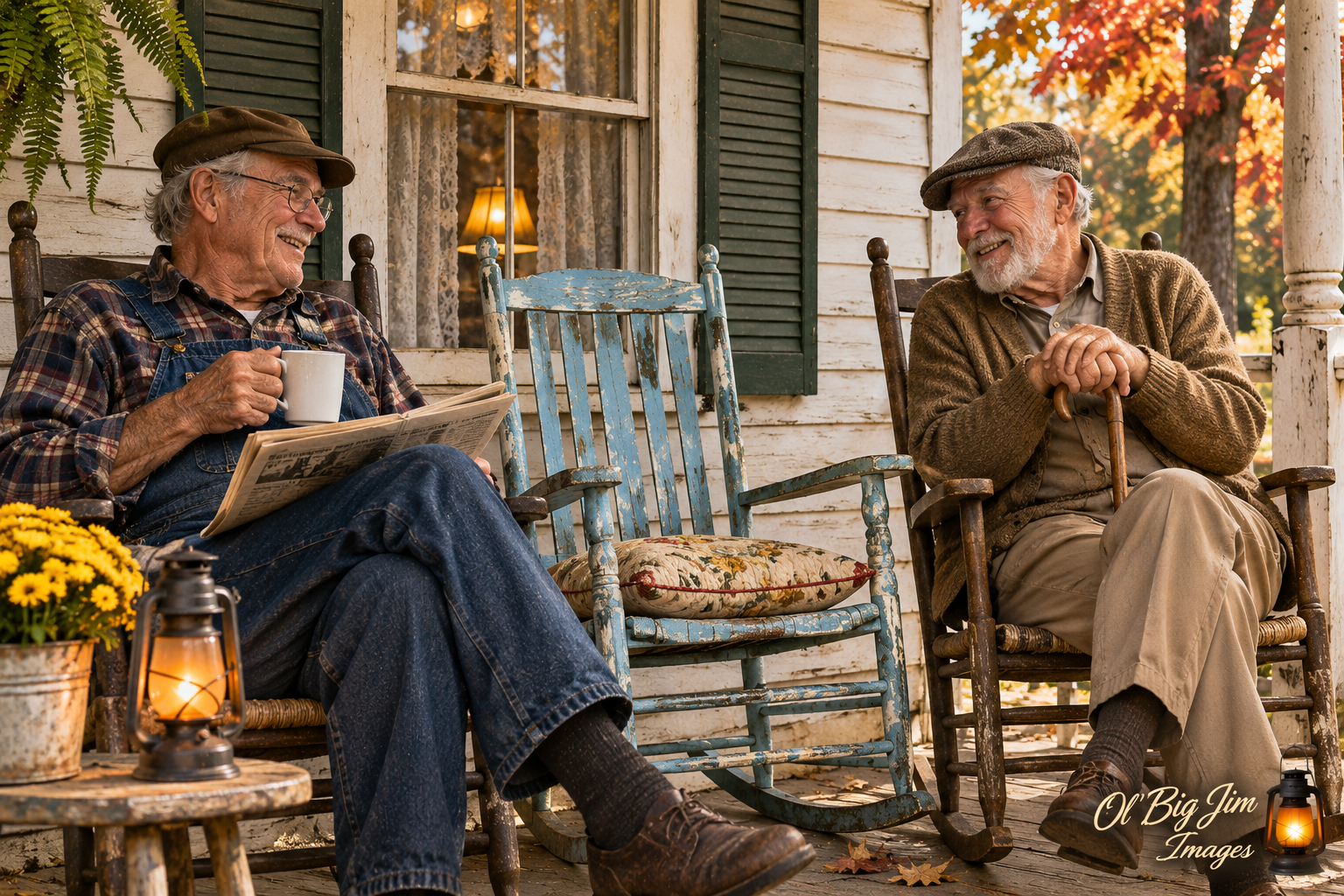
By the third Wednesday, Vernon had begun looking forward to Arthur’s visits.
He wouldn’t have admitted it, of course.
Vernon Ledbetter had spent seventy-eight years cultivating the impression that he was perfectly content without company.
But on Wednesday mornings, he found himself sweeping the porch.
He straightened the chairs.
Wiped down the little table.
Once, he even washed the coffee pot.
Lucille Abernathy noticed.
Naturally.
Lucille noticed everything.
She appeared at the porch steps one afternoon just as Arthur was leaving.
“Vernon, who’s your gentleman friend?”
Vernon frowned.
“Arthur.”
“Arthur who?”
“Bell.”
“Where’s he from?”
“Here and there.”
Lucille looked offended.
“Well, that’s helpful.”
Arthur tipped his cap.
“Pleasure meeting you, ma’am.”
Lucille smiled.
“Likewise. You married?”
Vernon closed his eyes.
“Lucille.”
“What?”
“Leave the man alone.”
“I’m making conversation.”
“You’re conducting a census.”
Arthur chuckled.
“No, ma’am. I’m a widower.”
Lucille’s expression softened.
“Oh. I’m sorry.”
“Thank you.”
“How long?”
“Forty-two years.”
Lucille blinked.
“You’ve been a widower forty-two years?”
“No, ma’am. I was married forty-two years. My wife passed last spring.”
Vernon looked at him.
Arthur had never mentioned a wife.
Lucille, sensing an opportunity to learn considerably more, opened her mouth.
Vernon interrupted.
“Lucille, ain’t your biscuits burning?”
She stared at him.
“I ain’t baking biscuits.”
“Then you ought to be. You’re wasting daylight.”
Arthur laughed.
Lucille gave Vernon a look that would have stripped paint off a battleship.
Then marched away.
“She’s a nice woman,” Arthur observed.
“She means well.”
“Seems interested in people.”
“She’d interrogate a tombstone if she thought it knew something.”
The visits continued.
Sometimes Arthur brought pastries.
Sometimes Vernon made coffee.
Sometimes they talked about the weather, the cost of groceries, or the alarming number of things that now required passwords.
Arthur had worked as a school custodian for most of his life.
Vernon had spent forty-three years running electrical wire through houses, factories, and churches.
Between them, they’d repaired nearly everything a building could contain.
Except, as Vernon observed, the people inside.
“People’s harder,” he said.
Arthur nodded.
“Don’t come with instructions.”
“And when they do, nobody reads ’em.”
They laughed.
But Vernon noticed something peculiar.
Arthur never stayed longer than an hour.
He never went inside the house.
And whenever Vernon asked where he was living, Arthur gave an answer that was perfectly reasonable but somehow incomplete.
“Over toward Jacksonville.”
“With family.”
“Just a little place for now.”
Vernon wasn’t a suspicious man.
Well, not unusually suspicious.
He’d once accused the mail carrier of stealing his electric bill, which the mail carrier pointed out was a rather peculiar thing to steal.
But Arthur’s reluctance bothered him.
Not enough to stop the visits.
Just enough to make him wonder.
Then, one Wednesday in late November, Arthur didn’t come.
At three o’clock, Vernon looked toward the sidewalk.
At three-fifteen, he checked his watch.
At three-thirty, he went inside and telephoned Lucille.
“Have you seen Arthur?”
“Arthur who?”
“Bell.”
“Oh, your gentleman friend.”
“Lucille.”
“No, I haven’t.”
“Well, he ain’t here.”
“Maybe he’s busy.”
“Maybe.”
“Maybe he’s sick.”
Vernon didn’t answer.
Lucille paused.
“Vernon?”
“What?”
“You worried about him?”
“No.”
“Then why’d you call?”
“To see whether you’d finally learned to mind your own business.”
He hung up.
Then immediately felt ashamed.
At four o’clock, he put the coffee away.
At five, he went inside.
And for the first time in months, the house seemed terribly quiet.
Arthur returned the following Wednesday.
He looked thinner.
Tired.
His cardigan hung loosely from his shoulders.
Vernon stood when he saw him.
“Where the hell you been?”
Arthur stopped at the steps.
“Afternoon to you, too.”
“You missed last Wednesday.”
“I know.”
“Didn’t call.”
“Didn’t have your number.”
“You could’ve asked.”
Arthur smiled faintly.
“Reckon I could’ve.”
Vernon stared at him.
Then stepped aside.
“Well, come on up before I change my mind.”
Arthur climbed the steps slowly.
More slowly than usual.
He sat in the kitchen chair.
Vernon poured coffee.
For a while, they said nothing.
Then Vernon asked, “You sick?”
Arthur looked at his cup.
“A little.”
“Doctor sick or aspirin sick?”
Arthur smiled.
“Doctor.”
Vernon nodded.
“Bad?”
Arthur didn’t answer immediately.
Then he said, “Bad enough.”
Vernon looked out toward the street.
A little breeze stirred the fallen leaves.
“Well,” he said, “that’s a helluva thing.”
“Yes, sir.”
They sat quietly.
After a while, Arthur looked toward the blue rocking chair.
“Your wife’s?”
Vernon nodded.
“Mildred.”
“How long?”
“Six years.”
Arthur studied the chair.
“She must’ve been something.”
Vernon smiled.
“She was.”
“Tell me about her.”
Vernon looked at him.
Nobody had asked him that in a long time.
People asked whether he was lonely.
Whether he was eating properly.
Whether he’d considered moving closer to his daughters.
But nobody asked about Mildred.
Not really.
So, Vernon told him.
About the girl he’d met at a church social.
About their first date, when he’d borrowed his brother’s car and run out of gas before reaching her house.
About the day they married.
About the children.
The arguments.
The vacations.
The Christmases.
The ordinary Tuesdays.
And the afternoon she’d announced she wanted the porch rocker painted blue because white furniture made everything look like a funeral home.
Arthur listened.
Didn’t interrupt.
Didn’t offer advice.
Just listened.
When Vernon finished, the sun had begun slipping behind the houses across the street.
Arthur looked at the blue chair.
“She sounds like a fine woman.”
Vernon nodded.
“Best I ever knew.”
Arthur smiled.
“Reckon I know what you mean.”
The following week, Arthur arrived carrying a photograph.
It was old.
Black and white.
The edges were curled.
He handed it to Vernon.
“Thought you might like to see this.”
Vernon examined it.
A young couple stood in front of a small white house.
The woman wore a simple dress.
The man had dark hair and a smile that seemed almost too large for his face.
“That you?”
Arthur nodded.
“Me and my wife, Sarah.”
“Pretty woman.”
“Yes, sir.”
Vernon studied the photograph.
Then looked at the house behind them.
Something about it seemed familiar.
He looked again.
The porch.
The windows.
The little wooden railing.
He frowned.
“Arthur?”
“Yes?”
“Where was this taken?”
Arthur looked toward the street.
“Right here.”
Vernon stared.
“Here?”
“On this porch.”
Vernon looked at the photograph again.
It was unmistakable.
His house.
The same front steps.
The same window.
Even the little decorative bracket beneath the roof.
“But that’s impossible,” he said. “I’ve owned this house since 1972.”
Arthur nodded.
“I know.”
Vernon stared at him.
“Then how…?”
Arthur took a deep breath.
“My father built this house in 1948.”
Vernon looked up.
Arthur continued.
“I grew up here.”
The porch seemed suddenly very quiet.
“I lived here until I was twenty-two. Married Sarah right after I came home from the Army. We stood right there on those steps the morning we left Piedmont.”
He pointed to the photograph.
“That was the last picture we took before moving away.”
Vernon looked at him.
“Why didn’t you tell me?”
Arthur smiled sadly.
“Didn’t know how.”
“Didn’t know how?”
“How do you knock on a stranger’s door and tell him you’d like to sit on his porch because it used to be yours?”
Vernon opened his mouth.
Then closed it.
Arthur looked toward the blue rocker.
“My mama had a chair just like that.”
Vernon followed his gaze.
“She did?”
“Yes, sir. Sat right there every afternoon. Watched us children playing in the yard.”
He smiled.
“Used to holler at us for tracking mud through the house.”
Vernon chuckled.
“Mildred did that, too.”
Arthur nodded.
“Sarah and I came back to Piedmont a few times over the years. We’d drive past the house. Never stopped.”
“Why not?”
“Didn’t want to bother whoever lived here.”
Vernon looked down at the photograph.
Arthur continued.
“After Sarah died last spring, I started thinking about places. The places we’d been happy. The places where life seemed simpler.”
He paused.
“And I kept thinking about this porch.”
Vernon looked at him.
“Why?”
Arthur smiled faintly.
“Because when I was a boy, my daddy used to sit right where you’re sitting.”
He pointed to Vernon’s chair.
“And I’d sit beside him.”
He looked out toward the street.
“We’d watch the cars go by. Talk about baseball. Sometimes we wouldn’t talk at all.”
Vernon said nothing.
Arthur’s voice grew quieter.
“I reckon I just wanted to sit here one more time.”
For a long while, neither man spoke.
Then Vernon looked at the photograph again.
At the young couple.
At the house.
At the porch that had held so many different lives.
He thought about Mildred.
About their daughters.
About birthdays and Christmas mornings and summer thunderstorms.
About the evenings they’d sat together while the children played in the yard.
He’d always thought of the house as theirs.
His and Mildred’s.
It had never occurred to him that somebody else had loved it first.
Or that somebody might come back looking for a little piece of the life he’d left behind.
Vernon cleared his throat.
“Arthur?”
“Yes?”
“That chair you’re sitting in ain’t much.”
Arthur looked down at the kitchen chair.
“Serves the purpose.”
“Hard on the backside.”
“Little bit.”
Vernon looked toward the blue rocker.
For six years, nobody had sat in Mildred’s chair.
He’d dusted it.
Painted the arms once.
Replaced the cushion when the old one began falling apart.
But he’d never allowed anybody to use it.
Not his daughters.
Not Lucille.
Not even the preacher, who’d made the mistake of sitting down in it during a visit and had been relocated with such efficiency that he probably thought Vernon was directing traffic.
Now Vernon looked at Arthur.
“Go on.”
Arthur frowned.
“Sir?”
“Sit in the blue chair.”
Arthur stared.
“Your wife’s chair?”
“That’s the one.”
“I wouldn’t feel right.”
“Well, I ain’t gonna stand here and wrestle a Baptist preacher over the last deviled egg just to get you comfortable.”
Arthur laughed.
Vernon smiled.
“Go on. Mildred would’ve liked you.”
Arthur stood slowly.
Walked over.
And sat in the blue rocking chair.
It creaked beneath him.
He rocked gently.
Once.
Twice.
Then closed his eyes.
Vernon watched him.
And for the first time in six years, the empty chair didn’t look empty anymore.
Arthur continued visiting.
Sometimes twice a week.
Then three times.
Eventually, Vernon told him there was no need to ask permission.
“Porch ain’t going anywhere.”
Arthur smiled.
“Much obliged.”
“Besides, somebody’s got to help me keep an eye on that fool down the street who keeps hauling washing machines without tying ’em down.”
They laughed.
But Arthur’s health continued declining.
Some afternoons he was too tired to talk.
Other days he simply sat in the blue rocker with his eyes closed, listening to the birds and the distant sounds of town.
Vernon never pressed him.
He made coffee.
Brought out blankets when the weather turned cold.
And occasionally told a story about Mildred.
Arthur told stories about Sarah.
And his father.
And the boy he’d once been.
Two old men.
Two lost wives.
One front porch.
And enough memories between them to fill every house on the street.
One afternoon in December, Arthur arrived with his daughter.
Her name was Caroline.
She was a pleasant woman in her forties, with her father’s eyes and the sort of expression that suggested she’d spent much of her adult life worrying about him.
She helped Arthur up the steps.
Vernon stood.
“Everything all right?”
Arthur smiled.
“Just wanted you to meet my daughter.”
Caroline shook Vernon’s hand.
“Daddy’s told me so much about you.”
“Hope none of it’s true.”
She laughed.
Arthur settled into the blue rocker.
Caroline looked around the porch.
“Oh, Daddy.”
Arthur smiled.
“Recognize it?”
She nodded.
“From the pictures.”
He looked toward Vernon.
“Caroline never lived here. But I told her about this house all her life.”
Caroline touched the railing.
“Daddy said his father used to sit right there and tell him stories.”
Vernon nodded.
“That’s what he told me.”
She looked at the blue chair.
“And his mother sat there.”
Arthur smiled.
“Yes, ma’am.”
Caroline turned to Vernon.
“Thank you for letting him come.”
Vernon waved a hand.
“Ain’t nothing.”
But Caroline shook her head.
“It is something.”
She glanced at her father.
“More than you know.”
Arthur Bell died the following February.
Quietly.
In his sleep.
His daughter telephoned Vernon the next morning.
He listened.
Said he was sorry.
And thanked her for calling.
Then he went out onto the porch.
The blue rocker stood beside his chair.
A little frost clung to the railing.
The morning was cold and clear.
Vernon sat down.
Looked at the empty chair.
And cried.
Not because he’d known Arthur all his life.
He hadn’t.
Not because they’d shared some extraordinary adventure.
They hadn’t.
But because, for a few months, he’d had somebody to sit with.
Somebody who understood what it meant to grow old in a world that kept taking people away.
And now that somebody was gone.
Again.
A week after the funeral, Caroline came to see him.
She carried a small wooden box.
“Daddy wanted you to have this.”
Vernon opened it.
Inside was the old photograph of Arthur and Sarah standing on the porch.
Beneath it lay another photograph.
Older.
A little boy sitting beside a man in a rocking chair.
The boy was perhaps eight years old.
The man wore overalls and held a pipe.
Behind them, a woman stood in the doorway.
Vernon recognized the porch immediately.
His porch.
Caroline smiled.
“That’s Daddy with his parents.”
Vernon studied the picture.
The man sat in the chair Vernon now used.
The woman stood beside the doorway.
And the boy…
The boy was sitting in a little wooden kitchen chair.
Vernon looked toward the chair beside his front door.
The same one Arthur had used during his first visits.
He stared.
“Well, I’ll be damned.”
Caroline laughed softly.
“Daddy said you’d probably say that.”
Vernon smiled through his tears.
Then he noticed something written on the back of the photograph.
In Arthur’s careful handwriting.
Some places remember us, even when we think we’ve forgotten them.
Beneath that was another sentence.
Thank you for letting me come home.
Vernon held the photograph for a long time.
Then he looked at Caroline.
“Your daddy was a good man.”
She nodded.
“Yes, sir.”
Vernon glanced toward the blue rocker.
“Reckon I’ll miss him.”
Caroline wiped her eyes.
“So will I.”
Now, you’d think that would be the end of it.
But Vernon Ledbetter was not quite finished.
That spring, he did something that astonished the entire neighborhood.
He bought two more rocking chairs.
Painted one green.
Left the other natural wood.
Then he placed a little sign beside the porch steps.
PORCH OPEN
COMPANY WELCOME
COFFEE IF I’VE GOT ANY
Lucille Abernathy nearly swallowed her dentures.
“Vernon! You’re inviting strangers onto your porch?”
“Appears so.”
“Anybody could come up here!”
“That’s generally how invitations work.”
“What if they’re dangerous?”
“Lucille, I’m seventy-eight years old. I’ve survived the Navy, forty-three years of electrical work, two daughters learning to drive, and your biscuits. I reckon I can manage a visitor.”
She sniffed.
“My biscuits are perfectly good.”
“Then bring some over and prove it.”
She did.
And stayed for two hours.
Before long, Vernon’s porch became something of a neighborhood institution.
People stopped by after work.
Retirees came to sit in the afternoons.
Young mothers rested while their children played in the yard.
One fellow came every Tuesday to discuss Alabama football, although Vernon claimed the man didn’t know a linebacker from a lawn mower.
Sometimes there were four people on the porch.
Sometimes six.
Sometimes nobody but Vernon.
And that was all right, too.
He still kept his own chair.
And Mildred’s blue rocker.
He didn’t mind people sitting in it anymore.
In fact, he rather liked it.
One afternoon, a young woman came up the steps carrying a baby.
“Mr. Ledbetter?”
“That’s me.”
“Would you mind if I sat for a minute?”
Vernon smiled.
“Help yourself.”
She settled into the blue rocker.
The baby fell asleep against her shoulder.
Vernon watched them for a moment.
Then looked out toward the street.
The afternoon sun lay warm across the sidewalk.
A breeze stirred the leaves.
Somewhere down the block, a dog barked at something that probably didn’t deserve it.
And Vernon thought about Mildred.
About Arthur.
About the boy in the photograph.
About all the people who’d sat on that porch before him.
And all the people who might sit there after he was gone.
He smiled.
“Comfortable?”
The young woman nodded.
“Very.”
“Good.”
He rocked gently.
“That chair’s got a lot of history.”
She looked down at it.
“Does it?”
“Oh, yes, ma’am.”
He smiled.
“And if you’ve got a minute, I reckon I could tell you about it.”
Now, I’ve always believed that houses remember more than we give them credit for.
Not in any spooky sense, mind you.
I don’t reckon the walls are listening or the floorboards are keeping diaries.
But a house holds the marks of the people who’ve lived there.
A worn place on the railing where somebody rested his hand.
A little scratch beside the door where a child measured her height.
A rocking chair with faded blue paint.
And sometimes, if you’re fortunate, somebody comes along who remembers what those things meant before they belonged to you.
Vernon Ledbetter thought he was lending a stranger his porch for an hour.
Arthur Bell thought he was borrowing a little piece of his childhood.
Neither man realized they were giving the other something he’d been missing.
And that, I reckon, is the peculiar thing about a good front porch.
You can sit on one your whole life and never know how much room there is.
Until somebody else pulls up a chair.
Arthur Bell borrowed Vernon’s porch for an hour.
Vernon gave him a place to come home.
And Arthur gave Vernon a reason to leave the light on.