A Piedmont Porchlight Story
By Jim L Wright
There are certain subjects upon which reasonable people may disagree.
Politics, for instance. Religion. Whether a man ought to wear his good shoes to the grocery store. Whether the Alabama football coach ought to be fired after losing a game by three points.
But in Piedmont, Alabama, there was one subject upon which reasonable disagreement had long since ceased to be possible.
Cornbread dressing.
More specifically, whether a respectable pan of Thanksgiving dressing ought to contain boiled eggs.
Now, before we go any further, I want to make something perfectly clear.
I ain’t takin’ sides. No ma’am, Pam.
I’ve lived long enough to know that a man who inserts himself into a disagreement between two Southern women over a family recipe is liable to find himself attending his own funeral before Christmas.
I ain’t got my affairs sufficiently in order for that.
But there were two ladies in Piedmont who’d been arguing about boiled eggs in dressing for thirty-seven years, and by the time our story begins, the disagreement had reached a point where even the preacher was beginning to reconsider his calling.
Their names were Beulah Mae Pritchett and Mabel Jane Hensley.
Now, Beulah Mae believed that boiled eggs were absolutely essential to proper Thanksgiving dressing. Not merely desirable, mind you. Essential.
She maintained that a pan of dressing without boiled eggs was nothing more than seasoned cornbread pretending to be something respectable.
Mabel Jane, on the other hand, regarded the introduction of boiled eggs into dressing as an act of culinary vandalism.
“Eggs belong in potato salad,” she declared. “Or deviled on a platter. They ain’t got no business hidin’ in cornbread.”
Beulah Mae disagreed.
Frequently.
Loudly.
And with scriptural references of questionable relevance.
Their dispute had begun thirty-seven Thanksgivings earlier, when Beulah Mae brought a pan of dressing to the Congregational Holiness Church fellowship dinner.
Mabel Jane took one bite.
Stopped chewing.
And asked, in a voice that could have carried across the railroad tracks, “Beulah Mae, what in the name of all that’s holy is that rubbery thing in my dressing?”
“Boiled egg.”
“In the dressin’?”
“That’s right.”
Mabel Jane looked at her as though she’d just confessed to putting kerosene in the communion wine.
“Well, I never.”
And she hadn’t.
But she was about to.
Over the next thirty-seven years, the disagreement became one of Piedmont’s more enduring institutions.
Mayors came and went.
Businesses opened and closed.
Children grew up, married, and had children of their own.
But every November, like clockwork, Beulah Mae and Mabel Jane resumed hostilities.
At church dinners, they placed their dressing pans at opposite ends of the serving table.
At family reunions, they inspected one another’s casseroles with the suspicion normally reserved for counterfeit currency.
And at Thanksgiving, they each made a point of telling anybody who’d listen that the other woman’s dressing wasn’t fit to feed a hog.
Now, I don’t know about you, but I’ve known some hogs in my time, and most of them weren’t particularly discriminating.
But I digress.
The trouble finally came to a head one Sunday morning when Preacher Boone announced that the church would be holding its annual Thanksgiving fellowship dinner the following Saturday.
He’d barely finished the announcement when Beulah Mae raised her hand.
“Preacher, are we havin’ dressin’ this year?”
He blinked.
“Well, I certainly hope so.”
“With eggs?”
A silence settled over the congregation.
Mabel Jane turned in her pew.
“Now, don’t you start.”
“I ain’t started nothin’. I’m jest askin’ the preacher a question.”
“You’ve been askin’ that same question for thirty-seven years.”
“And you ain’t answered it right yet.”
Preacher Boone cleared his throat.
“Ladies, perhaps we ought to remember that Thanksgiving is a time for gratitude and fellowship.”
“That’s exactly what I’m talkin’ about,” Beulah Mae said. “I’m grateful the Good Lord gave us chickens that lay eggs.”
Mabel Jane folded her arms.
“He also gave us sense enough to know where to put ’em.”
Somebody in the back pew snorted.
Preacher Boone closed his Bible.
He looked toward the ceiling.
And I suspect he was seriously considering asking the Almighty for an immediate transfer to a congregation somewhere in Montana.
By Monday morning, the argument had spread from the church to Curtis Pope’s barbershop, the Elevated Grounds Coffee Shop, and the front porch of the Piedmont Hotel.
Opinions were divided.
Families were divided.
One married couple reportedly went three days without speaking after discovering they’d been eating different kinds of dressing at their respective childhood Thanksgiving tables.
Curtis Pope announced that he was staying neutral.
Then he made the mistake of saying his mama had always put boiled eggs in hers.
That cost him two customers before lunchtime.
At the Elevated Grounds, Earl Ponder declared that the whole controversy was foolishness.
“Long as there’s gravy on it, I don’t give a hoot what’s in the dressin’.”
This was widely regarded as an attempt to avoid taking responsibility for an opinion.
And then somebody suggested a cook-off.
Not a friendly little recipe exchange, mind you.
A proper competition.
Two pans of dressing.
One with boiled eggs.
One without.
A blind tasting.
And a judge whose decision would settle the matter once and for all.
Naturally, somebody nominated Dink Rhinehart.
Now, Delbert “Dink” Rhinehart had spent forty-six years running a bar in New Orleans, which meant he possessed considerable experience settling disputes between people who’d had too much to drink.
Unfortunately, that experience hadn’t prepared him for two church ladies who’d been arguing about boiled eggs since before most of the congregation had been born.
Dink was sitting on his front porch when Beulah Mae and Mabel Jane arrived to inform him of his appointment.
He had a cup of coffee in one hand, a newspaper in the other, and Napoleon the cat occupying the chair beside him with the expression of a creature who considered the entire human race a regrettable experiment.
“Dink,” Beulah Mae announced, “we need you to judge a cook-off.”
Dink looked up.
“What kind of cook-off?”
“Cornbread dressin’.”
His face brightened.
“Well, hell, I can do that.”
Mabel Jane leaned forward.
“One pan’s got boiled eggs. The other’s got none.”
Dink’s smile faded.
“Oh.”
Beulah Mae narrowed her eyes.
“You got a problem with that?”
“No, ma’am.”
“Good.”
Mabel Jane added, “And we expect you to be fair.”
“Yes, ma’am.”
“And impartial.”
“Of course.”
“And you ain’t to know whose dressin’ is whose.”
Dink nodded.
“Blind tastin’. Got it.”
Beulah Mae folded her arms.
“And we don’t want none of that New Orleans foolishness, neither.”
Dink blinked.
“What New Orleans foolishness?”
“Putting oysters and such in everything.”
Dink looked offended.
“Woman, I ran a bar in New Orleans. I didn’t marry a damn oyster.”
Napoleon opened one eye.
Then closed it again.
He’d heard worse.
Just then, Ruby appeared in the doorway.
“What’s all this racket?”
Mabel Jane smiled.
“Ruby, we’re appointin’ Dink judge of the Thanksgiving dressin’ competition.”
Ruby looked at her husband.
Then at the two women.
Then back at her husband.
“Oh, Lord.”
Beulah Mae continued.
“And we’d like you to supervise.”
“Supervise what?”
“Make sure he don’t cheat.”
Ruby considered this.
Then she looked at Dink again.
“Well, somebody ought to.”
Dink lowered his newspaper.
“Ruby!”
“What?”
“I ain’t gonna cheat!”
Ruby gave him the sort of look a wife develops after years of hearing statements that require independent verification.
“Dink, you once told me you hadn’t touched the chocolate pie while you still had whipped cream on your mustache.”
“That was different.”
“How?”
“I wasn’t judgin’ it.”
Ruby turned back to the women.
“I’ll do it.”
And just like that, the Great Piedmont Dressing Dispute acquired an official judge and an official supervisor.
Neither of whom had the slightest notion what they’d gotten themselves into.
The cook-off was scheduled for Saturday afternoon in the church fellowship hall.
By Wednesday, the entire town had taken sides.
Beulah Mae’s supporters called themselves the Traditionalists.
Mabel Jane’s supporters called themselves the Purists.
The Traditionalists maintained that boiled eggs added richness, substance, and a proper texture to dressing.
The Purists maintained that anybody who wanted boiled eggs ought to go make themselves an egg sandwich and leave the dressing alone.
At the Elevated Grounds, somebody started a petition.
At Curtis Pope’s barbershop, somebody started taking bets.
And at the church, Preacher Boone issued a stern warning against gambling on the premises.
This did absolutely nothing to discourage the betting.
It merely moved the operation across the street.
Meanwhile, Ruby had begun preparing for her supervisory duties with the seriousness of a federal election commissioner.
She borrowed two identical baking dishes.
She arranged for the pans to be marked A and B.
She recruited Curtis Pope to handle the serving.
And she informed Dink that he was not to speak to either contestant until the competition was over.
Dink protested.
“Ruby, I ain’t under arrest.”
“No, but you might be if you don’t quit arguin’.”
He looked toward Napoleon.
The cat was sitting on the kitchen windowsill, watching the proceedings with considerable satisfaction.
“I swear,” Dink muttered, “there ain’t a soul in this house on my side.”
Napoleon yawned.
Saturday arrived.
By two o’clock, the fellowship hall was packed.
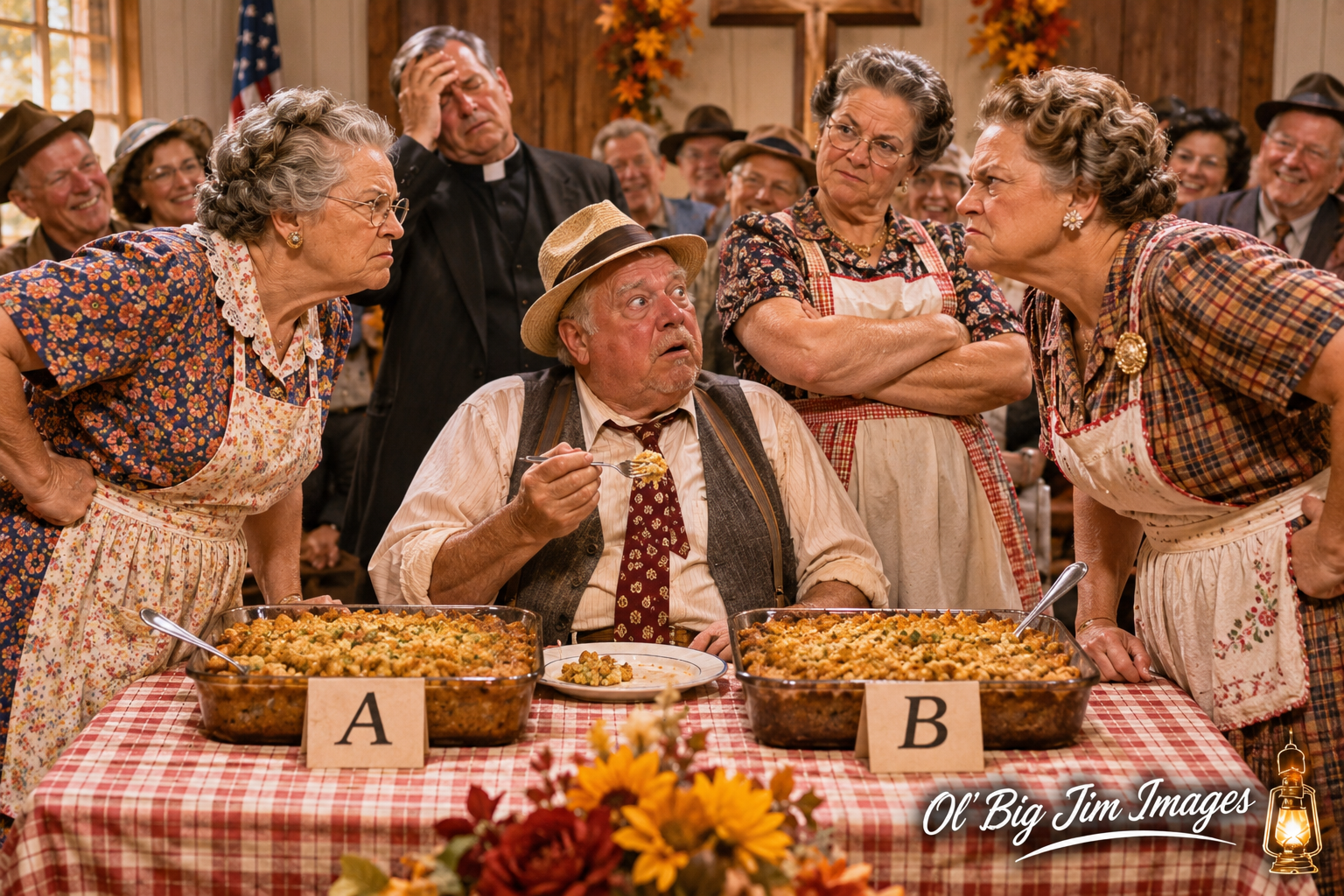
There were church members, townspeople, relatives of townspeople, and several individuals who hadn’t attended a church service in twenty years but weren’t about to miss a public disagreement involving two elderly women and a pan of cornbread dressing.
Preacher Boone opened the proceedings with a prayer.
He asked for wisdom.
He asked for patience.
And, somewhat pointedly, he asked the Lord to protect everybody from saying things they’d later regret.
Ruby stood beside a table at the front of the hall.
Two covered baking dishes sat before her.
One marked A.
The other marked B.
Dink sat in a chair nearby, looking increasingly like a man who’d agreed to perform a simple civic duty and discovered he was expected to negotiate a peace treaty between two hostile nations.
Ruby raised her hand.
“Now, everybody listen.”
The room quieted.
“Dink’s gonna taste both pans without knowin’ who cooked which one. He’s gonna judge ’em on flavor, texture, and whether they’re fit to serve at Thanksgiving dinner.”
Beulah Mae nodded approvingly.
Mabel Jane nodded suspiciously.
Ruby continued.
“And there ain’t gonna be no hollerin’, no arguin’, and no accusations of cheating.”
A voice from the back called out, “What about cussin’?”
Ruby looked toward the speaker.
“Depends on what Dink says.”
The room erupted in laughter.
Dink shook his head.
“I oughta stayed in New Orleans.”
Ruby removed the covers.
The smell of sage, onion, cornbread, and chicken broth filled the fellowship hall.
Dink picked up his fork.
The room went silent.
He took a bite from Pan A.
Chewed thoughtfully.
Nodded.
Then he took a bite from Pan B.
Chewed again.
Frowned.
Took another bite.
Then another.
Ruby leaned toward him.
“Dink, you’re supposed to be judgin’, not eatin’ supper.”
“I’m considerin’ the evidence.”
“You’ve considered half of Pan B.”
“It’s a complicated matter.”
Beulah Mae leaned forward.
Mabel Jane gripped the edge of her chair.
Preacher Boone closed his eyes.
Dink swallowed.
Set down his fork.
And cleared his throat.
“Well,” he announced, “I believe I’ve reached a decision.”
You could have heard a biscuit drop.
Ruby folded her arms.
“All right, Dink. Which one’s better?”
Dink looked at Pan A.
Then Pan B.
Then at the two women who’d spent thirty-seven years preparing for this moment.
He took a deep breath.
And said the seven words that nearly got him run out of Piedmont.
“I reckon they both need more gravy.”
For approximately three seconds, nobody moved.
Then Beulah Mae stood up.
“MORE GRAVY?”
Mabel Jane rose beside her.
“That’s your decision?”
Dink spread his hands.
“Well, they’re both good, but…”
“BUT WHAT?” both women demanded.
Ruby closed her eyes.
“Lord, give me strength.”
Dink tried again.
“I’m jest sayin’ a little more gravy would…”
Beulah Mae pointed at him.
“You ain’t got the sense God gave a turnip!”
Mabel Jane nodded.
“For once, Beulah Mae, I agree with you!”
The room went silent.
Beulah Mae turned toward Mabel Jane.
“You do?”
“I surely do.”
The two women looked at one another.
Thirty-seven years of disagreement.
Thirty-seven Thanksgivings of boiled eggs versus no boiled eggs.
And now, at last, they’d found common ground.
Unfortunately for Dink, he was standing on it.
Ruby stepped forward.
“All right, ladies. That’s enough.”
Beulah Mae folded her arms.
Mabel Jane folded hers.
Ruby looked at Dink.
“Delbert Rhinehart, you had one job.”
Dink stared at her.
“I DID THE JOB!”
“You were supposed to pick a winner!”
“I couldn’t!”
“Why not?”
“Because they both tasted good!”
Ruby looked at the two women.
Then at the dressing.
Then at her husband.
And slowly, a smile began to spread across her face.
“Well,” she said, “I reckon that settles it.”
Beulah Mae frowned.
“Settles what?”
Ruby gestured toward the pans.
“That there’s more’n one way to make good dressin’.”
The room fell quiet.
Preacher Boone opened one eye.
Ruby continued.
“Beulah Mae, you make yours with boiled eggs. Mabel Jane, you make yours without. And everybody who likes one can eat it, and everybody who likes the other can eat that.”
She paused.
“And anybody who don’t like either one can go home and eat a bologna sandwich.”
A few people chuckled.
Then somebody laughed outright.
Then the whole room joined in.
Even Beulah Mae smiled.
Even Mabel Jane.
And Preacher Boone, who’d been praying for peace since Sunday morning, finally looked as though he might live to see Christmas.
Now, you’d think that would’ve settled the Great Piedmont Dressing Dispute.
And for a little while, it did.
Beulah Mae and Mabel Jane even agreed to place their pans side by side at the Thanksgiving fellowship dinner.
They shook hands.
They smiled.
They told everybody how pleased they were that the matter had been resolved in such a Christian spirit.
Then, just as the crowd was beginning to disperse, Earl Ponder wandered up to the table.
He took a bite of Beulah Mae’s dressing.
Then a bite of Mabel Jane’s.
Chewed thoughtfully.
And said, “Y’know, my mama always put chopped celery in hers.”
Beulah Mae froze.
Mabel Jane turned slowly.
Ruby looked toward the ceiling.
Dink headed for the door.
And Preacher Boone, without saying a word, went into his office and locked it.
Because in Piedmont, Alabama, peace was a wonderful thing.
But it was seldom permanent.
Especially when somebody brought celery into the conversation.
Now, I don’t know where you stand on boiled eggs in cornbread dressing.
And I ain’t about to ask.
I’ve seen what happens when reasonable people start discussing such matters, and I intend to live long enough to enjoy another Thanksgiving.
But I will say this.
Whether you put boiled eggs in your dressing, leave ’em out, add celery, or simply drown the whole business in gravy, there’s one thing we ought to remember.
Thanksgiving ain’t really about what’s in the dressing.
It’s about who’s sitting around the table.
And if you happen to be sitting next to somebody who makes theirs different from yours, well, that’s just one more thing to be thankful for.
Unless they put raisins in it.
Then you’re on your own.
Happy Thanksgiving, y’all.
And may the Good Lord protect us from anybody who puts pineapple in the cornbread.
Now, Y’all, I can already hear the comments:
“My mama ALWAYS put boiled eggs in hers!”
“Well, mine didn’t, and she lived to be ninety-three!”
“Y’all ain’t even mentioned celery!”
And somewhere in the middle of it all, Dink Rhinehart is wondering whether he ought to have stayed in New Orleans.


