A Piedmont Porchlight Story
By Jim L Wright
Ruby Rhinehart could spot a crooked seam or a pucker from the other side of a room.
Dink claimed she could spot one from the other side of the street, although Ruby maintained that this was an exaggeration brought about by his natural inclination toward foolishness.
She’d acquired the talent during her years at Lawtex, where she’d inspected enough sewing to develop a permanent suspicion of anything advertised as handmade.
She knew a skipped stitch, a puckered seam, an improperly finished edge, and a dozen other little sins against the sewing machine that most of us wouldn’t notice if somebody circled ’em in red ink.
And she wasn’t above inspecting merchandise in department stores, either.
Dink once made the mistake of buying her a rather expensive blouse.
Ruby turned it inside out.
“How much you pay for this?”
“Never you mind.”
“Well, whatever it was, they owe you about a dollar and a half back.”
“Why?”
She showed him.
Dink couldn’t see a blessed thing wrong with it.
Which, according to Ruby, was precisely why people like him ought not to be allowed to shop unsupervised.
⁂
It was on a Saturday morning in November that Ruby and Dink attended an estate sale at a little brick house in Piedmont.
Dink wasn’t particularly interested in estate sales, but he enjoyed examining things that other people had accumulated over a lifetime. He considered it a form of archaeology.
Ruby considered it an excuse for him to bring home more junk.
By the time she’d made her way into the back bedroom, Dink had already acquired a brass shoehorn, a wooden cigar box, and something he insisted was an antique French corkscrew.
Ruby suspected it was a broken potato peeler.
There were several quilts folded at the foot of an old iron bed. Most were ordinary enough, the sort of quilts that had kept generations of Piedmont children warm through winters when the only heat in the bedroom came from whatever managed to wander down the hallway from the living room.
Ruby picked up the top one.
Examined it.
Put it back.
She picked up another.
“Machine stitched,” she murmured.
Then she reached for the third quilt.
It was a patchwork of faded blue, cream, and pale yellow, with little sprigs of flowers scattered across some of the squares. The colors had softened with washing and sunlight, and the binding was worn in places.
Ruby unfolded it across the bed.
She ran her hand over the material.
Then she stopped.
Near one corner, where two blue squares met a yellow one, was a tiny fold of fabric caught beneath a line of stitching. No bigger than a grain of rice.
Ruby bent closer.
She touched it with the tip of her finger.
“Well, I’ll be.”
Dink appeared in the doorway.
“Find somethin’?”
Ruby didn’t answer.
He came over and looked at the quilt.
“That’s pretty.”
“Yes.”
“You want it?”
Ruby was still looking at that little fold of fabric.
“I reckon I do.”
Dink examined the price tag.
“Twenty-five dollars. You want me to see if they’ll take twenty?”
Ruby looked up at him.
“No.”
Dink blinked.
“No?”
“Give ’em what they’re askin’.”
Now, in all the years Dink had known Ruby Roundtree Rhinehart, he’d never heard her discourage a man from negotiating the price of anything.
He went to find somebody to take his money.
⁂
Forty years earlier, there’d been a woman working at Lawtex named Lillian Pruitt.
Lillian was a little thing, barely five feet tall, with narrow shoulders and hands that always seemed to be cold. She was a good worker, though, and could coax a sewing machine into behaving when everybody else had given up on it.
Her husband had died unexpectedly, leaving her with three children, a house that wasn’t paid for, and an automobile that required considerably more faith than gasoline.
She didn’t complain.
Women like Lillian generally didn’t.
They simply got up in the morning and did whatever needed doin’, because there wasn’t anybody else to do it.
One year, several of the women at Lawtex decided to make quilts in their spare time, using fabric remnants they’d been permitted to take home. They worked on them during lunch breaks and after their shifts, helping one another with the cutting, sewing, and finishing.
The quilts were to be sold at a Christmas bazaar.
Ruby, being Ruby, had appointed herself inspector.
Nobody objected.
Well, nobody objected more than once.
Lillian had been working on a particularly pretty blue and yellow quilt. She’d put more hours into it than anybody knew, carrying pieces home in a paper sack and sewing after her children had gone to bed.
She’d already arranged for a woman in town to buy it.
The money was going toward Christmas.
Not Christmas decorations, mind you.
Not a fancy dinner.
Shoes.
Lillian’s youngest boy needed shoes, and his sister had outgrown her winter coat.
On the afternoon she finished the quilt, she brought it to Ruby.
“Look it over for me, would you?”
Ruby spread it across a table.
She examined the binding, the corners, and the stitching. She turned it over and examined the back.
It was beautiful work.
Then she found the flaw.
A little fold of blue fabric had been caught beneath the stitching near one corner.
Ordinarily, Ruby would’ve handed it back and told Lillian to take out the stitches and do it again.
But as she was about to speak, she noticed Lillian’s hands.
They were trembling.
“You all right, honey?”
Lillian nodded.
Then shook her head.
Then sat down.
“I’m just tired, Ruby.”
Ruby pulled up a chair.
Lillian stared at the quilt.
“I get home, and there’s supper to fix. Clothes to wash. Young’uns needin’ help with their schoolwork. Then I sit down at that sewing machine, and sometimes I wake up with my head layin’ on the table.”
She rubbed her eyes.
“I wanted this one to be nice.”
Ruby looked at the quilt.
“It is nice.”
“I wanted it to be perfect.”
There was a long silence.
Ruby knew how to correct that little flaw. It would require removing a section of stitching, straightening the material, and sewing it again. Not a particularly difficult undertaking.
But she looked at Lillian.
And she understood that the woman sitting beside her had spent the better part of a year trying to keep three children fed, clothed, warm, and convinced that everything was going to be all right.
Ruby folded the quilt.
“Passed.”
Lillian looked up.
“Really?”
“Really.”
“You didn’t find nothin’ wrong with it?”
Ruby looked her straight in the eye.
“Nothin’ that matters.”
⁂
Dink drove home from the estate sale in his red Cadillac with Ruby sitting beside him, the quilt folded across her lap.
He’d made several attempts at conversation, none of which had produced much in the way of results.
Finally, he said, “Ruby, you gonna tell me what’s so special about that quilt?”
She looked down at it.
“I knew the woman who made it.”
“Somebody from Lawtex?”
“Yes.”
“Good friend of yours?”
Ruby thought about that.
“I reckon I could’ve been a better friend.”
Dink glanced at her.
He knew his wife well enough to recognize when a conversation needed room to breathe.
So, he drove.
⁂
That evening, Ruby spread the quilt across the back of the sofa.
Napoleon, their enormous orange cat, immediately interpreted this as an invitation to take possession of it.
“Don’t you dare,” Ruby told him.
Napoleon dared.
Dink wisely refrained from comment.
Ruby sat down beside the cat and found the little fold in the fabric again.
She’d spent forty years remembering it.
Not every day, of course. There’d been whole years when she hadn’t thought about Lillian Pruitt or that Christmas quilt.
But every now and then, something would bring it back to her.
A crooked seam.
A tired woman standing in a grocery store counting her money.
A child wearing shoes that were a little too small.
She’d wonder whether Lillian had gotten those shoes for her boy. Whether the little girl had gotten her coat. Whether that Christmas had been a good one.
She hoped it had.
Dink came into the living room carrying two cups of coffee.
He handed one to Ruby and sat down.
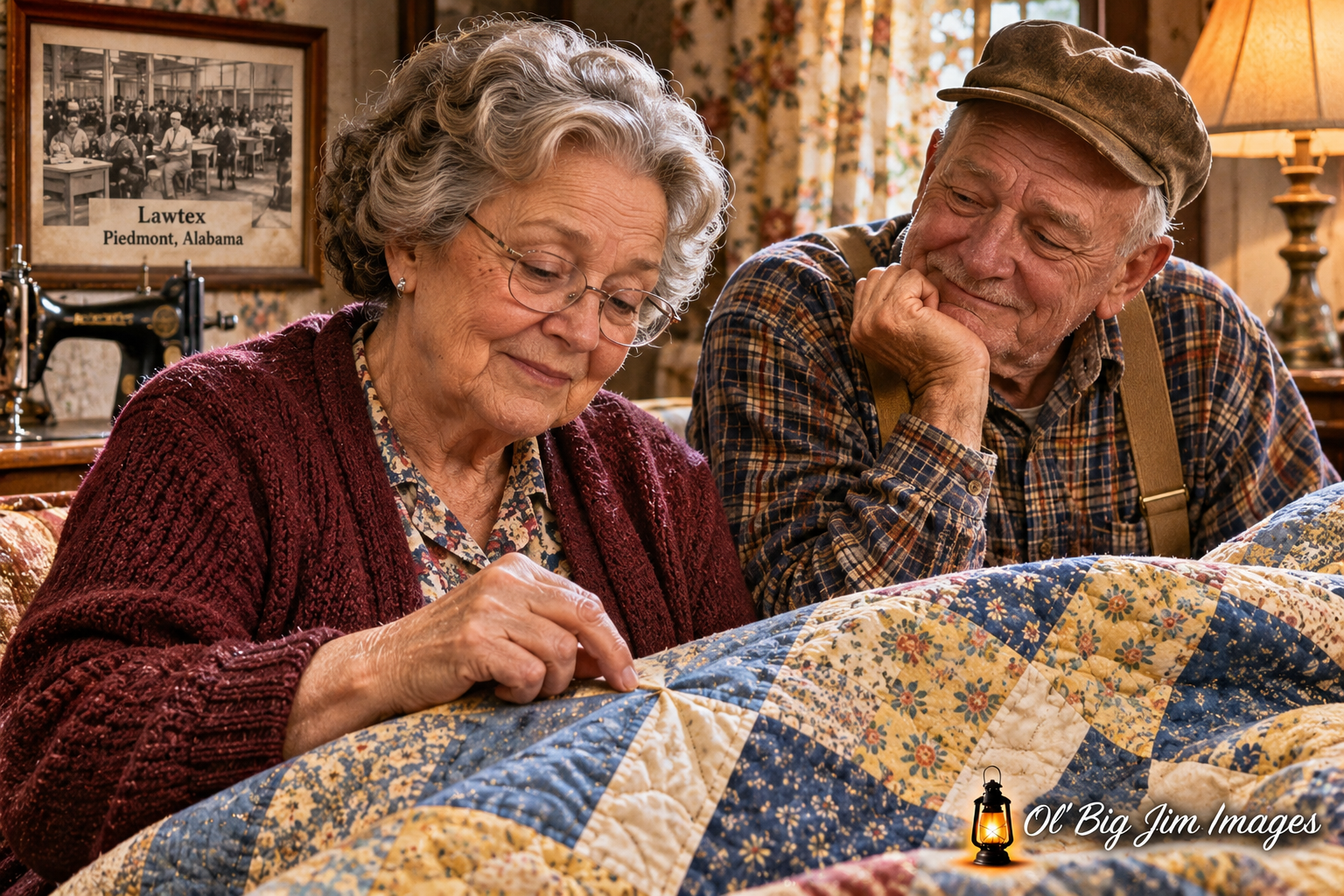
“You know,” he said, “I been lookin’ at that quilt, and I believe there’s a little somethin’ wrong with it right there.”
He pointed.
Ruby looked at him.
Of all the things in the world for Delbert Rhinehart to notice, he’d finally discovered a sewing imperfection.
“Well, would you look at that,” he continued. “Little piece of cloth caught up under the stitchin’.”
Ruby said nothing.
“Reckon you could fix that, couldn’t you?”
“Yes.”
“Wouldn’t take you long.”
“No.”
Dink waited.
“Well, you gonna?”
Ruby ran her hand across the quilt.
“No, Dink. I ain’t.”
He looked puzzled.
She took a sip of coffee.
“That quilt’s just exactly the way it’s supposed to be.”
And then, for the first time in forty years, Ruby told somebody about Lillian Pruitt.
Dink listened without interrupting.
When she’d finished, he reached over and laid his hand on hers.
“Sounds to me like you did your job that day, Ruby.”
She smiled a little.
“Maybe I did.”
⁂
I reckon most of us have something in our possession that wouldn’t mean much to anybody else.
An old pocketknife. A chipped coffee cup. A letter folded so many times that it’s liable to come apart if we open it again.
We keep such things not because they’re perfect, but because somewhere along the way they became witnesses to our lives.
Ruby Rhinehart had spent a good portion of hers looking for imperfections.
She’d found thousands of ’em.
Corrected most of ’em.
But there was one she’d deliberately allowed to remain, and for forty years she’d never told a soul.
That little quilt had kept somebody warm through forty winters. It had survived countless washings, children, grandchildren, and Lord only knows how many cats.
And that tiny fold of blue fabric was still there.
It hadn’t weakened the quilt.
It hadn’t diminished its beauty.
It hadn’t prevented it from doing a single thing a quilt was supposed to do.
Ruby could’ve taken out those stitches that evening and corrected the mistake.
But she wouldn’t.
Because somewhere in those forty years, she’d come to understand that the only thing wrong with that little imperfection would’ve been fixing it.