(The Giant’s Property Attorney Speaks)
My client categorically denies that possession of a beanstalk constitutes an invitation.
Let me repeat that for the record.
A naturally occurring, or even unnaturally occurring, vertical plant structure does not grant strangers the legal right to enter private property.
This has been established law for centuries.
Yet somehow, in this particular case, everyone seems willing to overlook it because the trespasser was young, energetic, and narratively favored.
The Client
Now my client, whom history insists on calling “The Giant,” was in fact a property owner.
A taxpayer.
A collector of valuable assets.
And, by all available evidence, a man who preferred that his belongings remain in his possession.
Hardly controversial.
He owned:
- a castle
- livestock
- certain musical property
- and a goose with unusual production capabilities
All lawfully acquired, as far as anyone can prove.
The Beanstalk
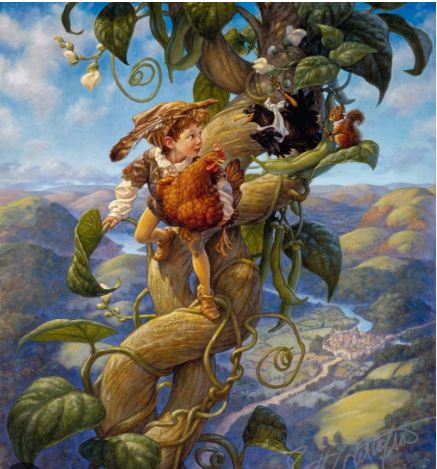
Now one mornin’, entirely without consultation, a beanstalk appears directly adjacent to the property.
No permit.
No environmental review.
No zoning variance.
No public notice.
Nothing.
And before my client can investigate this extraordinary agricultural development…
Someone climbs it.
The First Incident
Now imagine for a moment that you awaken to discover an unfamiliar child wanderin’ around your residence.
Would you be concerned? Naturally.
Would you ask questions? Certainly.
Would you perhaps raise your voice? Without a doubt.
Yet somehow this entirely reasonable reaction has been interpreted as evidence of villainy.
A Pattern Emerges
The boy leaves.
Returns.
Leaves again.
Returns again.
Each visit is accompanied by the disappearance of property.
Now, where I come from, we have a word for that.
The word is not “adventure.”
The word is “theft.”
The Goose
Let’s discuss the goose.
A beloved member of the household.
Productive.
Dependable.
Excellent attendance record.
One day she’s present.
The next day, she’s bein’ carried down a beanstalk by a juvenile entrepreneur.
Yet public sympathy remains overwhelmingly with the entrepreneur.
I find this perplexin’.
The Harp
Then comes the harp.
Now this particular item possessed both monetary and sentimental value.
It also had opinions.
Which admittedly complicated ownership.
Nonetheless, it belonged to my client.
The harp was removed without consent.
And suddenly everyone starts callin’ it a rescue mission.
The Pursuit
At this point, my client undertakes what legal professionals refer to as:
“A recovery effort.”
History calls it chasin’.
I call it protectin’ his assets.
The Structural Failure
Now we arrive at the truly troublesome part.
The beanstalk is severed.
My client falls.
Property damage occurs.
And somehow the official conclusion becomes:
“Problem solved.”
I would like to submit that this resolution would not be considered acceptable in most jurisdictions.
The Public Relations Disaster
What frustrates me most is not the loss of property.
Nor even the fatal descent.
It is the narrative.
Because the facts, as generally presented, amount to:
A stranger entered private property repeatedly.
Removed valuables.
Destroyed the access route.
And became the hero.
Meanwhile, the property owner became a cautionary tale.
I have seen less biased reporting from town gossip.
Closing Argument
Ladies and gentlemen, I ask only this:
Suppose the story had been told from the other direction.
Suppose a very large man descended unexpectedly into your home.
Removed your valuables.
And then collapsed your staircase while escaping.
Would you call that heroism?
Or would you call the sheriff?
The defense rests.
And that, as near as I can determine from the surviving records, is how a burglary became a fairy tale and a lawsuit became a legend.



I always thought Jack was a little presumptuous in taking the giant’s stuff. After all he’s the one who traded the cow for some beans.
LikeLiked by 1 person
Agreed, John. Jack took shameless advantage of the giant and he was nothing more than a common burglar dressed up as a hero. The author ought to be ashamed of himself.
LikeLiked by 1 person
Okay then. We need to charge him with the Giant’s death in addition to grand larceny
LikeLiked by 1 person
Excellent idea, John. There ain’t a jury in the world that would acquit him!
LikeLiked by 1 person
I agree.
LikeLiked by 1 person
I do believe I’ve got the scoop on the trial! Watch for an extra edition.
LikeLiked by 1 person
Oh good. 😀
LikeLiked by 1 person
Lol…that certainly cleared up any uncertainty when it comes to the activities of Jack in the Beanstalk… xxx
LikeLiked by 1 person
Thanks, Sally! It’s good to get the truth of the matter, innit?
LikeLiked by 1 person
Fascinating story, Jim! 😲
LikeLiked by 1 person
Thank you, Tim!
LikeLiked by 1 person
You’re welcome, Jim. 😊
LikeLiked by 1 person
A very interesting take on the matter, for sure. Thanks, Jim!
LikeLiked by 1 person
Thank you, Olga!
LikeLike
The Court finds in favor of the defense. Bang!
LikeLiked by 1 person