People have made a nursery song out of our misfortune, which is how you know nobody involved had to carry the water.
“Jack and Jill went up the hill to fetch a pail of water.” That is the official version, neat as a biscuit and twice as dry. It gives the impression of two cheerful children takin’ a wholesome little stroll for refreshment, perhaps singin’ to birds and learnin’ the value of cooperation.
Nonsense.
We were Labor.
Unpaid, under-supervised, and sent uphill with one pail between us by adults who plainly believed childhood was cheaper than plumbing.
Now I’m Jill, and before anybody asks, yes, Jack did fall down and break his crown. I am not here to erase that. He fell spectacularly. If falling was music, Jack would’ve been a brass band rollin’ downhill in Sunday clothes.
But notice how the rhyme adds, “and Jill came tumblin’ after,” like I simply got jealous of gravity and joined in. There were circumstances. There was terrain. There was mud. There was a hill that ought to have been condemned by the county.
Let’s begin with the water.
Our village well sat at the top of a hill because apparently whoever planned the settlement had a grudge against knees. I have heard explanations. “The spring was up there.” “The ground was purer.” “Our ancestors knew what they were doin’.” People love sayin’ ancestors knew what they were doin’ whenever the alternative is admittin’ generations of bad decisions.
Every morning, we was sent up to fetch water.
Not a cup. Not a polite little jug. A pail. A sloshin’, iron-handled, shoulder-pullin’ pail big enough to drown optimism. We carried it together because neither of us alone could manage it without listin’ sideways like a damaged boat.
Jack took one side. I took the other.
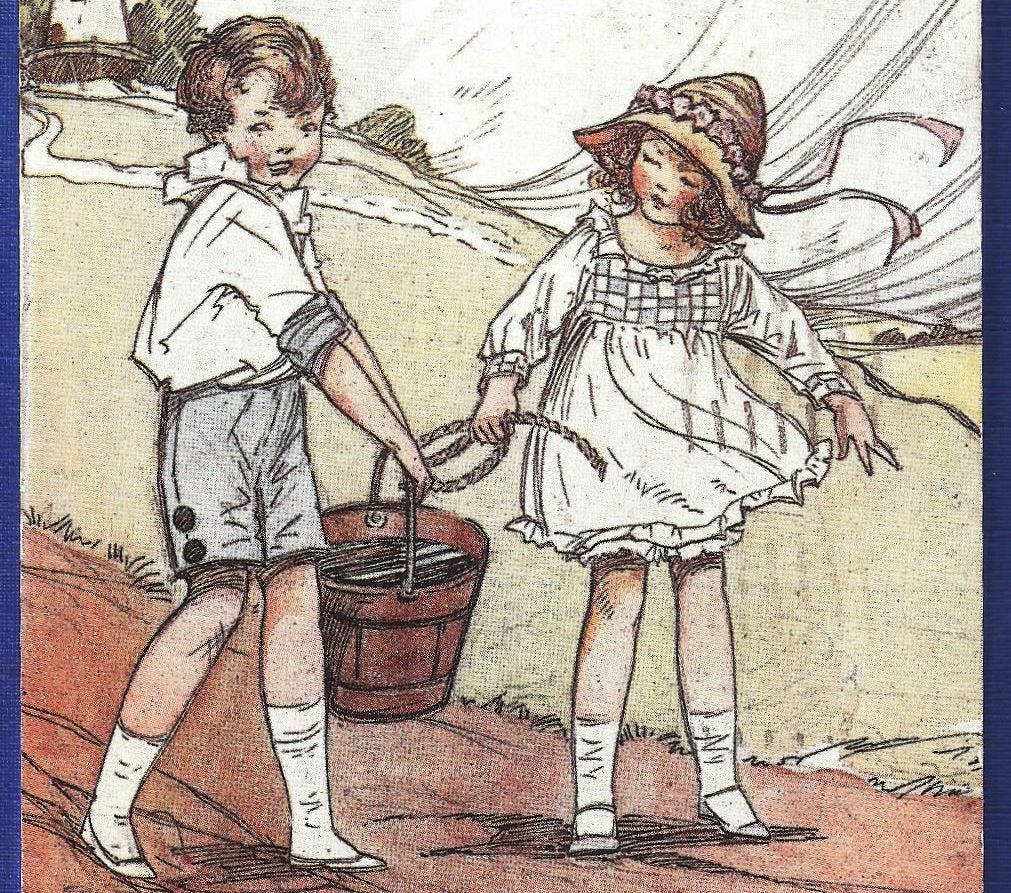
This arrangement sounds fair until you remember Jack’s attention was only partly available to the task of survivin’. He was the sort of boy who could trip over a shadow and then accuse the sun of poor placement. He had good intentions, which is what people say about boys when they run out of evidence.
Still, he was my friend.
That matters.
History has treated us like two names nailed together by rhyme, but Jack was a person. He had freckles, a cowlick, and a confidence in his own balance that weren’t supported by the record. He could whistle through his teeth. He once taught a beetle to ride in a walnut shell, though the beetle may not have consented. He made me laugh when I was tryin’ to be angry, which is a dangerous talent.
The morning in question, it had rained.
Not enough to cancel chores, naturally. Weather only cancels chores for people who own more than one pair of shoes. For the rest of us, rain is just water that arrives before you go fetch more.
The path up the hill had turned slick. The clay held prints from goats, carts, boots, and one wandering pig with more freedom than either of us. There were stones half-buried in the mud, roots stretchin’ across the track, and no rail, no steps, no rope, no sensible improvement of any kind.
At breakfast, I said, “That path is dangerous.”
Mother said, “Well then, be careful.”
That was the entire safety program.
Jack arrived at our gate wearin’ a hat too big for him and the expression of a man preparin’ for adventure instead of water.
“We goin’?” he asked.
“No,” I said. “We’re immigratin’ to Peru.”
He grinned. “Bring the pail.”
So, we went.
Up was bad enough. Down is what kills you, but up is where your soul starts writin’ complaints. The pail bumped between us empty, and Jack began explainin’ how, if we found gold in the well, he would buy a horse.
“There ain’t no gold in that well,” I said.
“You don’t know that.”
“I know there’s water in it because that’s what wells are famous for.”
“Could be both.”
“If there was gold in that well, grown men would’ve already emptied it and charged us to look at the hole.”
Jack considered this. “I’d buy you a ribbon.”
“With well gold?”
“With any gold.”
That softened me, which I regret on principle.
We reached the top breathin’ like bellows and filled the pail. Now, a full pail of water is not the same object as an empty pail. An empty pail is an inconvenience. A full pail is an argument with physics.
Jack took one side. I took the other.
“Careful,” I said.
“I’m always careful,” he said.
This was false in a broad and historical sense.
We started down.
Three steps in, water sloshed over Jack’s shoe.
He yelped.
“Don’t yelp,” I said.
“It’s cold.”
“It’s water, Jack. Bein’ cold is what it does.”
He shifted his grip. The pail swung. I leaned back. The mud accepted my heel with a personal interest.
“Jack.”
“I’ve got it.”
He did not have it.
A goat appeared.
I ain’t got no idea where it came from. Goats arrive in moments of crisis the way kinfolks arrive when there’s cake. It stepped onto the path below us and looked up with those square little eyes that suggest deep wickedness or no thoughts at all.
Jack said, “Shoo.”
The goat did not shoo.
We tried to go around it. This required a maneuver for which we had neither the training nor the footwear. Jack stepped on a wet stone. The stone moved. His foot flew forward. The pail flew backward. I held on because girls are raised to preserve household resources even during a catastrophe.
That was my mistake.
Jack went down.
Not a little down. Not a recoverable down. He performed a full public surrender to gravity. His hat left him first, then his legs, then the rest of him followed with enthusiasm.
His head struck a stone.
That is the “broke his crown” part, though let me clarify: Jack was not royalty. His crown was the top of his head, which began leakin’ in a manner that caused me immediate concern and later a rhyme.
I shouted his name.
The pail jerked.
I still had hold of it.
Now, if you are standin’ on a muddy hill attached by an iron handle to a tumblin’ boy and a determined volume of water, you may believe you can simply let go. You would be wrong. By the time your mind sends that message, your feet have filed separate paperwork.
I went after him.
I didn’t choose it. I was drafted.
The hill became sky, mud, sky, elbow, water, skirt, root, and Jack’s left boot. I remember callin’ him a fool, which may seem harsh, but affection under pressure often takes the shape of accuracy.
We landed in a heap at the bottom.
The pail arrived last and hit Jack in the stomach, which I admit improved neither his condition nor his disposition.
For a moment, we lay there.
Then Jack groaned.
I have never been so glad to hear such an unpleasant sound.
His head was bleeding. My dress was ruined. The pail was dented. The water was gone, havin’ returned to the earth by a route more direct than ours.
The adults came runnin’ then, because adults are quick to attend disasters they were too slow to prevent.
Mother cried. Jack’s father lifted him. Somebody fetched vinegar, cloth, and advice. The goat remained on the hill, chewin’ somethin’ and lookin’ innocent, which is how I knew it wasn’t.
By evenin’, the story had begun changin’.
First, it was, “Jack slipped.” Then, “Jack and Jill tumbled.” Then, “Children must be more careful.” By the next week, we had become a lesson in obedience, balance, and the hazards of horseplay, though there had been no horse and very little play.
Nobody mentioned the path.
Nobody mentioned the rain.
Nobody mentioned the decision to put the well at the top of a clay hill and send children to haul water down it before breakfast.
That’s the privilege of grown people: they turn their poor planning into your character flaw.
Jack healed, mostly. He had a scar under his hair and a deep distrust of goats, which I considered progress. I was bruised in colors usually reserved for sunsets and spoiled plums. For three days, I walked like a chair with one short leg.
And still, when water was needed, somebody said, “Jill, take the pail.”
I looked at the hill. I looked at the pail. I looked at the adults, who had learned nothing except how to rhyme about our injuries.
Then I said, “No.”
That part never made the song.
It should have.
Because the true end of the tale is not that Jack fell down and Jill came tumblin’ after.
The true end is that one morning, Jill set the pail on the table and said if the village wanted water so badly, it could either build steps, dig a proper well, or develop a taste for dust.
And do you know what happened?
They built steps.
Not right away. First, they fussed. Then they lectured. Then they predicted the collapse of civilization, as adults do whenever children decline to injure themselves for tradition.
But by harvest, there were steps cut into that hill, a rail along the steepest part, and a second pail so one child’s balance did not depend on another child’s foolishness.
Jack helped build them.
So did I.
The goat watched.
And if I happened to give it a little shove with my hip while passin’, I will only say the hill was slippery, and accidents have a long memory.



nice!!
LikeLiked by 1 person
Super, JIm
LikeLiked by 1 person