Mangled Mythology
Let me start off by sayin’ I didn’t ask for the labyrinth.
That fact gets lost in the retellin’, mostly because poets enjoy architecture more than fairness. They talk about twisting halls, dark passages, stone corridors, dead ends, echoes, and the terrible beast waitin’ at the center. They make it sound like I drew up the plans myself, sharpened a pencil, and said, “What this family needs is worse foot traffic.”
I was a baby.
A complicated baby, I grant you. But still.
Nobody consults the infant in these matters. One minute you are born into a royal household under circumstances everybody agrees not to talk about at the supper table, and the next you are declared a shame, a monster, and a municipal problem. Then some clever man named Daedalus gets hired to build a prison so confusing that even the maintenance staff had to leave breadcrumbs.
And yet somehow, I’m the villain.
Now I won’t deny that my appearance caused comment. I had the body of a man and the head of a bull, which makes introductions difficult. But in my defense, everybody in that family looked strange once you got to know them. King Minos had the moral character of spoilt milk. Queen Pasiphae had secrets. Ariadne was always wanderin’ around with string like a woman preparin’ for either rescue or crafts. Theseus had the expression of a man who had just discovered mirrors and approved of them.
But me? I had horns, so history stopped there.
They named me Asterion, though hardly anybody ever uses it. That was my name. It means “starry,” which is a mighty pretty thing to call a child before lockin’ him underground.
Most folks know me only as the Minotaur, which is less a name than a livestock filing system. Minos’s bull. That’s what it means. Not Asterion. Not son. Not prisoner. Just property with a snout.
I grew up in the labyrinth, if you can call it growin’ up. There was no nursery, no school, no aunties pinchin’ my cheek and lyin’ about how handsome I was. There were walls. There were torches. There were corridors that doubled back on themselves like politicians answerin’ questions. There were rats with more freedom than I had.
Meals came irregularly. Conversation came worse.
Sometimes a servant would lower food into the passage and run off before I could say thank you. I tried sayin’ thank you for a while. It echoed back so pitiful I quit.
Do you know what it does to a soul to hear only itself?
Of course, the official story says I ate people.
This is the part where everybody leans forward.
Fine. Let’s talk about that.
Every few years, Athens sent young men and women into the labyrinth as tribute. Nobody asked me if I wanted tribute. I didn’t send invitations. I didn’t write Athens and say, “Dear Sirs, please forward seven youths and seven maidens, with light seasoning and a delicate crunch.” That was politics. Minos demanded them. Athens provided them. Priests blessed the arrangement, which is how you know it was rotten.
Then the poor children were shoved into my prison.
Imagine bein’ blamed for what desperate creatures do in a dark place built by kings.
Some of them died of fear before they ever found me. Some got lost and wandered till thirst took them. Some attacked me. Some begged. One asked if I knew the way out, and I laughed so hard I scared us both.
I didn’t hate them.
That may surprise you. But I knew something of bein’ sacrificed for other people’s reputations.
The difference was, they got songs.
I got teeth.
Then came Theseus.
You can always tell when a hero enters a story because common sense jumps out of the nearest window. Theseus arrived with a sword, a chest full of confidence, and hair that suggested he had never once slept wrong. He weren’t like the others. The others trembled, prayed, wept, or cursed their fathers. Theseus walked like the floor had been laid special for him.
He had help, naturally.
Heroes always do. If a monster has one advantage, that’s proof of wickedness. If a hero has weapons, gods, princesses, magic thread, and favorable lighting, that’s destiny.
Ariadne, the triflin’ heifer, gave him the thread.
Now I don’t blame her entirely. She was young, romantic, and trapped in a palace where her father’s idea of problem-solvin’ involved prisons and tribute. A handsome stranger promised escape, and she believed him. Many intelligent women have been undone by a man with clean sandals and an impure heart.
Still, I wish she had brought me some string first.
Theseus entered the labyrinth unwinding that thread behind him, which I admit was clever. I had been down there for years and never thought of it, mostly because nobody had given me any thread, hope, or a door.
I heard him before I saw him.
Not his footsteps. His certainty.
It rang off the walls.
“Asterion,” he called.
That startled me. Most came in shoutin’ “beast” or “monster” or “where am I?” But he used my name. For one foolish second, I thought maybe he had come to talk.
I stepped into the torchlight.
He lifted his sword.
So much for conversation.
“You really don’t have to do this,” I said.
That line has become common among us misunderstood parties, but there’s a reason for that. We keep meetin’ men who do, in fact, think they have to do a thing.
“I must free Athens,” he said.
“Well,” I said, “I ain’t holdin’ Athens. I’m holdin’ a wall.”
He frowned, as if I had made the sort of point that ruins speeches.
“You devour our children.”
“Your politicians send them here.”
“You are the terror of the maze.”
“I live in it.”
“You are a monster.”
“I was born.”
There are arguments a sword cannot answer, which is why swords tend to interrupt.
He came at me.
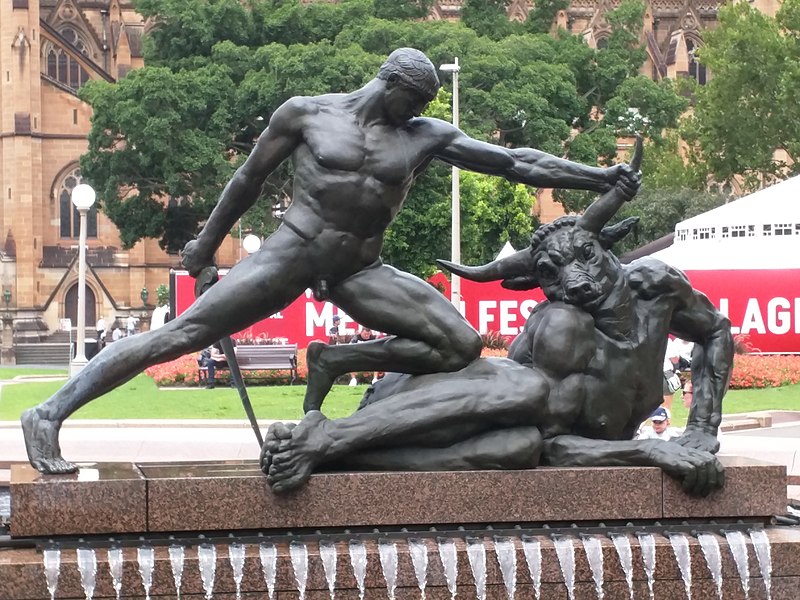
I won’t say I fought nobly. Nobility is for people with witnesses. I fought like a cornered thing, because I was one. Horn, hand, hoof, shoulder against stone. The labyrinth filled with dust and grunts and the ugly scrape of bronze. He was strong. I was stronger. He was trained. I was tired.
That, right there, is the part nobody ever considers. Monsters are always expected to be fresh for the climax. Nobody asks whether the monster slept badly, whether his knees hurt, whether he had been lonely for twenty years and was emotionally unprepared for company with a blade.
In the end, Theseus won.
Of course, he did. He had the thread, the princess, the sword, the future, and all the narrators waitin’ outside.
When I fell, the labyrinth grew quiet.
Not peaceful. Just empty.
Theseus stood over me breathin’ hard, and for a moment he looked less like a hero and more like a man who had killed somebody in a basement and was wonderin’ if the song would make it cleaner.
“Tell them my name,” I said.
He didn’t.
Or if he did, nobody wrote it down where children could find it.
They followed the thread out. They cheered. Athens was saved. Minos was humbled. Ariadne ran off with Theseus, then got abandoned on an island, which just proves my earlier remarks about clean sandals.
As for the labyrinth, I suppose it stood there awhile after me, empty and clever and useless. A prison without a prisoner is just architecture with a guilty conscience.
So no, I didn’t build the maze.
I didn’t demand the tribute.
I didn’t start the war, design the punishment, seduce the queen, anger the gods, hire Daedalus, or ask to be born into a family that treated scandal like a construction project.
I was put in the center of everybody else’s shame and then blamed for havin’ horns. Beautiful horns, I might add.
That’s how monsters are made, more often than not. Somebody powerful makes a mess, somebody clever builds walls around it, and somebody different gets left inside to carry the shame.
Still, if you ever visit Crete and hear wind movin’ through old stones, listen close.
It may just be the ruins breathin’.
Or it might be me, still tryin’ to find the exit.


Amazing story of the Minotaur, Jim, captivating to me.
LikeLiked by 1 person
Thanks, Tim. You know somethin’? Back in the dark ages, when I first started reading these ol’ tales, I never seemed able to identify with or cheer for the alleged hero. The characters that spoke to me in those days were the three gruff billy goats, Medusa (of course), and the Minotaur sort of characters. It made for some fun story-telling as I grew up.
LikeLiked by 1 person
Great, Jim! 😲
LikeLiked by 1 person
Love these mythological stories, Jim
LikeLiked by 1 person
Thank you, John. I think I enjoy “mangling” the ancient myths most of all!
LikeLiked by 1 person
Ha ha ha. I’m glad you are having fun with it.
LikeLiked by 1 person