
A Piedmont Porchlight Story
There are three things you can count on in Piedmont, Alabama. Somebody will know your business before you do. Curtis Pope will have an opinion about it. And if the bell at Beulah Congregational Holiness Church starts ringing after midnight, somebody’s fixing to have a very bad night.
Now, I don’t know who established that last rule, but I can tell you precisely when I learned about it. It was a Tuesday in October, and I was sitting in my kitchen eating a piece of leftover coconut cake when the telephone rang. Eleven forty-seven.
I remember the time because I’d just looked at the clock and decided that eating coconut cake at nearly midnight was probably a sin. Then I decided the Lord had considerably more pressing matters to attend to.
“Hello?”
“Jim?”
It was Sheriff Lyle Booker.
“Evening, Lyle.”
“You awake?”
“No, I’m answering the telephone in my sleep.”
“Well, get dressed.”
“Why?”
“Church bell’s ringing.”
I looked at the clock again. “Which church?”
“Beulah.”
“Somebody die?”
“That’s what we’re trying to find out.”
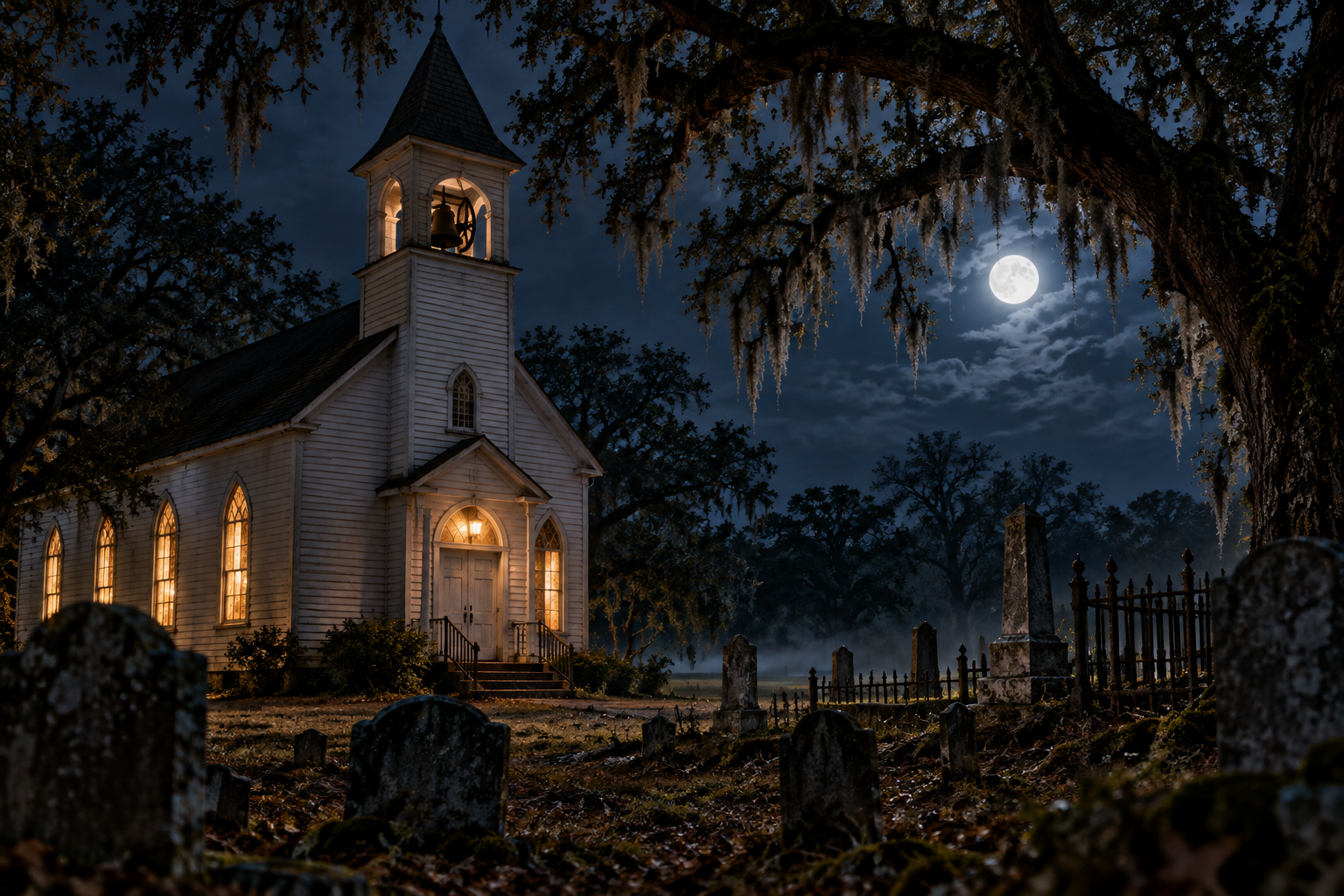
Now, Beulah Congregational Holiness Church was an old white clapboard building with a steeple that leaned just enough to make a fellow nervous during a thunderstorm. It stood on a little rise outside town, surrounded by oak trees and a cemetery where half the congregation had been waiting patiently for the other half since approximately 1890.
The bell had been installed in 1912.
It was a great bronze thing, cast somewhere up North and hauled into Piedmont on a railroad flatcar. According to local tradition, the bell had rung for weddings, funerals, revivals, baptisms, the end of two world wars, and once, accidentally, when Brother Amos Hightower mistook the bell rope for the cord that operated the attic fan.
That last occasion caused considerable excitement during the Wednesday night prayer meeting.
But by the time I arrived, the bell had stopped. Sheriff Booker stood in the churchyard with his hands on his hips. Beside him were Curtis Pope, Earl, and Preacher Boone, who looked as though somebody had awakened him in the middle of a particularly agreeable dream.
“Evening, gentlemen,” I said.
Curtis looked at his watch. “Morning, technically.”
“Well, ain’t that comforting.”
Preacher Boone was staring up at the steeple. “Nobody’s been in the church tonight.”
“Then who’s ringing the bell?” I asked.
“That’s what I’d like to know.”
Earl cleared his throat. “Could be a raccoon.”
Curtis turned toward him. “A raccoon?”
“Well, they get into attics.”
“Coon would have to weigh three hundred pounds and know how to pull a rope.”
“Maybe there’s more than one.”
Curtis stared at him. “Earl, sometimes I wonder how you remember to breathe.”
The church door was locked. Preacher Boone produced a key, and we went inside. The sanctuary smelled of old hymnals, lemon furniture polish, and the faint lingering memory of somebody’s fried chicken supper.
Moonlight came through the tall windows. The pews stood in neat rows. The pulpit was empty. And the bell rope hung from a small opening in the ceiling near the rear vestibule.
It wasn’t moving. Sheriff Booker shone his flashlight up toward the opening.
“Anybody up there?”
No answer.
“Come down if you’re up there.”
Nothing.
Curtis whispered, “Maybe the raccoons don’t speak English.” I told him to hush.
There was a narrow stairway leading into the attic. Lyle went first. I followed. Curtis insisted on coming because, as he put it, somebody needed to supervise the investigation. Earl stayed downstairs with Preacher Boone.
The attic was hot and smelled of dry timber and old dust. The bell mechanism was visible through an opening in the steeple. A heavy iron wheel. A thick rope. And the great bronze bell itself.
Everything looked perfectly ordinary. Until Lyle noticed the footprints. They were in the dust beside the bell. Small footprints. Bare feet. The kind a child might leave. They began near the attic stairs and ended directly beneath the bell.
There were no footprints leading back. “Well,” Curtis said, “that ain’t natural.” Lyle crouched beside them.
“Could be old.”
“How old?”
“Don’t know.”
Curtis looked toward the bell. “Well, whoever made ’em either flew outta here or got themselves turned into a pigeon.”
I was about to suggest that we return downstairs when the bell moved. Not much. Just enough to make the clapper touch the bronze.
Tong.
A soft, hollow sound.
All three of us froze. The rope hung perfectly still.
Then the bell moved again.
TONG.
This time louder.
Lyle raised his flashlight. “Who’s there?”
The bell swung once more.
TONG.
And from somewhere below us came a voice. A child’s voice.
“Somebody answer it.”
We got down those attic stairs considerably faster than we’d climbed them. Earl and Preacher Boone were standing in the sanctuary, pale as bed sheets.
“Did y’all hear that?” Earl whispered.
“Hear what?” Lyle asked.
“The little girl.”
I looked at him. “What little girl?”
Earl pointed toward the pulpit. “She was standing right there.”
Preacher Boone nodded. “Little thing. White dress. Barefoot.”
“What’d she say?”
Earl swallowed. “She asked why nobody was answering the bell.”
Nobody spoke.
Then Curtis said, “Well, I don’t know about the rest of y’all, but I believe I’ve attended enough church for one evening.”
The following morning, the whole town knew. By breakfast, three different versions of the story were circulating.
In one, a ghostly child had been seen ringing the bell. In another, the bell had rung by itself while Sheriff Booker wrestled a demon in the attic. And in the third, Curtis Pope had fainted dead away and had to be revived with smelling salts.
Curtis took particular exception to that one.
“I did not faint,” he announced at the Coffee Cup.
Miss Lorene looked up from her biscuits. “Nobody said you did.”
“Everybody’s saying it.”
“Well, if everybody’s saying it, maybe there’s something to it.”
Curtis glared at her. “I was standing the entire time.”
“Then you must’ve fainted standing up.”
By noon, Preacher Boone had telephoned me.
“Jim, I need a favor.”
“Depends on what it is.”
“Would you come down to the church?”
“Why?”
“Found something.”
“What?”
“An old record book.”
Now, that got my attention. I’ve always been fond of old records. They have a way of remembering things people would just as soon forget. When I arrived, Preacher Boone had a large leather-bound ledger spread across his desk. The pages were yellowed and brittle.
He turned to an entry dated October 20, 1918.
“Read that.”
The handwriting was cramped but legible. Miss Eleanor Bellamy, age seven, passed away this morning of influenza. At her mother’s request, the church bell was rung seven times.
No funeral service held owing to quarantine.
Beneath the entry was another note.
Mother insists the child said the bell would ring again when someone came to take her home.
I looked at Preacher Boone. “Where’s she buried?”
He shook his head. “That’s the trouble.”
“What trouble?”
“There’s no burial record.”
We went out to the cemetery. The oldest graves were toward the back, beneath the oaks. Some markers were so weathered you could barely read them. Others had sunk into the red Alabama clay. We searched for nearly an hour.
Finally, Preacher Boone stopped beside a small stone half-hidden by ivy. He knelt and brushed away the leaves.
There was a name.
ELEANOR BELLAMY
1911–1918
And beneath it, almost worn away:
WAITING FOR MAMA.
Preacher Boone sat back on his heels. “Well, I’ll be.”
I looked around. “Where’s her mother?”
He shook his head. “No idea.”
That afternoon, I went down to Magnolia Mortuary and started digging through the old burial records. It took me nearly two hours. Then I found her.
Margaret Bellamy.
Died October 20, 1948.
Thirty years to the day after her daughter. Buried at Beulah Congregational Holiness Church.
But the record included a note that made me sit very still. At family’s request, interment conducted after sundown.
Church bell rung seven times. Witnesses reported hearing a second bell answering from within the cemetery. I went back to Beulah just before dark. The cemetery was quiet. A breeze moved through the oak leaves. Somewhere in the distance, a dog barked.
I found Margaret Bellamy’s grave. It was beside Eleanor’s. Her small stone had fallen over. It was half buried by the red clay, and fallen leaves had finished the job of hiding it. I stood there for a while, thinking about a little girl who’d waited thirty years for her mother.
Then I noticed something peculiar. The grass between the two graves was flattened. As though somebody had been walking back and forth.
Barefoot.
Small feet.
I looked toward the church. The bell began to ring.
Once.
Twice.
Three times.
Four.
Five.
Six.
Seven.
Then silence.
I waited. And from somewhere deep beneath the cemetery came an answering sound.
Tong.
Just once.
Soft.
Almost gentle.
Now, I don’t know what happened at Beulah that night. I don’t know whether a little girl finally found her mother. And I don’t know why the church bell rang again at precisely eleven forty-seven the following Tuesday. But I do know this.
When Preacher Boone opened the church the next morning, he found the bell rope lying neatly coiled on the floor.
And beside it was a small pair of white shoes.
Children’s shoes.
Old-fashioned.
With little pearl buttons.
Inside one shoe was a folded piece of paper.
On it, in a child’s handwriting, were five words.
Thank you for answering, Mama.
Curtis Pope says he doesn’t believe a word of it. Says there’s always a reasonable explanation for everything. Which is a remarkable statement coming from a man who once refused to cut hair on Friday the thirteenth because he believed the scissors might turn against him.
But I noticed something the other day. Curtis has started attending church regularly. Not Beulah, mind you. He goes to the Methodist church now.
When I asked him why, he said he preferred a congregation where the bells knew how to mind their own business.
And I reckon that’s as good a reason as any.
⁂