
A Piedmont Porchlight Story
Now, if you ever got your hair cut by Curtis Pope, you probably remember two things.
First, Curtis could cut hair faster than most men could tell a lie.
Second, you were liable to hear three or four lies before he finished.
Curtis had been cutting hair in Piedmont for so long that nobody could remember exactly when he’d started. Some claimed he’d opened his shop shortly after the Civil War, which was ridiculous, of course, although Curtis never made much effort to correct them.
“How old are you, Curtis?” somebody asked him once.
“Old enough to know better.”
“Know better than what?”
“Most everything I’ve ever done.”
His barber shop stood just across the railroad tracks from the depot, not far from the pool hall, in a narrow brick storefront with two barber chairs, a cracked linoleum floor, and a revolving pole that hadn’t revolved since Jimmy Carter was president.
The place smelled of talcum powder, hair tonic, shaving soap, and the accumulated opinions of several generations of Piedmont men.
There was a calendar on the wall featuring a tractor that had been out of production for twenty-seven years, a coffee pot that had never been properly washed, and a little wooden sign above the mirror.
WE FIX BAD HAIRCUTS. WE DON’T FIX BAD MARRIAGES.
Curtis said the sign had saved him considerable trouble over the years.
“Man comes in here complainin’ about his wife,” he’d explain, “I can straighten his sideburns. I can’t straighten his thinkin’.”
Now, Curtis charged twelve dollars for a haircut.
Fifteen if you wanted your beard trimmed.
Twenty if you wanted to discuss politics.
And thirty if you insisted on explaining why he’d cut it wrong.
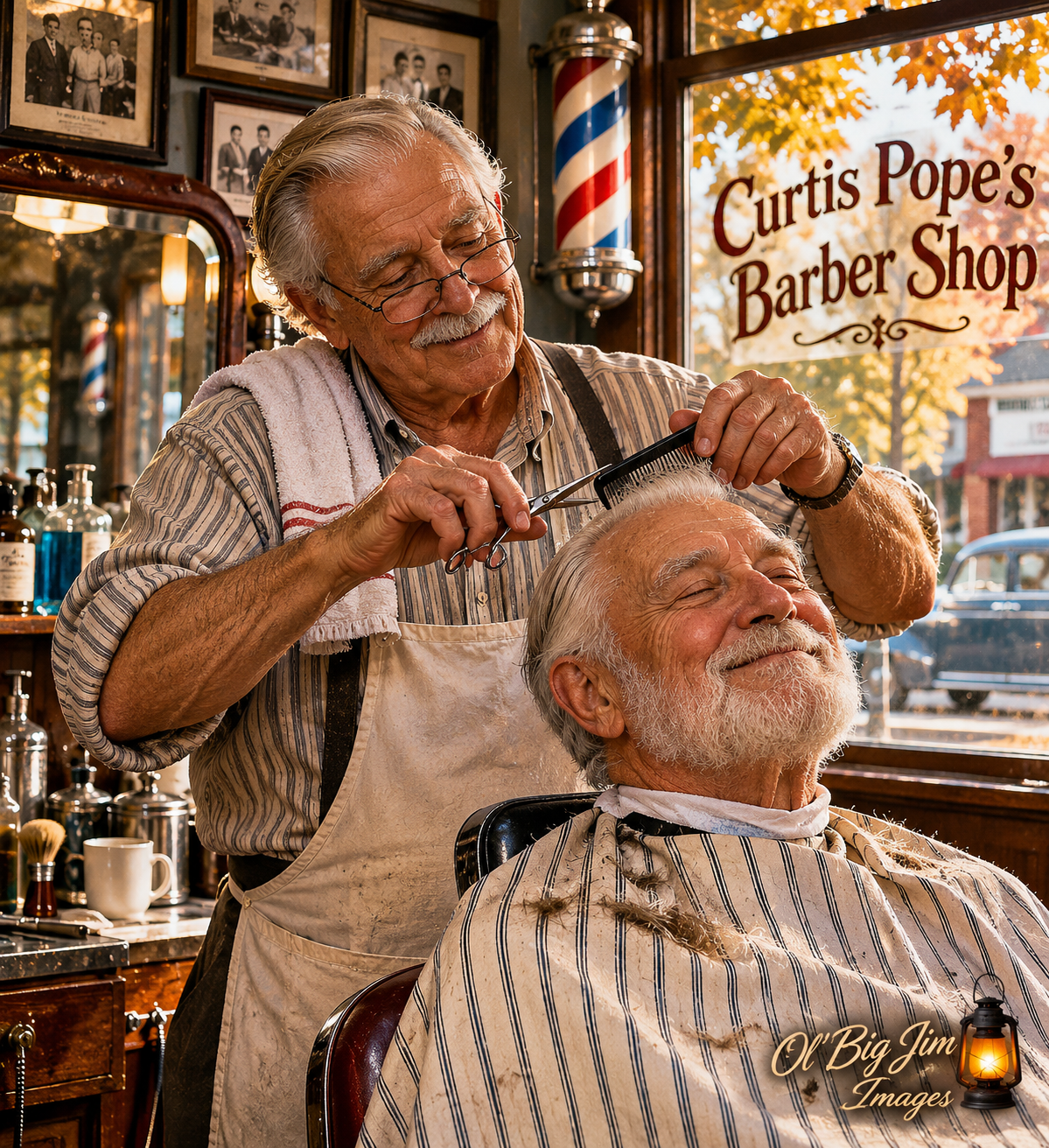
But there was one man Curtis never charged.
His name was Henry Beasley.
Henry was a small, stooped fellow who lived in a little white house on the edge of town, near the road leading toward Dugger Mountain.
He’d worked at the cotton mill until his knees gave out, then spent his retirement tending a vegetable garden and repairing lawn mowers for people who generally couldn’t afford to pay him.
He wasn’t a talkative man.
In fact, Henry could sit through an entire haircut without saying more than six words, and four of those were usually “Mornin’, Curtis” and “Much obliged.”
He came in every other Thursday.
Always at nine o’clock.
Always wearing the same brown felt hat, which he’d remove and place carefully on the empty chair beside the window.
And Curtis would say, “Well, Henry, reckon we ought to see what’s growin’ under there.”
Henry would smile.
Curtis would drape the striped barber cloth around his shoulders.
And fifteen minutes later, Henry would get up, put on his hat, and reach for his wallet.
Every time, Curtis would wave him off.
“Put that thing away.”
“Curtis, I can pay.”
“Didn’t say you couldn’t.”
“Then let me.”
“Nope.”
“Why not?”
“Because I don’t charge for improvements that nobody’s gonna notice.”
Henry would chuckle.
And that was the end of it.
For thirty-eight years.
Now, naturally, people noticed.
Piedmont folks can overlook a great many things, but somebody getting something free when everybody else has to pay is not among them.
One morning, a fellow named Earl Ponder watched Henry leave without paying.
He turned to Curtis.
“How come Henry gets his hair cut for nothin’?”
Curtis swept a little hair into a dustpan.
“Because he does.”
“Well, I been comin’ here twenty years.”
“That’s what the records show.”
“You ever gonna give me a free haircut?”
Curtis looked at him.
“Earl, I’ve seen what you do to a dollar. If I gave you a free haircut, you’d try to get change back.”
The men waiting along the wall burst out laughing.
Earl didn’t appreciate it.
But he paid his twelve dollars.
And Curtis kept cutting Henry’s hair for free.
Nobody knew why.
Some said Henry had once pulled Curtis out of Terrapin Creek.
Others claimed Henry had loaned him money when he opened the shop.
One particularly imaginative gentleman suggested that Henry knew something about Curtis’s activities during a church picnic in 1974.
Curtis denied all three stories.
Especially the church picnic.
“Whatever happened in 1974,” he announced, “is between me, the Lord, and a woman who moved to Gadsden.”
That only made matters worse.
One Thursday in November, Henry didn’t come in.
Curtis noticed immediately.
At nine o’clock, he looked toward the door.
At nine-fifteen, he checked the clock.
At nine-thirty, he asked whether anybody had seen Henry.
Nobody had.
“Probably overslept,” somebody suggested.
“Henry ain’t overslept since 1962,” Curtis replied.
He waited another half hour.
Then he put down his scissors.
“Fellas, I’m closin’ early.”
Earl Ponder looked at the clock.
“It’s ten o’clock.”
“Then I’m closin’ real early.”
Curtis took off his barber’s apron, hung it on the hook behind the door, and drove out toward Dugger Mountain.
Henry’s little white house stood behind a low picket fence.
His vegetable garden had gone to seed for the winter.
A rusty wheelbarrow leaned against the shed.
There was no smoke coming from the chimney.
Curtis knocked.
No answer.
He knocked again.
Still nothing.
He tried the door.
It was unlocked.
“Henry?”
The house was quiet.
Curtis stepped inside.
He found Henry sitting in his favorite chair beside the window.
His brown felt hat rested on the table.
A newspaper lay folded in his lap.
And his eyes were closed.
Curtis knew before he touched him.
Henry Beasley had gone home.
The funeral was held three days later.
Nothing elaborate.
Henry hadn’t wanted anything elaborate.
He’d left instructions for a simple service, a plain casket, and no flowers.
“Flowers are for the livin’,” he’d written. “And if anybody wants to spend money on me, tell ’em to buy somebody a sack of groceries.”
Curtis attended.
So did half the town.
Henry had repaired lawn mowers for widows, fixed bicycles for children, sharpened garden tools for elderly neighbors, and performed a hundred little kindnesses nobody had thought to keep track of.
At the cemetery, Curtis stood beside the grave with his hat in his hands.
He didn’t cry.
Not then.
He simply watched as the casket was lowered.
Then he said quietly, “Much obliged, Henry.”
And went home.
The following Monday, Curtis opened the shop at seven-thirty.
He swept the floor.
Wiped down the mirrors.
Put fresh towels in the cabinet.
And set the coffee pot going.
At nine o’clock, he looked toward the door.
Then remembered.
He stood very still.
After a while, he went into the back room.
There was an old metal filing cabinet beneath a shelf of shaving supplies.
Curtis opened the bottom drawer.
Inside were receipts, photographs, tax records, and a shoebox filled with odds and ends he’d accumulated over the years.
He found what he was looking for.
A little envelope.
Yellowed with age.
On the front, in Henry Beasley’s careful handwriting, were the words:
For Curtis Pope, when the time comes.
Curtis stared at it.
He’d never seen it before.
There was no stamp.
No return address.
Just his name.
He opened it.
Inside was a folded sheet of paper.
And a small brass key.
Curtis unfolded the letter.
Dear Curtis,
If you’re reading this, I reckon I’ve finally missed my appointment.
Don’t go getting sentimental about it. You’ve been telling me for thirty-eight years that my hair wasn’t worth cutting anyway.
Curtis smiled.
Now, I know you’ve been wondering why I never insisted harder on paying you.
Truth is, I figured out a long time ago that you needed to give me those haircuts more than I needed to get ’em.
Curtis frowned.
He read on.
You remember that winter back in 1988?
Your shop nearly went under. Your daddy had just died, your wife was sick, and the bank was making noises about taking the building.
You never told anybody how bad things were.
But I knew.
Curtis lowered the letter.
He remembered.
Lord, how he remembered.
The heating bill.
The overdue mortgage.
The empty appointment book.
The nights he’d sat alone in the barber chair wondering whether he’d have to close the doors.
He returned to the letter.
I knew because I was the one who talked to Mr. Pritchard down at the bank.
I asked him what it would take to keep your shop open.
He told me.
And I paid it.
Curtis stopped breathing.
He read the sentence again.
And I paid it.
The bank had called him one morning in February 1988 and told him his overdue payments had been settled.
Curtis had assumed there’d been some bookkeeping mistake.
The bank manager refused to explain.
He’d spent years wondering who’d helped him.
And now he knew.
Henry.
Quiet little Henry Beasley.
The man who repaired lawn mowers and never had two nickels to rub together.
Curtis’s hands began trembling.
He read on.
You tried to give me my first free haircut a few weeks later.
I knew what you were doing.
You thought I was having a hard time, and you didn’t want to embarrass me by offering charity.
So, you made a joke about my hair and told me to put my wallet away.
I let you.
Not because I needed the money.
But because I figured a man ought to be allowed to give something without somebody making a fuss over it.
Curtis sat down.
The old barber chair creaked beneath him.
And I reckon you ought to know something else.
Every time you cut my hair, I put twelve dollars in a little box at home.
Didn’t spend it.
Didn’t tell anybody.
Just put it away.
I figured one day you might need it.
The key in this envelope opens the little metal box beneath my bed.
Whatever’s in there is yours.
Don’t argue.
You always were a stubborn old mule.
Your friend,
Henry.
Curtis lowered the letter.
For a long time, he sat without moving.
Then he took off his spectacles.
And cried.
Now, Curtis Pope was not a man given to public displays of emotion.
He’d once cut his thumb badly enough to require seven stitches and finished three haircuts before going to the emergency room.
He’d attended funerals, weddings, divorces, and church business meetings without shedding a tear.
But that Monday morning, sitting alone in his barber shop with Henry Beasley’s letter in his hands, he cried like a child.
Eventually, he wiped his face.
Put the letter carefully back in its envelope.
And drove out to Henry’s house.
Henry’s niece, a woman named Louise, was sorting through his belongings.
She greeted Curtis warmly.
“Uncle Henry talked about you all the time.”
Curtis swallowed.
“Did he?”
“Oh, yes. Said you were the best barber in Calhoun County.”
“Well, he was a liar.”
Louise laughed.
Curtis showed her the key.
She nodded.
“I know what that’s for.”
She led him into Henry’s bedroom.
Beneath the bed stood a small gray metal cash box.
Curtis knelt.
Inserted the key.
And opened it.
Inside were envelopes.
Dozens of them.
Each marked with a date.
Each containing twelve dollars.
Thirty-eight years of free haircuts.
Every other Thursday.
Curtis began counting.
Then stopped.
He didn’t need to know the total.
He sat back on his heels.
“That old son of a gun.”
Louise smiled.
“There’s something else.”
She handed him another envelope.
This one contained a bank deposit slip.
Henry had opened a savings account years earlier.
Every Christmas, he’d added a little more.
Sometimes twenty dollars.
Sometimes fifty.
Occasionally a hundred.
The account was designated for the benefit of Curtis Pope.
Curtis stared at the balance.
It wasn’t a fortune.
But it was enough to pay for a new barber chair.
Enough to repair the roof that had been leaking for three years.
Enough to keep the shop open a little longer.
Curtis shook his head.
“Henry, you stubborn old fool.”
Louise touched his shoulder.
“He loved you, Mr. Pope.”
Curtis looked up.
She smiled.
“Uncle Henry said you were the only man in town who ever made him feel like he wasn’t poor.”
Curtis couldn’t speak.
Louise continued.
“He said everybody else was always trying to help him. Giving him things. Doing favors. Making sure he knew they were being generous.”
She paused.
“But you just cut his hair.”
Curtis looked down at the little box.
“And he let me.”
“Yes, sir.”
Curtis closed his eyes.
For thirty-eight years, he’d believed he was doing Henry a kindness.
And for thirty-eight years, Henry had been doing the same for him.
Neither had ever mentioned it.
Neither had ever asked for thanks.
And somehow, that made it worth more.
The following Thursday, Curtis opened the shop as usual.
At nine o’clock, he looked toward the door.
The bell didn’t ring.
Nobody came in wearing a brown felt hat.
Curtis stood behind his chair for a moment.
Then he took a little cardboard sign from beneath the counter.
He’d made it the night before.
He placed it beside the cash register.
It read:
HENRY BEASLEY MEMORIAL HAIRCUT FUND
IF YOU CAN PAY, PAY.
IF YOU CAN’T, SIT DOWN.
NO QUESTIONS ASKED.
Earl Ponder read it.
“What’s this?”
Curtis shrugged.
“Just something I’m trying.”
“You giving away haircuts now?”
“Some.”
“Well, hell, Curtis. You’ll go broke.”
Curtis looked at him.
“Been broke before.”
Earl frowned.
“How’s that supposed to work?”
Curtis picked up his scissors.
“Reckon we’ll find out.”
Earl considered the sign.
Then reached into his wallet.
He took out a twenty-dollar bill.
Placed it on the counter.
“My haircut’s twelve.”
Curtis nodded.
“That’s right.”
“Keep the change.”
Curtis looked at him.
Earl shrugged.
“Put it in Henry’s fund.”
Curtis smiled.
“Much obliged, Earl.”
“Don’t get sentimental.”
“Wouldn’t dream of it.”
Over the next several months, the little fund grew.
Some customers paid extra.
Some paid nothing.
One elderly widow brought Curtis a homemade pecan pie.
A young father who’d lost his job came in with two little boys and left with three fresh haircuts and twenty dollars Curtis insisted he’d found lying on the floor.
Nobody questioned it.
Nobody made a fuss.
And every other Thursday at nine o’clock, Curtis left one appointment open.
Not because he expected Henry to walk through the door.
Not because he believed in ghosts.
But because some habits are worth keeping.
Sometimes he’d sit in the empty chair and drink his coffee.
Sometimes he’d sweep the floor.
Sometimes he’d look toward the window and remember Henry placing that brown felt hat on the chair beside it.
And once in a while, when somebody asked why he never booked an appointment for nine o’clock on alternate Thursdays, Curtis would smile.
“That’s Henry’s time.”
“Henry’s dead, Curtis.”
“I know.”
“Then why keep it open?”
Curtis would look at the empty chair.
Then at the little sign beside the register.
And he’d say, “Because he’s still paying for it.”
Now, I don’t know whether Curtis ever calculated exactly how much Henry had left him.
I don’t know whether that old barber chair ever got replaced.
And I certainly don’t know whether Earl Ponder ever managed to get a free haircut.
Knowing Earl, I suspect he tried.
But I do know this.
For thirty-eight years, two old men sat in a little barber shop in Piedmont, Alabama, each believing he was helping the other.
And neither one understood just how much he was receiving.
That’s a peculiar thing about kindness.
Sometimes the person giving it gets more than the person receiving it.
Sometimes the person receiving it turns out to have been giving all along.
And sometimes the finest things in life are exchanged without anybody ever reaching for a wallet.
Curtis Pope gave Henry Beasley thirty-eight years of free haircuts.
Henry gave Curtis something considerably more valuable.
He gave him a reason to keep the door open.
And every other Thursday at nine o’clock, in that little barber shop across the tracks, there was still a chair waiting for a man in a brown felt hat.
The haircut was free.
The friendship never was.



It says this post is private
Karla Sullivan https://karlasullivandotcom.wordpress.com https://muckrack.com/karla-sullivan https://karlasullivan.com/
LikeLike