A Piedmont Porchlight Story
By Jim L Wright
There are certain things a married man ought never to say to his wife.
He ought never ask whether she’s planning to wear that to church.
He ought never suggest that his mother’s cornbread was better.
And under absolutely no circumstances should he inform a woman who has survived seventy-odd years of life’s aggravations that she’s too old to operate an automobile.
Delbert “Dink” Rhinehart managed to violate that last rule at precisely 8:17 on a Wednesday morning.
By lunchtime, he’d come to regret it.
By supper, he was considering changing his name and moving back to New Orleans.
The trouble began with a 1959 Cadillac Series 62 convertible, a magnificent eighteen and three-quarters-foot monument to American excess that Dink had purchased shortly before returning to Piedmont after forty-six years in Louisiana.
The automobile was cherry red, with white leather seats, enough chrome to blind a low-flying aircraft, and tailfins that looked capable of bringing down a crop duster.
Dink loved that Cadillac.
He polished it every Saturday, checked the oil every Sunday, and occasionally went out to the garage just to look at it.
Ruby had once caught him sitting behind the wheel, listening to the radio with his eyes closed.
“What’re you doin’?”
“Thinkin’.”
“About what?”
“Life.”
“Well, quit thinkin’ about it with the engine runnin’. You’re wastin’ gas.”
On the Wednesday in question, Ruby was standing beside the Cadillac, examining its enormous steering wheel.
“Dink, I believe I’ll take the Cadillac into town this mornin’.”
Dink looked up from the newspaper.
“The Cadillac?”
“Yes, Delbert. That great big red thing out there with the fins. I don’t believe we own another one.”
“Where you goin’?”
“Over to Mabel Jane’s, then down to the Coffee Cup. Might stop by the Fair Store if I see somethin’ worth lookin’ at.”
Dink folded his newspaper.
“Well, honey, I don’t know about that.”
Ruby turned.
“You don’t know about what?”
“About you drivin’ the Cadillac.”
“Why not?”
“Well, it’s a mighty big automobile.”
Ruby waited.
“And it’s got a powerful engine.”
She continued waiting.
“And you ain’t driven a convertible since, what, 1972?”
“That’s right.”
Dink should have stopped there.
He could have said the brakes needed adjusting.
He could have said the tires were low.
He could have announced that the Cadillac had developed a mysterious mechanical ailment requiring immediate attention.
Instead, he said the one thing guaranteed to shorten his remaining life expectancy.
“Ruby, honey, that Cadillac’s a little too much automobile for a woman your age.”
There was a silence.
Not an ordinary silence.
It was the sort of silence that falls over a church fellowship hall when somebody announces that the potato salad has been left in the sun since breakfast.
Ruby looked at him.
“Would you care to repeat that, Delbert?”
Dink sensed danger.
“Well, I just meant…”
“Go on.”
“It’s a big car.”
“So am I, compared to some folks. You got a problem with that, too?”
“No, ma’am.”
“Then I suggest you hand me them keys.”
“Ruby…”
“Delbert.”
Dink surrendered the keys.
History would record this as the last sensible decision he made that morning.
At 10:15, Ruby pulled into Mabel Jane’s driveway.
Or, more accurately, she pulled into the driveway, backed out, pulled in again, decided she didn’t like the angle, backed out a second time, and finally parked the Cadillac across the entire width of the concrete apron.
Mabel Jane came out carrying her purse.
“Good Lord, Ruby! Whose automobile is that?”
“Mine.”
“Since when?”
“Since approximately eight-seventeen this mornin’.”
Mabel Jane walked slowly around the Cadillac.
“Lord, look at them fins.”
“Pretty, ain’t they?”
“Looks like somethin’ Elvis Presley would’ve driven.”
Ruby smiled.
“Get in.”
Mabel Jane hesitated.
“You sure you know how to drive this thing?”
Ruby gave her a look.
“Mabel Jane, I drove automobiles before you learned how to put on lipstick.”
“Well, that ain’t necessarily comfortin’. I’ve seen how you put on lipstick.”
Ruby ignored her.
Mabel Jane climbed into the passenger seat, arranged her pocketbook on her lap, and fastened her seat belt.
Then she fastened it again.
Ruby started the engine.
The Cadillac roared to life.
Mabel Jane jumped.
“Sweet Jesus!”
“It’s just the engine.”
“Sounds like it’s eatin’ another automobile.”
Ruby shifted into drive.
The Cadillac moved forward with all the dignity of a battleship leaving port.
They reached the end of the street.
Ruby stopped.
Looked left.
Looked right.
Looked left again.
Mabel Jane watched her.
“Ruby?”
“What?”
“You plannin’ on goin’ today?”
“I’m checkin’ for traffic.”
“Ain’t been a car past here in ten minutes.”
“Then we’re due for one.”
Eventually, Ruby turned onto the road toward downtown Piedmont.
And somewhere back at the house, Dink Rhinehart developed an uneasy feeling in the pit of his stomach.
The first indication that Piedmont was about to experience an unusual Wednesday arrived when Ruby drove past Curtis Pope’s barbershop with the Cadillac’s convertible top down.
Curtis was sweeping hair off the floor.
He looked up.
Stopped sweeping.
And watched the enormous red automobile glide past with Ruby behind the wheel and Mabel Jane sitting bolt upright beside her.
Curtis set down his broom.
“Well, I’ll be damned.”
Earl Ponder, sitting in the barber chair waiting for a haircut, looked toward the window.
“What?”
“Ruby Rhinehart just drove past in Dink’s Cadillac.”
Earl sat up.
“Dink with her?”
“Nope.”
“Who was?”
“Mabel Jane.”
Earl considered this.
Then he stood.
“Curtis, I believe I’ll come back for that haircut.”
“Where you goin’?”
“To see what happens.”
Curtis watched him leave.
Then he looked at the empty barber chair.
“Well, hell.”
He hung the CLOSED sign on the door.
Some things were more important than cutting hair.
By the time Ruby reached the Coffee Cup, word had already begun spreading through town.
Mrs. Beulah Mae Crabtree saw the Cadillac pass the Congregational Holiness Church and immediately telephoned Eunice Studdard.
“Eunice, you ain’t gonna believe what I just seen.”
“What?”
“Ruby Rhinehart’s drivin’ that red Cadillac.”
“Dink with her?”
“No!”
“Well, Lord have mercy.”
“And Mabel Jane’s ridin’ shotgun.”
There was a pause.
“Beulah Mae?”
“Yeah?”
“I’m puttin’ my shoes on.”
At the Coffee Cup, Ruby parked the Cadillac in front of the restaurant.
It took her three attempts.
The first left the automobile six feet from the curb.
The second put one tire on the sidewalk.
The third was reasonably successful, provided nobody needed to use the parking space behind her.
Mabel Jane climbed out.
Her knees appeared to be considering retirement.
“Ruby, I believe I’ll have coffee.”
“Good idea.”
“And maybe somethin’ sweet.”
“Fine.”
“And perhaps a nerve pill.”
Ruby locked the Cadillac.
“Don’t be dramatic.”
Inside, the Coffee Cup fell silent.
Every head turned.
Ruby looked around.
“What?”
Nobody answered.
She marched to her usual table.
Mabel Jane followed.
The waitress approached.
“Morning, Ruby. Morning, Mabel Jane.”
“Morning, honey.”
“Y’all want the usual?”
“Coffee and a piece of pecan pie,” Ruby said.
Mabel Jane raised one finger.
“Make mine two.”
Meanwhile, Dink Rhinehart had discovered that worrying about an automobile was considerably worse when somebody else was driving it.
He’d tried reading the newspaper.
He’d tried watching television.
He’d even attempted to repair the dripping kitchen faucet.
Nothing helped.
Finally, he telephoned Curtis Pope’s barbershop.
No answer.
He called Earl Ponder.
No answer.
He called the Coffee Cup.
The waitress answered.
“Coffee Cup.”
“Is Ruby Rhinehart there?”
“Yes, sir.”
“Is she all right?”
“Far as I can tell.”
“How’s the Cadillac?”
There was a pause.
“Mr. Rhinehart, I don’t generally examine automobiles while I’m servin’ breakfast.”
“Would you tell Ruby I called?”
“Certainly.”
“And tell her to be careful.”
Another pause.
“Mr. Rhinehart?”
“Yes?”
“I believe I’ll just tell her you called.”
Dink hung up.
He sat down.
Then stood up again.
Napoleon watched from the sofa, thoroughly enjoying the collapse of his principal adversary.
At eleven-thirty, Ruby announced that she intended to drive up toward Dugger Mountain.
Mabel Jane nearly dropped her coffee cup.
“Dugger Mountain?”
“That’s what I said.”
“In that Cadillac?”
“Yes.”
“Ruby, them roads have curves!”
“So do most roads, Mabel Jane. That’s why they put steerin’ wheels in automobiles.”
“But the mountain!”
“What about it?”
“You ain’t driven up there in years.”
Ruby leaned back in her chair.
“Mabel Jane, I believe you and Delbert have both forgotten somethin’.”
“What’s that?”
“I was drivin’ automobiles before either one of you decided I needed supervisin’.”
Mabel Jane opened her mouth.
Then closed it.
She knew that tone.
It was the same tone Ruby used when somebody questioned her cornbread recipe.
There would be no further discussion.
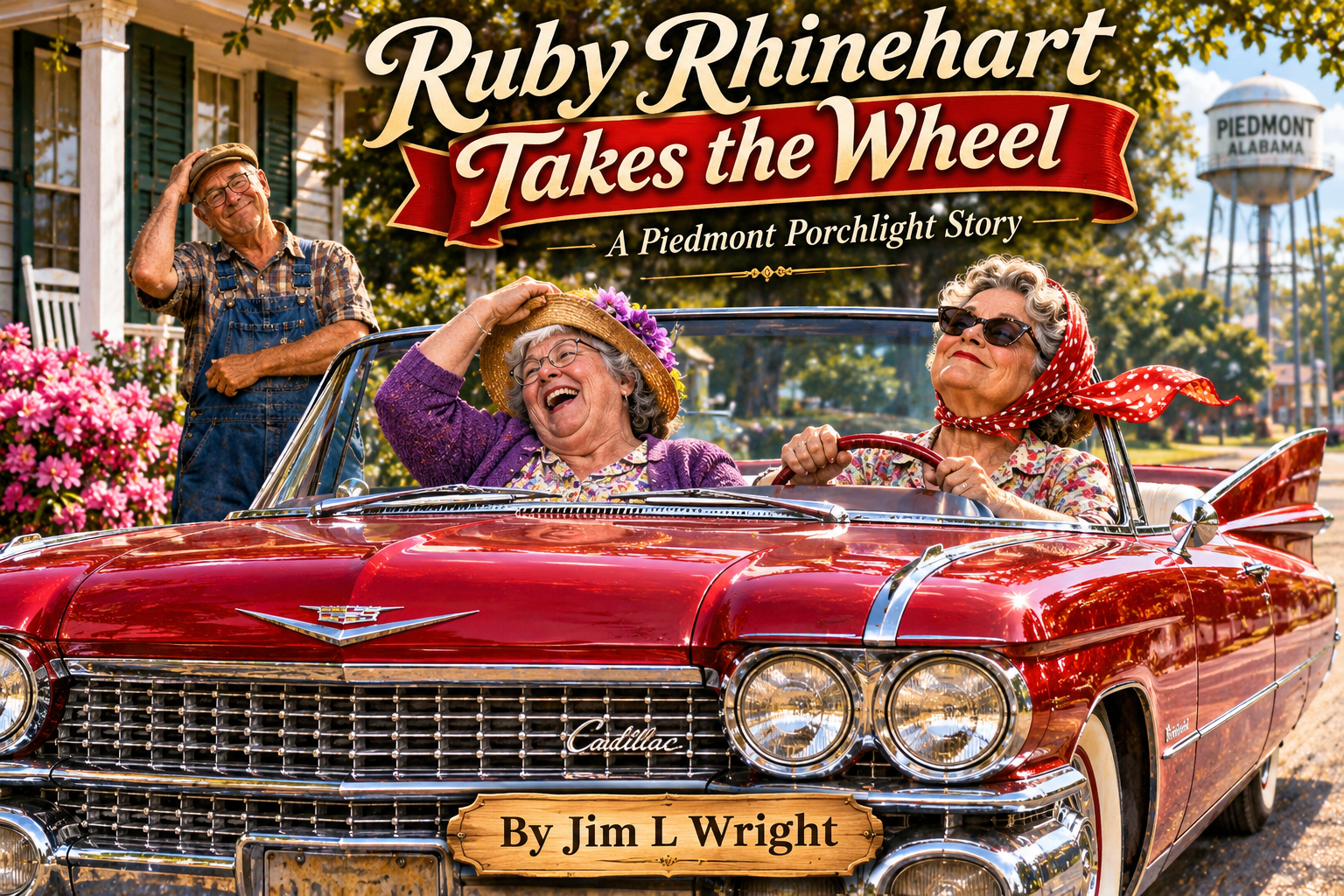
The Cadillac climbed toward Dugger Mountain shortly after noon.
The convertible top was down.
Ruby wore a silk scarf tied beneath her chin and a pair of enormous sunglasses she’d purchased in Birmingham sometime around 1968.
Mabel Jane wore an expression of profound spiritual concern.
“Ruby?”
“What?”
“You reckon we ought to put the top up?”
“Why?”
“Wind’s messin’ up my hair.”
“Should’ve worn a scarf.”
“I didn’t know we was goin’ mountain climbin’ in a red battleship!”
Ruby laughed.
The Cadillac rounded a curve.
Mabel Jane grabbed the dashboard.
“LORD!”
“What now?”
“Nothin’. Just practicin’.”
They continued climbing.
And somewhere between the third and fourth switchbacks, Ruby began to remember something.
Not the road.
Not the Cadillac.
Herself.
The woman who’d once driven a convertible down Highway 21 with the radio playing, the wind in her hair, and absolutely no concern about what anybody thought.
The woman who’d waited forty-six years for Delbert Rhinehart but hadn’t spent those years standing still.
She’d lived.
She’d worked.
She’d laughed and cried and buried people she loved.
She’d made decisions, paid bills, fixed things that broke, and managed her own life without asking anybody’s permission.
And now her husband, whom she loved more than she’d ever admit in public, had suggested that she was too old to drive an automobile.
Well.
Ruby smiled.
She pressed the accelerator just a little.
The Cadillac responded with a deep, satisfied rumble.
Mabel Jane closed her eyes.
“Ruby?”
“Hmm?”
“If I die up here, tell my sister she can have my good china.”
“You ain’t gonna die.”
“And tell Earl Ponder he still owes me three dollars.”
“Mabel Jane!”
“What?”
“Would you hush and enjoy the ride?”
Mabel Jane opened one eye.
Looked out across the mountains.
The autumn trees were burning red and gold beneath a sky so blue it hardly seemed real.
The wind tugged at her hair.
And somewhere beneath the fear, something stirred.
She smiled.
Just a little.
“Well,” she admitted, “it is kinda pretty.”
Ruby grinned.
“Now you’re talkin’.”
At two-fifteen, the Cadillac returned to Piedmont.
Ruby drove straight home.
Dink was standing in the driveway.
He’d been standing there for at least twenty minutes, although he would later deny it.
The Cadillac rolled to a stop.
Ruby switched off the engine.
For a moment, nobody moved.
Then Mabel Jane climbed out.
Her hair looked like she’d spent the afternoon wrestling a leaf blower.
Her face was flushed.
And she was smiling.
“Dink,” she said, “your wife is a menace.”
Dink looked horrified.
“What happened?”
“Nothin’,” Ruby said.
Mabel Jane continued.
“We went up Dugger Mountain.”
“YOU WHAT?”
“And we had the top down.”
Dink closed his eyes.
“Lord, give me strength.”
“And Ruby drove like she was twenty-five again.”
Ruby climbed out.
“Don’t exaggerate, Mabel Jane. I drove like I was thirty.”
Mabel Jane laughed.
Then she leaned over and kissed Ruby on the cheek.
“Thank you, honey.”
Ruby looked surprised.
“For what?”
“For remindin’ me I ain’t dead yet.”
And with that, Mabel Jane walked home, carrying her pocketbook and a considerably improved opinion of Wednesday afternoons.
Dink examined the Cadillac.
He walked around it once.
Then again.
He checked the tires.
Looked at the chrome.
Ran his hand along the enormous tailfin.
Ruby watched him.
“Find anything wrong?”
“No.”
“Anything scratched?”
“No.”
“Anything bent?”
“No.”
“Then what’s the problem?”
Dink looked at her.
“Ruby, honey, I was just worried about you.”
She softened.
Just a little.
“I know, Delbert.”
“It’s a big automobile.”
“I know that, too.”
“And them mountain roads…”
“Dink.”
He stopped.
Ruby stepped closer.
“I’ve spent most of my life bein’ careful. Careful with money, careful with people, careful not to make a fool of myself.”
She glanced toward the Cadillac.
“But I ain’t dead yet, and I don’t intend to spend whatever years I’ve got left sittin’ in the passenger seat.”
Dink looked at her for a long moment.
Then he smiled.
“Well, honey, I reckon you got a point.”
Ruby nodded.
“I generally do.”
He reached into his pocket.
Pulled out the Cadillac’s spare keys.
And handed them to her.
“Reckon you ought to have your own set.”
Ruby looked down at the keys.
Then back at her husband.
For a moment, she didn’t say anything.
Finally, she smiled.
“Thank you, Delbert.”
Dink put his arm around her.
“Just promise me one thing.”
“What’s that?”
“Next time you go up Dugger Mountain, take me with you.”
Ruby considered this.
Then she shook her head.
“Nope.”
Dink blinked.
“No?”
“No, sir.”
“Why not?”
Ruby smiled sweetly.
“Because, Delbert Rhinehart, that Cadillac’s a little too much automobile for a man your age.”
That evening, Dink sat in his favorite chair, nursing a glass of sweet tea and contemplating the mysterious workings of marriage.
Napoleon occupied the sofa.
Ruby was in the kitchen, humming something that sounded suspiciously like an old rock-and-roll tune.
Dink looked toward the cat.
“Napoleon, I believe I’ve married a dangerous woman.”
Napoleon yawned.
Dink sighed.
“And the worst part is, I believe I like it.”
From the kitchen came Ruby’s voice.
“I HEARD THAT!”
Dink smiled.
Outside, the red Cadillac sat gleaming beneath the porch light.
Its chrome shone.
Its tailfins pointed toward the stars.
And somewhere in the house, a woman who’d been told she was too old to drive it was already planning where she’d go next.
Because age, I reckon, is a peculiar thing.
It’ll tell you what you ought to stop doing.
It’ll remind you what you used to be.
But every now and then, if you’re fortunate, somebody will hand you a set of keys and remind you that the road ahead is still yours to travel.
Even if you have to scare the everlasting hell out of Mabel Jane to prove it.
The End


😂😂😂
LikeLiked by 1 person