A Piedmont Porchlight Story
By Jim L Wright
My Aunt Mary used to insist that the road to hell is paved with good intentions.
Well, I don’t know about hell, but I can tell you for certain that the road to matrimony sometimes starts with a pecan pie delivered to the wrong house.
And if Earl Ponder is doing the delivering, there’s no telling where it’ll end.
This particular calamity began on the Tuesday before Thanksgiving, when Miss Beulah Mae Pritchett baked what she considered the finest pecan pie ever to emerge from a Piedmont kitchen.
Now, Beulah Mae was not a woman given to modest assessments of her own cooking.
She’d been making pecan pies for forty-seven years, and in all that time she’d never once admitted that anybody else’s was better.
Not even her mother’s.
Especially not her mother’s, although she’d never have dared to say so while the woman was alive.
Beulah Mae’s pies had won ribbons at church suppers, county fairs, and one unfortunate baking competition in Jacksonville where one judge had the temerity to suggest that her crust was a trifle thick.
She’d written the man’s name in the back of her Bible.
She didn’t write it on the prayer list, either.
On Tuesday morning, Beulah Mae had a problem.
She’d promised to send a pecan pie to her sister, Mary Lou, who lived over on the other side of town, but her automobile had developed what the mechanic described as an electrical problem and what Beulah Mae described as “a deliberate act of rebellion.”
So, when Earl Ponder happened by, she enlisted his services.
“Earl, I need you to take this pie over to Mary Lou’s.”
Earl looked at the pie.
“What’s in it?”
“Pecans, Earl.”
“I can see that. I meant what else.”
“Things that don’t concern you.”
“Well, I was just askin’.”
“And don’t you go stickin’ your finger in it.”
Earl looked offended.
“Beulah Mae, I am seventy-three years old.”
“And you’ve been stickin’ your fingers in other people’s food for every one of ’em.”
She handed him a carefully wrapped pie and a slip of paper.
“Here’s the address. Four-oh-one Fagan Street.”
Earl examined the paper.
“Looks like forty-one.”
“It’s four oh one, Earl.”
“You sure?”
“Earl Ponder, I reckon I ought to know where my own sister lives.”
“Well, I reckon you ought to.”
And with that, Earl took possession of the pie.
Which was the last time anybody involved in the matter had a clear understanding of where it was supposed to go.
Now, Walter P. Treadaway lived at One-oh-four Fagan Street.
Walter was seventy-nine years old, a widower of twelve years, and a man whose daily routine was so predictable that you could have set the depot clock by it, back when there was a depot clock worth setting.
He rose at six.
Made his bed.
Ate two pieces of toast, one fried egg, and half a grapefruit.
Read the newspaper.
Complained about something in it.
Then spent the rest of the morning finding something else to complain about.
He was not an unpleasant man.
He simply believed that a day without at least one complaint was a day insufficiently examined.
At eleven-fifteen Tuesday morning, Walter heard somebody knocking at his front door.
He opened it to find Earl Ponder holding a pecan pie.
“Walter.”
“Earl.”
“Got somethin’ for you.”
Walter looked at the pie.
“What’s that?”
“Looks like a pecan pie.”
“I can see that. Who’s it from?”
Earl scratched his head.
“Beats me.”
“What do you mean, beats you?”
“Woman gave it to me.”
“What woman?”
“Beulah Mae Pritchett.”
“Then why didn’t you say so?”
“Because I don’t reckon she baked it for you.”
Walter stared at him.
“Earl, are you feelin’ all right?”
“Never better.”
Earl handed him the pie.
“Anyway, here it is.”
And before Walter could ask another question, Earl had shuffled off back to his truck.
Walter stood in the doorway holding a pecan pie that had arrived without explanation.
He considered the possibilities.
Then he remembered that Clara Bell Whitcomb had spoken to him after church the previous Sunday.
Well, Clara Bell must’ve asked Beulah Mae to bake it. That made perfect sense to Walter, who’d never known Clara Bell to be much of a hand at cooking.
She’d asked whether he had plans for Thanksgiving.
He’d told her he didn’t.
She’d said that was a shame.
And now, two days later, here was a pie.
Well.
Walter wasn’t born yesterday.
He’d been born considerably before yesterday, as a matter of fact, and he knew perfectly well what a pecan pie meant when it arrived unexpectedly at a widower’s front door.
At least he thought he did.
By noon, Walter had eaten one slice.
By one o’clock, he’d eaten another.
By three, he’d decided that whoever had baked the pie deserved a letter of appreciation.
And by supper, there wasn’t enough left to identify the original shape of the blessed thing.
Walter sat at his kitchen table with his best stationery.
He wrote slowly, carefully, and with the sort of attention usually reserved for legal documents and letters to the Internal Revenue Service.
Dear Clara Bell,
I don’t believe anybody’s ever made me feel quite so remembered on Thanksgiving. The pie was wonderful, but the thought behind it was even sweeter.
Yours truly,
Walter P. Treadaway
He read it twice.
Then he added a postscript.
P.S. I particularly enjoyed the pecans.
He considered adding something about the crust.
Decided that might be getting personal.
And mailed the letter.
Clara Bell Whitcomb received Walter’s note on Wednesday afternoon.
She read it once.
Then again.
Then a third time, just to make certain she hadn’t misunderstood.
Walter Treadaway was thanking her for a pie.
A pecan pie.
Which was remarkable, considering Clara Bell hadn’t baked a pecan pie since 2018, when she’d accidentally left one in the oven during a telephone conversation and produced something that could have been used to resurface Highway 9.
She sat down.
Read Walter’s letter again.
And smiled.
Now, Clara Bell had admired Walter Treadaway from afar for fifteen years.
She liked the way he always stood when a lady approached his table.
She liked the way he polished his shoes.
She even liked the way he complained about the price of groceries, although she’d privately thought he could stand to complain a little less and smile a little more.
But Walter had never shown the slightest inclination toward courtship.
Until now.
Clara Bell studied the letter.
The thought behind it was even sweeter.
Well, now.
That was practically poetry.
She fetched her own stationery.
Dear Walter,
I’m so pleased you enjoyed the pie. It’s always nice to know that a little kindness can make somebody’s day brighter.
Perhaps we might have coffee together sometime.
Fondly,
Clara Bell
She stared at the word Fondly for several minutes.
Then she underlined it.
Twice.
Meanwhile, Beulah Mae Pritchett had discovered that her sister Mary Lou had not received the pie.
This discovery occurred during a telephone conversation that began pleasantly and deteriorated with remarkable speed.
“Mary Lou, how’d you like that pecan pie?”
“What pecan pie?”
“The one I sent you.”
“You ain’t sent me no pie.”
“I most certainly did.”
“Well, I most certainly didn’t get it.”
“Earl Ponder took it over there yesterday.”
“Then Earl Ponder ate it.”
“Earl wouldn’t dare.”
“Beulah Mae, Earl Ponder would eat the flowers off a funeral wreath if somebody put enough sugar on ’em.”
Beulah Mae hung up.
Called Earl.
And asked him a question that cannot be repeated in its entirety in a respectable family publication.
Earl maintained his innocence.
“I took it to the address you gave me.”
“Four-oh-one Fagan Street?”
“That’s right.”
“Then why didn’t Mary Lou get it?”
“Maybe she wasn’t home.”
“Earl, she lives there!”
“Well, I can’t account for everybody’s whereabouts.”
“Who answered the door?”
“Walter Treadaway.”
There was a silence.
Then Beulah Mae spoke in a voice that could have stripped paint off a battleship.
“WALTER TREADAWAY?”
“Yes, ma’am.”
“Walter Treadaway lives at ONE-OH-FOUR Fagan Street!”
Earl considered this.
“Well, that’s close.”
“CLOSE?”
“Same numbers.”
“EARL PONDER, YOU DELIVERED MY PIE TO THE WRONG HOUSE!”
“Now, Beulah Mae, let’s not get excited.”
“EXCITED?”
“I can hear you fine.”
And with that, Earl hung up.
Which was probably the wisest decision he’d made all week.
By Wednesday evening, the missing pie had become a matter of considerable public interest.
At Curtis Pope’s barbershop, Earl explained that the problem was Beulah Mae’s handwriting.
“She wrote the numbers backward.”
Curtis looked at him.
“One-oh-four and four-oh-one ain’t backward, Earl. They’re completely different numbers.”
“Same difference.”
“No, it ain’t.”
“Well, it’s the same two numbers.”
Curtis set down his scissors.
“Earl, if I owed you a hundred and four dollars and gave you four hundred and one, would that be the same difference?”
Earl thought about it.
“No, but I’d appreciate it.”
Meanwhile, Beulah Mae had informed Mabel Jane Hensley that her prizewinning pecan pie had been stolen.
“Stolen?” Mabel Jane asked.
“Practically.”
“Who stole it?”
“Walter Treadaway.”
“Walter Treadaway wouldn’t steal a pie.”
“Well, he ate it!”
“That don’t mean he stole it.”
“It wasn’t his!”
“Did he know that?”
“He ought to have!”
Mabel Jane folded her arms.
“Beulah Mae, you can’t blame a man for eatin’ a pie somebody hands him.”
“Oh, yes, I can!”
“Well, that’s your problem.”
And just like that, the two ladies were no longer speaking.
Again.
This was becoming such a regular occurrence that Preacher Boone had considered adding a special reconciliation service to the church calendar.
On Thanksgiving morning, Walter Treadaway received Clara Bell’s reply.
He read it standing beside the mailbox.
Then he sat down on the porch swing and read it again.
Perhaps we might have coffee together sometime.
Fondly.
Underlined twice.
Walter removed his glasses.
Cleaned them.
Put them back on.
And examined the word once more.
Well, I swanee.
At seventy-nine years old, Walter Treadaway appeared to have acquired himself a sweetheart.
And all because of a pecan pie.
He went inside and telephoned Clara Bell.
“Clara Bell?”
“Walter!”
“I got your letter.”
“Oh, good.”
“I was wonderin’…”
“Yes?”
“Would you care to come over for Thanksgiving dinner?”
There was a pause.
Then Clara Bell said, “Why, Walter, I’d be delighted.”
Walter smiled.
“Wonderful.”
“What time?”
“Six o’clock.”
“I’ll be there.”
He hung up.
Stood in his kitchen.
Looked at the clock.
And experienced a sensation he hadn’t felt since the day he’d accidentally locked himself out of the house wearing nothing but his bathrobe.
Panic.
Because Walter had just invited a lady to Thanksgiving dinner.
And Walter couldn’t cook.
Not a lick.
His first telephone call was to Curtis Pope.
“Curtis, how do you cook a turkey?”
Curtis, who was at home enjoying a rare Thanksgiving morning without customers, nearly dropped the telephone.
“Walter, why in the name of all that’s holy would you want to cook a turkey?”
“Got company comin’.”
“What kind of company?”
“Lady company.”
Curtis sat down.
“Walter Treadaway, have you finally lost your natural mind?”
“Just tell me how to cook the turkey.”
“Well, first you thaw it.”
Walter frowned.
“Thaw it?”
“Yes, thaw it.”
“Why?”
“Because you can’t cook a turkey froze solid!”
Walter looked toward his freezer.
“How long does that take?”
“Depends on the size.”
“About fifteen pounds.”
Curtis closed his eyes.
“Walter, when’s she comin’?”
“Six o’clock.”
“Tonight?”
“Yes.”
“Walter, you don’t need a recipe. You need a miracle.”
By eleven o’clock, Curtis Pope had called his wife.
His wife had called her sister.
Her sister had called Beulah Mae Pritchett.
And Beulah Mae had called Preacher Boone.
By noon, approximately half of Piedmont knew that Walter Treadaway had invited Clara Bell Whitcomb to Thanksgiving dinner.
The other half knew by twelve-fifteen.
And everybody had an opinion.
Beulah Mae insisted that Walter had no business inviting a woman to dinner when he couldn’t cook.
Mabel Jane said that was ridiculous because plenty of married men couldn’t cook and had been getting away with it for generations.
Earl Ponder suggested Walter order a pizza.
Preacher Boone suggested prayer.
Curtis Pope suggested calling the National Guard.
And Walter, who had no idea his personal affairs had become the subject of a town-wide emergency, was standing in his kitchen examining a frozen turkey with the expression of a man who’d just discovered an unexploded artillery shell.
At one-thirty, the doorbell rang.
Walter opened it to find Beulah Mae Pritchett standing on his porch.
She was carrying a roasting pan.
Behind her stood Mabel Jane Hensley, holding a covered casserole dish.
The two women were not speaking.
They had apparently agreed, however, that allowing Walter to cook Thanksgiving dinner was a threat to public safety.
“Move aside,” Beulah Mae commanded.
Walter moved.
Mabel Jane marched past him.
Beulah Mae followed.
“Where’s the turkey?”
Walter pointed toward the kitchen.
“In there.”
“Is it thawed?”
“No.”
Beulah Mae closed her eyes.
“Lord, give me strength.”
Mabel Jane opened the freezer.
Looked at the turkey.
And said, “Well, at least he ain’t tried to cook it yet.”
Beulah Mae glared at her.
“I thought we weren’t speaking.”
“We ain’t. I was talkin’ to the turkey.”
By three o’clock, Walter’s kitchen had become a battlefield.
Beulah Mae was supervising the preparation of a ham she’d brought from home.
Mabel Jane was making dressing.
Walter was peeling potatoes under strict supervision.
And Earl Ponder, who’d arrived uninvited, was sitting at the kitchen table eating pickles from a jar.
“Earl,” Beulah Mae snapped, “what are you doin’ here?”
“Heard there was an emergency.”
“Well, there is.”
“Thought I might help.”
“Then get out of the kitchen.”
Earl considered this.
“Could I take some pickles with me?”
“TAKE THE WHOLE JAR!”
Earl did.
At five-thirty, the house smelled wonderful.
The table was set.
The ham was ready.
The potatoes were mashed.
The dressing was golden brown.
And Walter Treadaway, wearing his best suit and a tie he’d spent twenty minutes trying to straighten, stood before the hallway mirror.
He looked nervous.
He looked hopeful.
And he looked considerably younger than he had that morning.
At five-fifty-eight, Clara Bell Whitcomb arrived.
She wore a blue dress, a little pearl necklace, and a smile that made Walter forget approximately half the English language.
“Clara Bell.”
“Walter.”
“You look…”
“Yes?”
“Real nice.”
She blushed.
“Thank you.”
Walter took her coat.
And for the first time in twelve years, his house felt like it was waiting for somebody.
Dinner was wonderful.
Not because Walter had cooked it.
He hadn’t.
Not because everything went according to plan.
It hadn’t.
But because Clara Bell laughed at his stories.
And Walter listened when she talked.
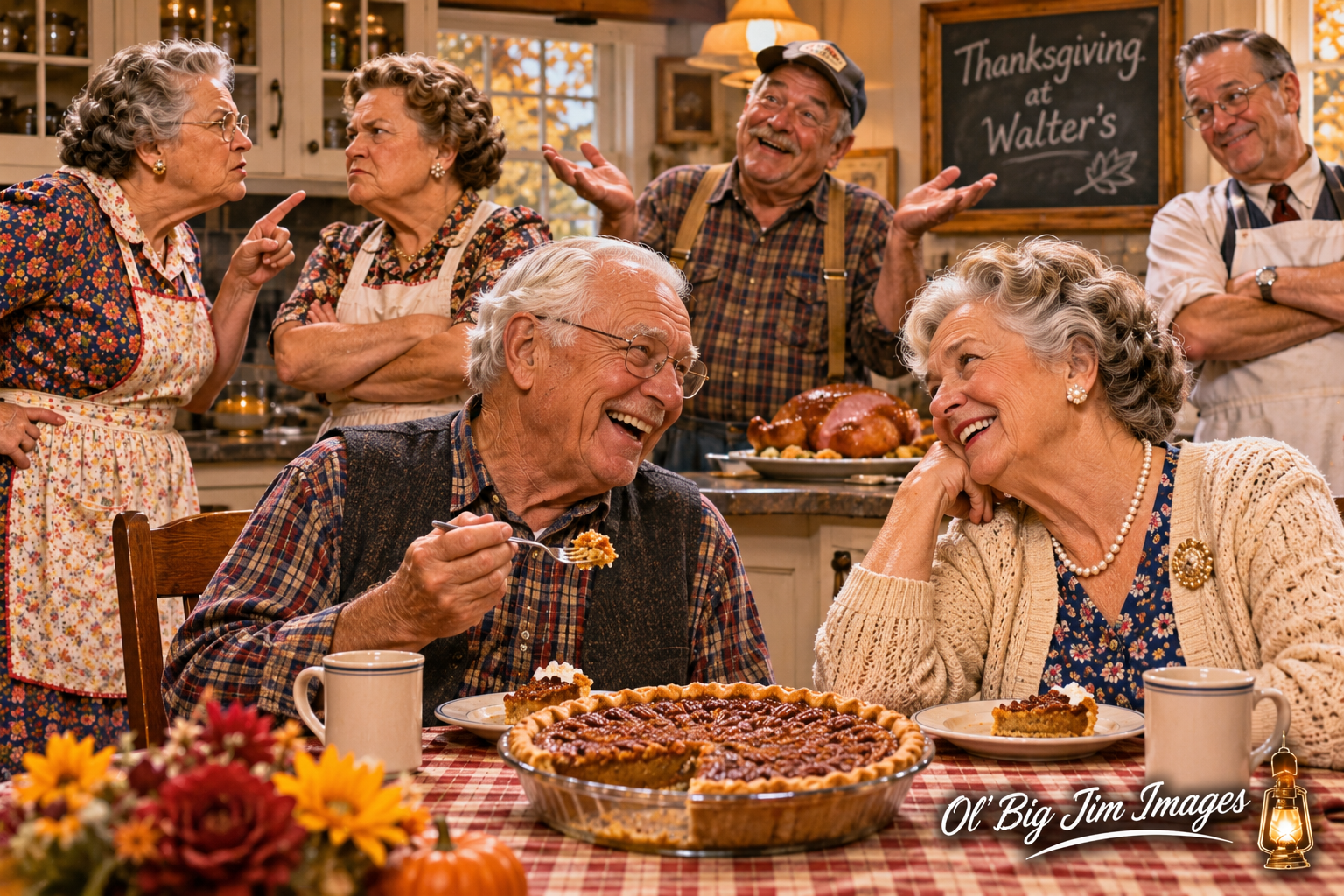
And somewhere between the ham and the sweet potatoes, they discovered that they both liked old movies, disliked television commercials, and thought the world had gotten entirely too complicated for its own good.
After dinner, Walter brought out the dessert.
A pecan pie.
Beulah Mae had delivered a replacement that afternoon, accompanied by a warning that Earl Ponder was never again to be trusted with anything more valuable than a grocery receipt.
Clara Bell looked at the pie.
Then at Walter.
And smiled.
“Walter, there’s somethin’ I ought to tell you.”
He set down the plates.
“What is it?”
“I didn’t bake that first pie.”
Walter blinked.
“You didn’t?”
“No.”
“Then who did?”
“Beulah Mae Pritchett.”
Walter stared at her.
“Beulah Mae?”
Clara Bell nodded.
“Earl delivered it to the wrong house.”
Walter sat down slowly.
“Well, I’ll be.”
Clara Bell folded her hands.
“I knew you thought it was from me.”
“You did?”
“Yes.”
“Then why didn’t you say somethin’?”
She smiled.
“Because, Walter, I’ve been waitin’ fifteen years for you to write me a letter, and I wasn’t about to let a pecan pie spoil it.”
Walter looked at her.
Then he began to laugh.
Not a little chuckle.
A great, wonderful, rolling laugh that seemed to come from somewhere deep inside him.
Clara Bell joined in.
And before long, they were both laughing so hard that Walter had to take off his glasses and wipe his eyes.
Finally, he reached across the table.
Took her hand.
And said, “Clara Bell, would you care to have supper with me again sometime?”
She squeezed his hand.
“Walter Treadaway, I thought you’d never ask.”
Now, I reckon that ought to have been the end of it.
But this was Piedmont.
And Piedmont has never been particularly interested in leaving well enough alone.
By Friday morning, Earl Ponder was taking credit for the entire romance.
“If I hadn’t delivered that pie, Walter’d still be sittin’ home by hisself.”
Beulah Mae was furious.
“You delivered it to the wrong house!”
“Exactly.”
“That wasn’t the plan!”
“Well, it worked out better than your plan.”
Mabel Jane, who had resumed speaking to Beulah Mae long enough to hear this exchange, said, “He’s got a point.”
Beulah Mae turned on her.
“Don’t you start!”
And the two women stopped speaking again.
At Curtis Pope’s barbershop, Walter’s romance was the principal subject of discussion.
Curtis asked whether he intended to marry Clara Bell.
Walter smiled.
“Reckon we’ll see.”
Earl Ponder leaned back in his chair.
“Just remember, Walter. You owe it all to me.”
Walter considered this.
Then he nodded.
“Earl, I reckon I do.”
Earl beamed.
“See there?”
Walter continued.
“And if I ever get married again, I’m gonna let you deliver the invitations.”
Earl looked delighted.
“Why, I’d be honored!”
Walter smiled.
“Figure that way, at least half the people won’t show up.”
And that, as best I can recollect, is how a pecan pie intended for four-oh-one Fagan Street wound up at One-oh-four, started a feud, rescued a Thanksgiving dinner, and brought two lonely people together.
Beulah Mae eventually forgave Earl.
Mabel Jane eventually forgave Beulah Mae.
And Walter Treadaway eventually learned to make a decent pot of coffee, although Clara Bell insisted on supervising.
As for Earl Ponder, he never did admit he’d made a mistake.
In fact, he maintained until the day he died that he’d delivered that pie exactly where Providence intended it to go.
And I reckon, for once in his life, Earl might have been right.
Because that Thanksgiving, Walter Treadaway learned two important things.
The first was that a pecan pie could change a man’s life.
And the second was that he ought to send Earl Ponder a Christmas card.
Preferably by mail.
Because there wasn’t a soul in Piedmont who trusted that man to deliver it.