(Who Would Like It Known That Certain Events Were Not Covered)
I was assigned to Pecos Bill’s territory in the spring of 1883.
By the time autumn wandered in, I no longer believed weather was a naturally occurring phenomenon.
The Assignment
At the time, I was considered one of the company’s more promising adjusters.
Detail-oriented.
Reliable.
Capable of distinguishin’ between flood damage and wind damage.
This was before I learned there existed a third category.
The First Claim
The first claim arrived in April.
A farmer reported the loss of a barn.
Cause of damage:
“Cowboy.”
Naturally, I assumed the man was drunk.
I denied the claim.
Three days later I visited the property.
The barn was gone.
Not damaged.
Gone.
The farmer pointed toward the horizon.
I looked.
The barn was approximately two counties away.
An Explanation Is Offered
I asked what happened.
The farmer sighed.
The way a man sighs when explainin’ the obvious.
Then he said:
“Bill was practicin’.”
Now you’ll notice that this statement explains absolutely nothin’.
Yet everybody present appeared satisfied.
The Tornado Matter
The next incident involved weather.
Or what I believed was weather.
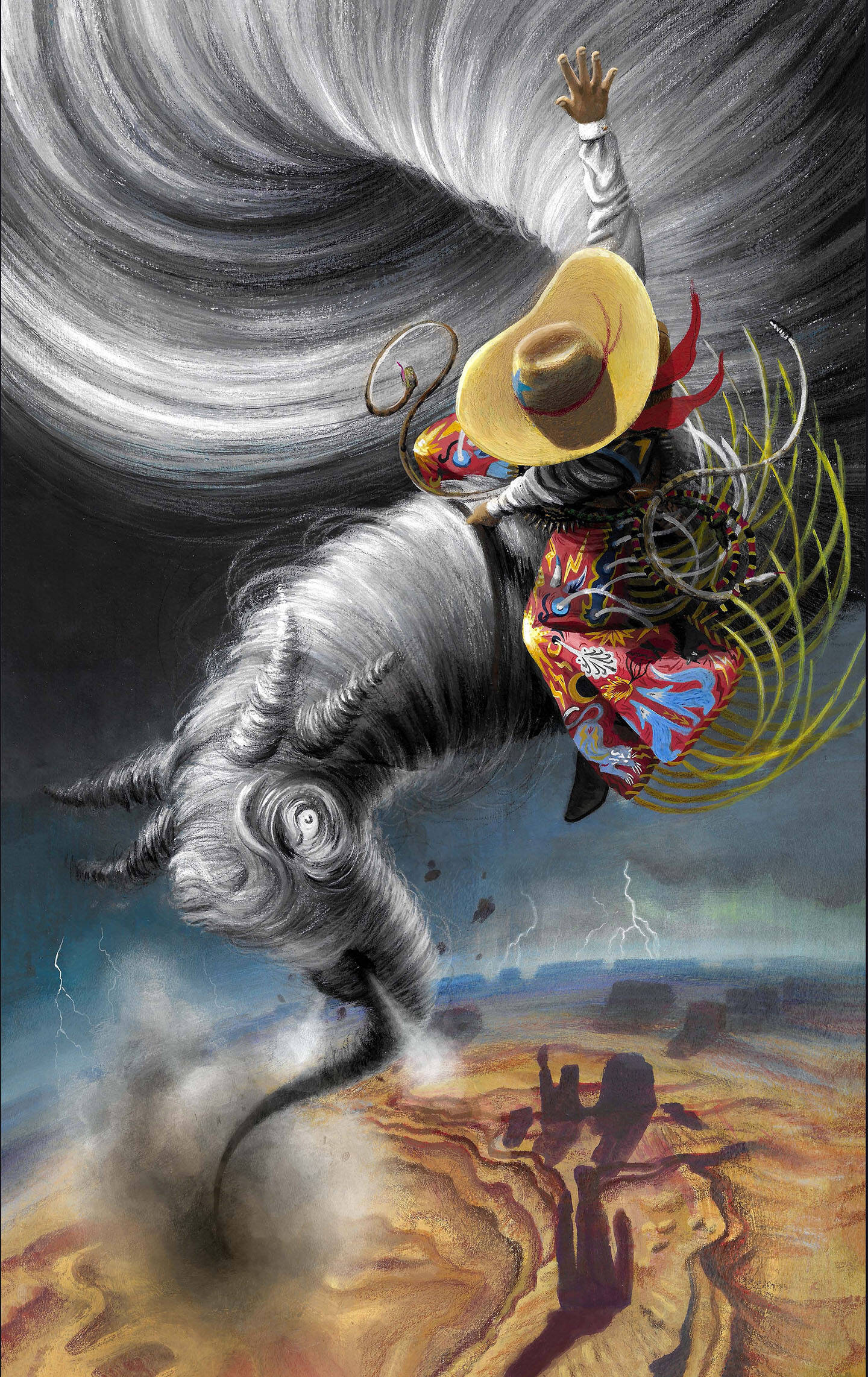
Several witnesses reported observin’ Mr. Bill ridin’ a tornado.
At speed.
Using a saddle.
Now company policy contains extensive language concernin’:
- hail
- lightning
- floods
- fire
There is surprisingly little guidance regardin’ recreational cyclone usage.
The Committee Meeting
Back at headquarters I filed my report.
The claims committee read it.
Silently.
Then the chairman asked:
“Are you serious?”
I replied:
“I used to be serious, but that was before I entered Pecos Bill’s territory.
Now I’m merely reportin’.”
Claim #47
Cause of Loss:
Atmospheric relocation of cattle.
The policyholder alleged that a tornado carrying Mr. Bill had inadvertently transferred thirty-two head of livestock into Oklahoma.
Investigation confirmed the cattle.
Investigation also confirmed Oklahoma.
Claim #63
Cause of Loss:
Excessive rope deployment.
Now this one was unusual even by local standards.
Apparently, Mr. Bill had attempted to rope a thundercloud.
Why?
The witnesses disagreed.
One claimed he was conductin’ research.
Another said he was just bored.
Frankly, given what I’ve learned recently, both explanations seemed equally plausible.
The River Incident
I arrived at a ranch to inspect flood damage.
Only to discover there was no river.
The rancher informed me there had once been a river.
A very good river.
Dependable.
Predictable.
Then Bill had gotten involved.
The river now occupied an entirely different valley.
When asked why, the rancher shrugged and said:
“Seemed like a good idea at the time.”
I did not inquire whose idea.
I already knew.
A Professional Breakdown
By July I had developed a system.
Every new claim was placed into one of three categories:
Category A
Normal weather.
Category B
Livestock.
Category C
Pecos Bill.
Category C soon required its own filing cabinet.
The Final Straw
The event that ended my career occurred in late August.
A ranch owner submitted a claim for damages caused by what he described as:
“Experimental weather cowboyin’.”
Now there comes a point in every man’s life when his faith is tested.
Mine arrived in triplicate.
The Investigation
I traveled to the site.
Interviewed witnesses.
Reviewed evidence.
Measured impact areas.
And after three days of work, I reached the only conclusion available.
The claim was accurate.
Every word of it.
My Resignation
Upon returning to headquarters, I submitted a letter.
It read:
Dear Sirs,
I have devoted fourteen years to the insurance profession.
During that time, I have successfully evaluated floods, fires, storms, and acts of God.
I am no longer qualified to evaluate acts of Pecos Bill.
Respectfully,
Hiram T. Wainwright
Closing Observation
Now people often ask whether the stories about Pecos Bill are true.
To which I reply:
I certainly hope not.
Because if even half of them happened…
The laws of nature are nothing more than suggestions.
Final Note
I still receive correspondence from former clients.
Every now and then a letter arrives describin’ some impossible event.
A mountain moved.
A cloud behaved suspiciously.
A creek developed opinions.
And at the bottom of the page, without fail, are the same three words:
“Bill was involved.”
And that, as near as I can determine from the surviving records, is how I became the only insurance adjuster in American history to classify a natural disaster as a repeat customer.



Awesome story about Pecos Bill’s insurance adjuster, Jim!
LikeLiked by 1 person
Thanks, Tim!
LikeLiked by 1 person
You’re welcome, Jim! 😊
LikeLiked by 1 person