
A Piedmont Porchlight Story
There was a fellow who used to come to Piedmont every October. Nobody knew exactly when he’d started coming, and nobody seemed particularly interested in finding out. That’s the thing about Piedmont. A body can do something peculiar for forty years, and eventually folks just accept it as part of the natural order of things. Like the train whistle. Or the smell of biscuits coming out of the Coffee Cup. Or Curtis Pope telling everybody he’d once cut Elvis Presley’s hair.
He hadn’t, of course. But Curtis had told that particular lie so many times he’d begun correcting people who remembered it differently.
Anyway, this fellow would show up sometime during the second week of October. Always dressed the same. Gray suit, brown felt hat, white shirt buttoned all the way up, and shoes polished so brightly you could’ve shaved in ’em. He wasn’t particularly tall, and he wasn’t particularly short. Wasn’t fat. Wasn’t skinny. Had the sort of face you might recognize in a crowd without being able to remember where you’d seen it.
He’d stop at the Coffee Cup, order coffee, drink about half of it, and leave enough money on the table to pay for three cups. Then he’d wander over to Curtis Pope’s place. Never got a haircut. Never got a shave. Just stood inside the doorway for a minute or two and asked after somebody.
Now, here’s where the trouble started. Curtis insisted the fellow always asked about a woman named Evelyn. Miss Lorene said that was a damn lie. “He asks about Margaret,” she told me one afternoon. “Always has.”
“Well, how would you know?” I asked.
“Because I heard him.”
“When?”
“October.”
“Which October?” She looked at me like I’d asked whether water was wet.
“Every October, you ol’ fool.” Well, there wasn’t much arguing with that.
Curtis claimed the fellow’s name was Hensley. Miss Lorene said it was Pritchard. Mr. Blackwelder thought he might’ve worked for the railroad, although he couldn’t remember what made him think so. Sheriff Booker said he’d seen the fellow several times but had never spoken to him.
“Why not?” I asked.
“Didn’t have any reason to.” That settled that.
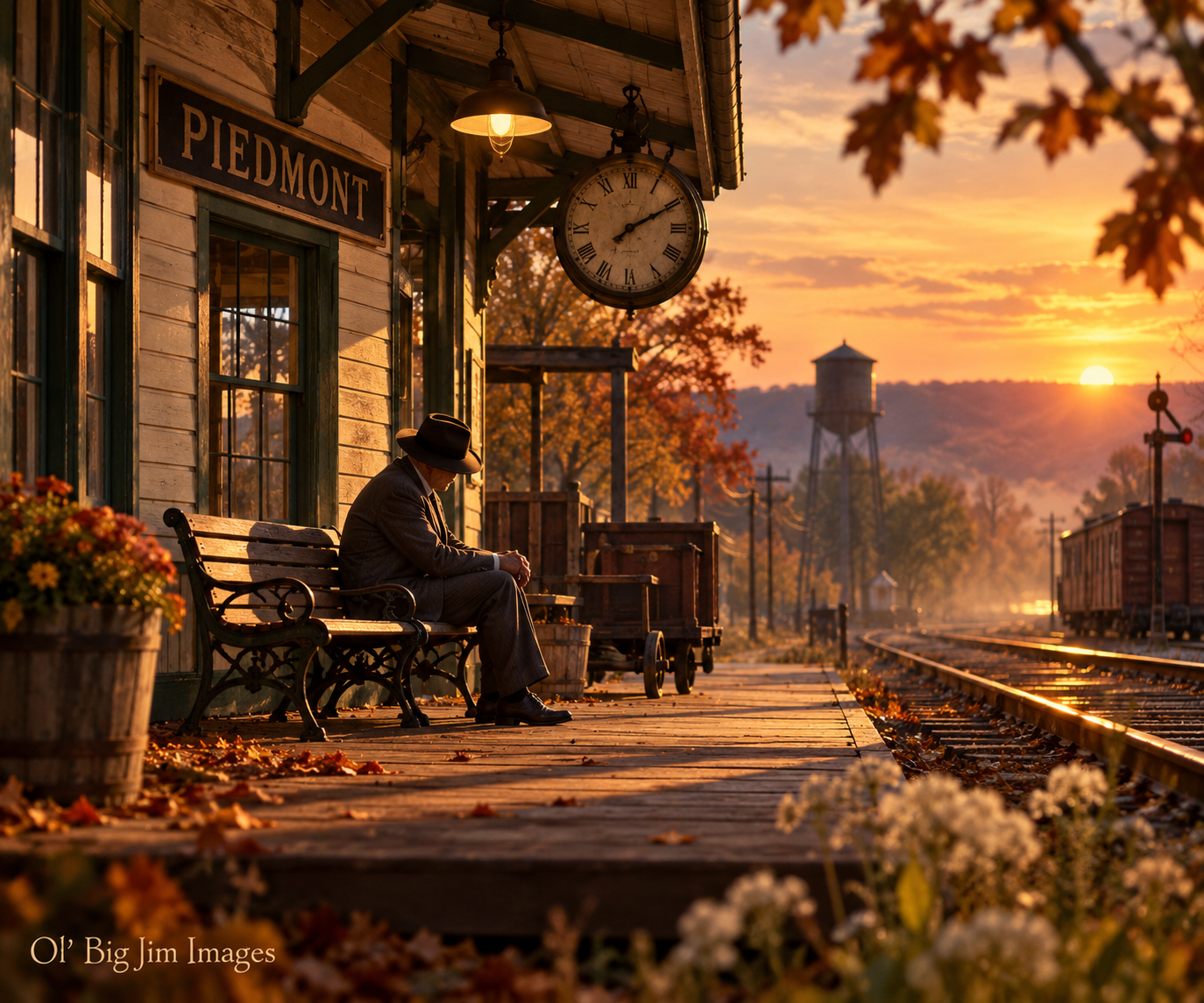
After visiting Curtis, the stranger would walk down to the depot, sit on the old wooden bench, and wait. Sometimes an hour. Sometimes all afternoon. He never read a newspaper. Never smoked. Never spoke to anybody unless somebody spoke first. And nobody much bothered him. There wasn’t anything unfriendly about it. It’s just that people in Piedmont generally know when a fellow wants to be left alone.
Well, most people do.
Curtis never did learn that particular social grace. One October afternoon, Curtis finally got curious enough to walk down to the depot.
“Waiting on somebody?” he asked.
The stranger nodded.
“Anybody I know?”
“Maybe.”
“Well, who is it?”
The stranger looked at him for a moment.
“Somebody who’s late.”
Curtis glanced up at the depot clock. “Well, hell, that thing ain’t worked in thirty years.”
“I know,” the stranger said. And went right on waiting.
Now, that’s the part of the story Curtis always told. Miss Lorene said he’d left something out. “What’d I leave out?” Curtis demanded.
“The man asked whether the afternoon train had come through.”
“Well, fer cryin’ out loud, there ain’t been an afternoon passenger train through here in years.”
“That’s what I told him.”
“What’d he say?”
Miss Lorene took a sip of coffee. “Said he knew that, too.”
There was one thing about the stranger that nobody noticed for a good many years. He never seemed to get any older. Now, before you go imaginin’ some supernatural foolishness, let me remind you that folks in Piedmont ain’t particularly observant about such things. A man could gain forty pounds, lose every hair on his head, and start wearing spectacles thick enough to stop a bullet, and somebody would still say, “Well, you ain’t changed a bit!”
That’s Southern politeness. Or poor eyesight. Sometimes it’s hard to tell the difference.
But Curtis had been cutting hair long enough to notice when a man’s hairline started retreating toward his collar. And one October afternoon, while the stranger stood in the doorway of the barbershop asking his customary question, Curtis finally noticed something peculiar. The fellow looked just exactly like he did twenty years earlier.
Same gray suit. Same brown hat. Same little crease beside his mouth. Not another wrinkle. Not another gray hair. Not even the decency to grow so much as an extra chin. Curtis waited until the man had gone before mentioning it to Earl, who was occupying the barber chair round about that time.
“You ever notice that fellow don’t seem to age?”
Earl opened one eye. “Which fellow?”
“The one comes every October.”
“Well, maybe he takes care of hisself.”
“For twenty years?”
“Some folks do, Curtis.” Curtis considered that.
“Well, he ain’t changed a lick.” Earl closed his eye again. “Neither has your haircut, and you’ve been giving me the same one since Eisenhower was president.” Curtis didn’t appreciate that observation. Particularly since it was true.
A few days later, he mentioned the matter to Miss Lorene over breakfast at the Coffee Cup. She was buttering a biscuit and didn’t look up. “That man’s been coming here longer than twenty years.”
“How much longer?”
“Long enough.”
“Well, what’s that supposed to mean?”
“It means if you’d quit interruptin’, I might tell you.”
Curtis shut up. An uncommon occurrence. Miss Lorene set down her knife. “I remember seeing him when I was a girl. My daddy and I were walking past the depot one October afternoon. That fellow was sitting on the bench, looking down the tracks.”
“Same fellow?”
“Same hat.”
“Lots of men wore hats back then.”
“Same suit.”
“Lots of men wore suits.”
“Same face.”
Curtis scratched his chin.
“Well, hell.”
“That’s what I thought.”
Now, Miss Lorene wasn’t a woman given to flights of fancy. She believed in sensible shoes, properly cooked vegetables, and keeping a little cash hidden where the government couldn’t find it. If she said she’d seen that man forty years earlier, she believed it. Whether she was right was another matter altogether. Memory’s a peculiar thing.
It’ll remember what somebody wore to church in 1952 but can’t recollect where you left your spectacles five minutes ago. Still, the matter began to trouble Curtis.
He went down to Blackwelder’s Hardware and asked whether anybody remembered the stranger. Mr. Blackwelder was counting out a pound of ten-penny nails.
“Gray suit?” he asked.
“Yep.”
“Brown hat?”
“Yep.”
“Comes every October?”
“That’s him.”
Mr. Blackwelder dropped another nail into the scale.
“Reckon I do.”
“Well, how long’s he been coming?” Mr. Blackwelder thought about it.
“Long as I can remember.”
“Don’t you find that peculiar?”
“What’s peculiar about a man coming to town?”
“He don’t get no older!”
Mr. Blackwelder looked up.
“Neither do you, Curtis. Not in your own estimation.”
That got a laugh from everybody in the store. Everybody except Curtis. He’d come looking for answers and was getting considerably more aggravation than he’d bargained for. But then Mr. Blackwelder said something that stopped the laughter.
“Come to think of it, my daddy used to mention that fellow.”
Curtis leaned forward.
“What’d he say?”
“Not much. Said there was a man who came every October and waited at the depot.”
“Waited for what?”
“Train, I reckon.”
“Well, which train?”
Mr. Blackwelder tied the paper sack shut.
“Didn’t say.”
Curtis stood there a moment. “Your daddy’s been dead thirty years.”
“Thirty-two.”
“And he remembered that man?”
“I reckon so.”
“Well, don’t that strike you as odd?”
Mr. Blackwelder handed a customer his nails.
“Not particularly.”
“Why not?”
“Because my daddy remembered a whole lot of things I never did understand.”
And that was the end of that. Or it would’ve been, if Curtis hadn’t decided to investigate. Now, Curtis Pope investigating anything was a spectacle worth watching. The man couldn’t find his own shaving brush half the time, and it hung on a hook directly beneath his nose. But he was determined.
He went through old pictures. Asked questions. Pestered half the town. And eventually found himself at the Southern Railroad depot, standing beneath that clock nobody could agree about. The hands hadn’t moved in years. At least, not that anybody could prove.
Curtis sat down on the bench. Looked down the tracks. And tried to imagine what a man might be waiting for over the better part of half a century. A train? A woman? An apology? Or something else entirely?
He sat there long enough for the afternoon shadows to stretch across the platform. Then he noticed something. Scratched into the wood of the bench, just beneath the armrest, were four words.
I SAID I’D WAIT.
Curtis ran his fingers over the letters. They were old. Weathered. Almost worn smooth. He couldn’t remember ever seeing them before. But that didn’t mean much. Curtis had been sitting on that bench since he was a boy and hadn’t noticed the words until now. He looked up at the depot clock. Then down the tracks.
And for the first time in his life, Curtis Pope found himself sitting somewhere without a single thing to say. That lasted nearly four minutes. Which, for Curtis, was something approaching a medical emergency.
The following October arrived right on schedule. The stranger didn’t.
Now, ordinarily, the absence of one man in a gray suit wouldn’t have caused much excitement in Piedmont. Folks disappeared from view all the time. Some moved away. Some died. Some simply got tired of listening to Curtis Pope and found somewhere else to get their hair cut.
But this fellow had become something of a fixture. Like the depot clock. Or the crack in the sidewalk outside the Shoe Cove. Nobody paid much attention to him until he wasn’t there.
Curtis noticed first. He’d been expecting the stranger sometime during the second week of October, and when Friday came without so much as a glimpse of that brown felt hat, he began asking questions.
“Anybody seen that fellow?”
“What fellow?”
“The one comes every October.”
“Well, Curtis, it’s still October.”
“I know what month it is, Earl.”
“Just checking. You forgot February last year.”
“I did NOT forget February!” his voice rose a full two octaves.
“You told me it had thirty days.”
“That was a joke!”
“Well, it wasn’t a very good one.” Curtis gave up.
By the following Tuesday, he’d asked nearly everybody in town. Nobody had seen the stranger. Miss Lorene was the only person who seemed particularly concerned. She stopped by the barbershop one afternoon and stood in the doorway.
“Has he come?”
Curtis shook his head. “Nope.”
She looked toward the depot. “Well, that’s peculiar.”
“That’s what I’ve been telling everybody!”
“Don’t get excited, Curtis, it don’t suit you.” And she went on about her business.
But the next afternoon, somebody saw her sitting on the depot bench. Alone. Looking down the tracks. Now, that was unusual. Miss Lorene wasn’t one to sit around waiting for things. She believed in getting up and doing something about them, preferably before somebody else had time to offer advice.
Yet there she sat. For the better part of an hour. When somebody asked what she was doing, she said she was resting her feet. Nobody believed her. Nobody argued, either. A few days later, I wandered down to the depot myself.
The October air had turned cool enough to make a body grateful for a jacket. Queen Anne’s lace nodded along the fence, and dry leaves scraped across the platform whenever the wind picked up. I had The Irish Blackthorn with me. I’d been carrying it most days since bringing it home from Ireland, and by then it had become as much a part of my daily routine as coffee and complaining about my back.
The bench was empty. I sat down. Rested the stick against my knee. Looked down the tracks. Nothing. Not a soul. Not a train. Not even Curtis Pope, which was something of a blessing.
I stayed there a while, enjoying the quiet. Then I heard footsteps behind me. Slow ones. Measured. The kind made by somebody who wasn’t in any particular hurry. An elderly woman came along the platform. She wore a dark blue dress, a little gray cardigan, and a hat that looked as though it had been fashionable sometime before I was born.
She stopped beside the bench. Looked at the empty space next to me. And asked a question. “Has he come yet?”
I looked up. “Ma’am?”
“The gentleman. Has he come?”
I knew immediately who she meant. “No, ma’am. Not this year.”
She nodded. “Well, that’s a shame.”
She looked down the tracks. “He promised he’d wait.”
Now, there are moments in a man’s life when he ought to keep his mouth shut. I’ve missed most of mine. “Wait for what?” I asked.
She smiled. “Not what, honey.”
I waited.
“Who.”
She said it so softly I almost missed it. I looked at her a moment. “Would that be you?”
She didn’t answer.
Instead, she reached into her handbag and took out a little white handkerchief. Folded it once. Then again. “He’s been very patient,” she said.
“Reckon he has.”
“Longer than he ought to’ve been.” She looked toward the depot clock.
For the first time since she’d arrived, something changed in her expression. Not fear. Not surprise. Recognition, maybe.
“I told him not to wait forever.”
“Did he listen?”
She smiled again. “Men seldom do.”
Well, I couldn’t argue with that. She tucked the handkerchief back into her bag. Then she looked at me.
“Would you mind telling him something, if you see him?”
“Certainly, ma’am.”
“Tell him I’m sorry.”
I waited for the rest. There wasn’t any. She turned and began walking toward town. I watched her go. There was something familiar about her, though I couldn’t have said what. Perhaps I’d seen her at the Coffee Cup. Perhaps she’d been somebody’s aunt. In Piedmont, that generally covered half the population. Before she reached the corner, beside the Little Gem, she stopped. Turned. And called back.
“Oh, and one more thing.”
“Yes, ma’am?”
“Tell him he needn’t come next October.” Then she was gone. Not vanished. Not dissolved into the air. She simply turned the corner at First National and walked out of sight. Which, to my way of thinking, is considerably more unsettling.
I sat there a few minutes longer. Thinking. Then I happened to glance at the depot clock. Now, I’d been looking at that clock for years. Everybody had. The hands had been stopped for so long that nobody could remember exactly when they’d quit moving.
But something was different. The minute hand had moved. Just one minute. I checked my watch. Looked back at the clock. Then checked my watch again. “Well, I’ll be damned.”
I stood up. Reached for The Irish Blackthorn. And noticed something scratched into the bench, just beneath the armrest.
Four words.
I SAID I’D WAIT.
I’d heard Curtis talking about those words. But I’d never actually looked at them. I ran my fingers over the letters. Old. Weathered. Worn almost smooth. And beneath them, so faint I had to lean down to make them out, were two more words.
YOU DID.
Now, I don’t know who carved those words. I don’t know when. I don’t know whether the woman had anything to do with them. And I certainly don’t know why the depot clock moved one minute that afternoon. Could’ve been the wind. Could’ve been some old piece of machinery finally giving up. Could’ve been that I’d remembered the position of the hands wrong in the first place.
Memory’s like that. But I’ll tell you one thing. That stranger never came back to Piedmont. Not the following October. Not the one after that. And as far as I know, nobody ever saw the elderly woman again, either. Curtis Pope eventually stopped asking questions. Miss Lorene never did say much about it.
Though once, when somebody mentioned the man in the gray suit, she looked out the Coffee Cup window toward the depot and said something I haven’t forgotten.
“Some promises take longer to keep than others.” Then she went right back to buttering her biscuit. And that was that. Or so I thought.
Because the following October, I stopped by the depot again. The bench was empty. The clock was still stopped.
And somebody had left a single white rose on the seat.
Now, I reckon there are a hundred perfectly sensible explanations for that.
But I never did find one I liked better than the others.



Good morning Jim. Happy Sunday!
LikeLiked by 1 person
Good morning, Vero, and welcome! Come on in, drag up a chair and set a spell while I get the coffee going.
LikeLike
October isn’t over yet.♥
LikeLiked by 1 person
No ma’am, ’tisn’t. I’ve a few more yarns to spin before we can even think about November.
LikeLike