
A Piedmont Porchlight Story
There used to be a house out on the Piedmont and Jacksonville highway that nobody could keep empty. Now, I don’t mean people were fighting over it. Quite the contrary. By the time I was old enough to pay attention, you couldn’t have given that house away without throwing in a hundred dollars and a written apology. Maybe even a set of dishes.
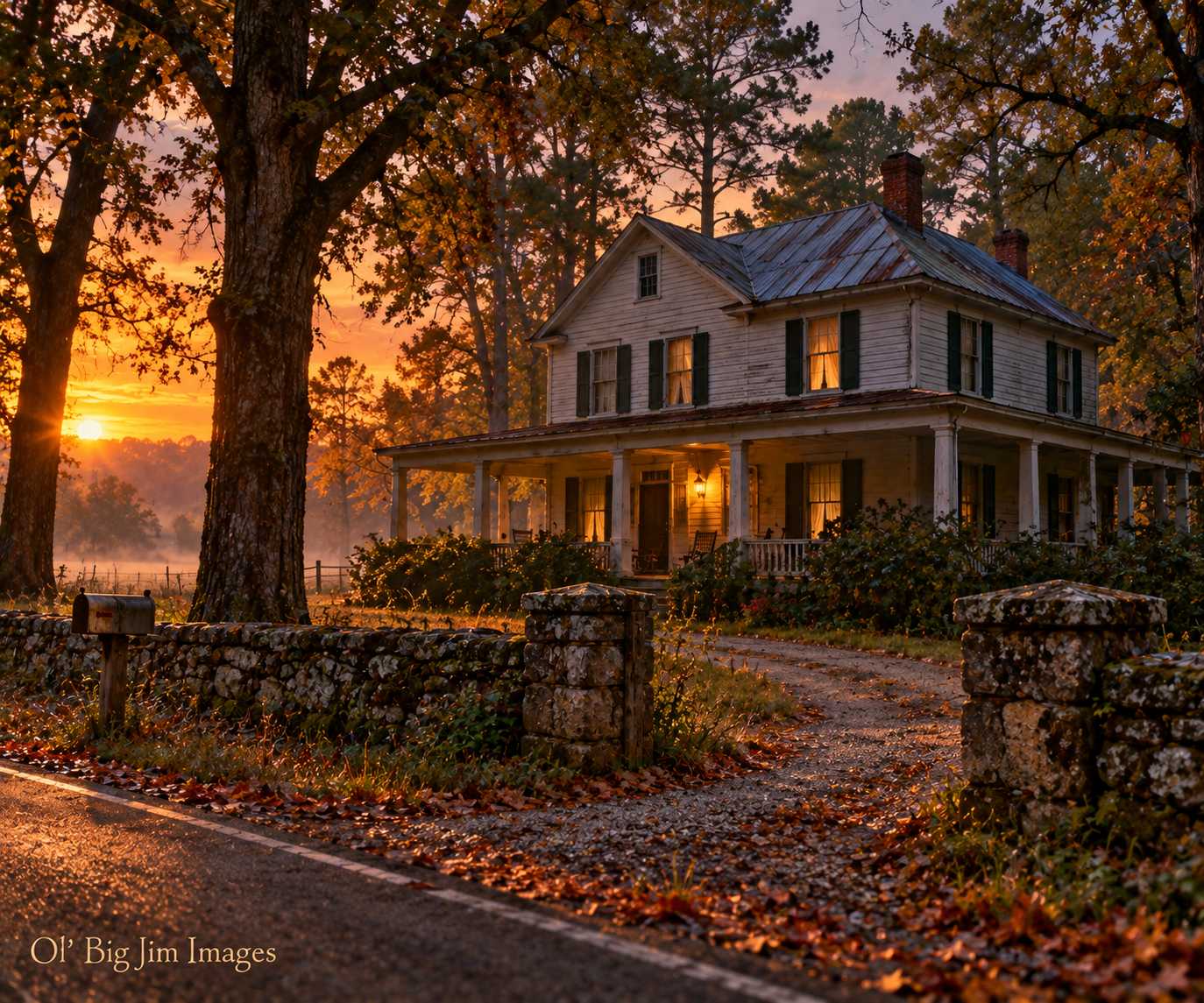
It wasn’t an ugly house, either. Two stories, white clapboard siding, a deep wrap-around front porch held up by big square columns, and four big windows looking out toward the road. Had a tin roof that turned the rain into music and a pair of old pecan trees out front that dropped enough nuts every fall to feed half of Calhoun County.
The place sat back from the road behind a low stone wall that was built by the WPA, with a gravel driveway winding up through a stand of pines. There was nothing particularly remarkable about it, except that it wouldn’t stay empty.
The first person I ever heard mention the place was Mr. Blackwelder’s daddy. He was sitting on a stool behind the counter at the hardware store one afternoon, watching his son count nails into a paper sack.
“Somebody’s moved back into the old Bellamy place,” he said.
Mr. Blackwelder didn’t look up. “Who?”
“Don’t know.”
“Well, how do you know somebody’s moved in?”
“Smoke coming out the chimney.”
“Could be somebody burning trash.”
“At seven o’clock in the morning?”
“Could be somebody burning trash early.”
His daddy considered that. “Well, they’re cooking breakfast, too.”
That got his attention. “How’d you know that?”
“Smelled bacon.”
Now, there’s not a great deal you can say against bacon. It’s one of the few things in this world that can make an otherwise sensible man get out of bed before daylight.
But the Bellamy house had been empty for nearly six years. The last family to live there had moved to Gadsden, taking everything they owned except a broken rocking chair and a cast-iron bathtub.
The electricity had been disconnected. The water well had been capped off. And the chimney hadn’t drawn a proper fire since Roosevelt was president. Nevertheless, there was smoke coming out of it. And somebody was frying bacon. At least, that’s what Mr. Blackwelder’s daddy said.
A few days later, he drove past again. No smoke. No smell of breakfast. No sign of anybody. The house looked just as empty as it ever had.
“Well, maybe they moved out,” Mr. Blackwelder suggested.
“Without moving in?”
“People do peculiar things.”
His daddy looked at him. “Boy, you ain’t listening.”
Which, according to Mr. Blackwelder, was something his daddy said at least fortyleven times a day.
⁂
Over the years, other people noticed things. Miss Lorene claimed she’d seen a woman hanging sheets on the clothesline behind the house. “White sheets,” she said. “Big ones. Looked like they belonged on a double bed.”
“Well, who was the woman?” Curtis Pope asked.
“Didn’t see her face.”
“How come?”
“Because I was driving, Curtis. I generally try to look at the road now and again.”
“Well, maybe somebody bought the place.”
“Then why’d the sheets disappear before I came back?”
Curtis scratched his chin. “Wind?”
“Wind don’t take down a clothesline and roll it up neat against the porch.”
That gave Curtis something to think about. He thought about it for the better part of three minutes, then went back to discussing whether a man ought to wear a hat indoors.
Another fellow swore he’d seen lamplight in an upstairs window. Not electric light. Lamplight. The soft yellow kind that flickers when somebody walks past it. He’d stopped his truck and watched for a minute, figuring somebody was camping out in the old place.
Then the light went out. He drove up the gravel driveway to investigate. Found the front door locked. All the windows shut. And not a soul around.
“Well, what’d you do?” somebody asked him.
“Left.”
“Didn’t you knock?”
“Hell, no. I ain’t that damned curious.” That sounded to me like an entirely reasonable answer.
⁂
The strangest part wasn’t what people saw. It was what happened when somebody actually tried living there.
In the late sixties, a young couple from Anniston bought the place for next to nothing. They painted the porch and the tin roof, and planted roses along the front walk. For a while, everything seemed perfectly ordinary. Then one morning the husband came downstairs and found the kitchen table set for breakfast. Four plates. Four cups. Four sets of silverware. Now, there were only two people living in that house. And neither of them had set the table.
His wife thought he was playing a joke. He thought she was. They argued about it until the coffee got cold. The next morning, there were four plates again. This time, somebody had put a little vase of flowers in the middle of the table.
The wife threw the flowers out. The husband put the extra dishes away. And they agreed not to mention the matter again. Which is generally the first mistake people make when something peculiar starts happening.
The third morning, the table was set for six. They moved out before Sunday.
When Curtis heard about it, he said, “Well, maybe they was expecting company.”
Miss Lorene looked at him. “Curtis, sometimes I wonder how you manage to dress yourself.”
“Same way you do, Lorene.”
“I doubt that. I doubt that very much.”
⁂
After that, the house stood empty for another spell. Or appeared to. A farmer who owned the adjoining pasture reported hearing somebody playing a piano inside. Now, the Bellamy place didn’t have no piano. Hadn’t had one in years. But the farmer said he heard music drifting out through the open upstairs windows on a Sunday afternoon.
He recognized the tune. “Shall We Gather at the River.” Played slowly. Not particularly well. As though somebody was learning. He stood by the fence and listened until the music stopped. Then he went back to feeding his cattle.
When somebody asked why he hadn’t investigated, he said, “Because whoever was playing it needed the practice, and I didn’t reckon I could help. Hell, I don’t know how to play no piano.”
I always liked that answer.
⁂
By the time I was grown, the Bellamy place had acquired something of a reputation. People called it haunted. People called it cursed. One fellow claimed the house sat on an old Indian burial ground, which was what people generally said about anything they couldn’t explain and didn’t want to investigate. Mr. Blackwelder dismissed that particular theory.
“There’s no evidence of any burial ground out there,” he said.
“Well, what do you reckon it is?” Curtis asked.
“An old house.”
“That’s all?”
“That’s all I can prove.”
And I reckon that’s as sensible an answer as anybody ever gave.
But I did have an experience of my own. It was an October afternoon, cool and bright, with the leaves just beginning to turn along the road. I’d been out toward Jacksonville and was driving back to Piedmont when I noticed something at the Bellamy place.
The front porch light was burning. Now, that wouldn’t have been particularly remarkable except that the house had been empty for years, and as far as anybody knew, there wasn’t a working electrical wire in the place.
I pulled over. Sat there a moment. Looked at the house. The light was a soft yellow glow beside the front door. Nothing flickering. Nothing moving. Just a porch light. I thought about getting out and walking up the driveway.
Then I thought about the condition of my back, the distance to the porch, and the general foolishness of trespassing on property that had already driven off several perfectly reasonable people. So, I stayed in the car. And watched.
After a few minutes, the front door opened. Not wide. Just enough to let somebody out. A figure stepped onto the porch. Couldn’t tell whether it was a man or a woman. The afternoon sun was behind the house, putting the porch mostly in shadow.
The figure stood there for a moment. Then raised one hand. Not waving exactly. More like acknowledging somebody who’d just arrived. I looked behind me. Nobody. Looked back toward the porch. The figure was gone. The door was shut. And the porch light had gone out.
Now, I know what you’re thinking. You’re thinking I ought to have driven up there and knocked.
Well, I didn’t. I’ve lived long enough to learn that curiosity is a fine thing until it gets you into a situation where you have to explain yourself to the sheriff. So, I did the sensible thing and drove on into Piedmont.
Stopped at the Coffee Cup. Miss Lorene and Beulah Mae were chatting over a cuppa coffee. I ordered mine, and I told the ladies what I’d seen. They listened without interrupting, which was unusual enough to make me nervous.
When I finished, Beulah Mae stirred her coffee. “Well,” she said, “I reckon they’re back.”
“Who’s back?”
She looked at me. “The people who live there.”
“Beulah Mae, ain’t nobody livin’ there.”
She gave me a patient little smile. “Yeah, that’s what everybody keeps saying.”
⁂
A few weeks later, the county finally decided the Bellamy place was too far gone to save. The roof had started sagging. The porch steps were rotten. And one of the upstairs windows had fallen out altogether.
A demolition crew arrived early one Monday morning. Three men, a truck, and a machine big enough to turn the house into kindling before lunchtime. They’d been instructed to make sure the building was empty before starting.
One of the men walked around the outside. Another checked the downstairs rooms. The third went upstairs. They found no furniture. No clothes. No dishes. No sign that anybody had lived there in years. That house was empty. Completely empty.
They came back outside. Started the machine. And that’s when the foreman noticed something. A little girl was standing in the upstairs window. He shut the engine off. Called to the other men. By the time they looked, she was gone.
They went back inside. Searched every room. Looked in the closets. Checked the attic. Nobody. The foreman figured he’d imagined it. Or perhaps seen a reflection. Or maybe a trick of the light. He wasn’t a superstitious man. He was a man with a job to do. So, they went back outside. Started the machine again.
And there she was. Same window. Same little girl. Standing perfectly still. Watching. This time, all three men saw her. They shut the machine off. Went back inside. And found the house empty.
Again.
Now, I don’t know what happened after that. Some people said the crew refused to tear the house down. Others said the county postponed the demolition because of a property dispute.
Curtis Pope claimed the foreman quit his job and moved to Florida, although Curtis also claimed he’d once cut Elvis Presley’s hair, so I wouldn’t put too much stock in that.
What I do know is that the house stood there another eleven years. And nobody ever lived in it. Not officially. Eventually, a storm took off half the roof, and the rest of the place came down not long afterward. The county cleared the lot. Hauled away the lumber. Filled in the root cellar. Weeds took over the bare spot where the house had stood in fairly quick order.
Last I heard, the property belonged to somebody from Birmingham who intended to build a little weekend cabin there. I don’t know why he never did. But a few Octobers ago, I was driving back from Jacksonville and passed the old Bellamy place after sundown.
The house had been gone for over a decade. Nothing left but the stone wall, the pecan trees, and weeds. Lots of weeds. And as I passed, I saw something. A light. Small. Yellow. Hanging in the darkness about six feet above the ground. Right where the front porch light used to be.
I slowed down. Looked again. It was gone. Could’ve been a reflection. Could’ve been somebody’s flashlight. Could’ve been any number of things. I didn’t stop to find out. But I will tell you this.
The next morning, I mentioned it to Mr. Blackwelder. He listened. Thought a moment. Then said, “Well, I reckon tearing down the house didn’t make much difference.”
“What do you mean?”
He went back to counting nails. “Apparently, they weren’t living in the house.”
He dropped another nail into the scale.
“They was living at the address.”
⁂