
A Piedmont Porchlight Story
Piedmont used to have two railroad stations.
Now, I mention that because somebody will inevitably read this story and inform me that I’ve got my depots confused. There was the Southern Railroad depot down near the Coffee Cup, and there was the Seaboard station, where the Silver Comet stopped on its way between New York and Birmingham.
And I know the difference.
I’ve been confused about a great many things in my life, but I generally know which railroad I’m standing beside.
The Silver Comet first stopped in Piedmont on May 23, 1947. There was a crowd to welcome it, and I reckon half the town turned out to see that shiny new streamliner.
The train made its last stop here on January 18, 1969.
After that, the years went by. The trains quit running, the tracks were taken up, and the old right-of-way eventually became part of the Chief Ladiga Trail.
Bicycles replaced locomotives.
People started walking where passengers once rode.
And everybody got accustomed to the idea that the Silver Comet was gone.
Everybody except, apparently, the Silver Comet.
⁂
The first person I heard tell about it was Earl. Now, Earl had been having trouble sleeping, which he blamed on his mattress, the weather, his wife’s snoring, and the general decline of civilization. He’d tried everything except going to bed at a reasonable hour.
One morning at the Coffee Cup, he announced that somebody had been running a train through town in the middle of the night. Curtis Pope looked up from his eggs. “What train?”
“How the hell should I know?”
“Well, where was it?”
“Over by the old Seaboard station.”
Curtis stared at him. “Earl, there ain’t no tracks over there.”
“I know that.”
“Well, how’s a train supposed to run without tracks?”
“That’s what I’d like to know!”
Miss Lorene, who was sitting at the next table, lowered her newspaper. “Maybe somebody’s got their television turned up too loud.”
“Sounded like it was coming right through my bedroom window.”
“Well, Earl, if a train came through your bedroom window, I reckon your wife might’ve noticed.”
“She slept right through it.”
“That woman deserves a medal.”
And that was the end of the conversation. For about three days.
⁂
Then somebody else heard it. Asa McMuray was walking his dog near the trail one evening when he heard a whistle. Not the high, sharp whistle of a modern diesel. A long, mournful sound that seemed to come from somewhere beyond the trees.
He stopped. The dog stopped. The whistle sounded again. And then came the unmistakable rumble of wheels rolling over steel rails. Asa looked toward the trail. Nothing. No lights. No train. Just the paved path stretching away into the darkness.
His dog tucked its tail between its legs and headed for home. Asa followed. He said afterward that he’d never seen a dog so determined to get indoors. Curtis suggested the animal might’ve smelled a skunk.
Miss Lorene asked whether skunks had taken up operating passenger trains. Curtis allowed as how he didn’t believe so.
“Well, then,” she replied, “I guess we’ve narrowed it down that much, anyway.”
⁂
The following week, three people heard the whistle on the same night. That made it considerably harder to dismiss. One was Earl. One was Frances Murphy. She lived near the old right-of-way. And the third was Mr. Blackwelder, who had been awake thumbing through a hardware catalogue because, according to him, a man could never know too much about hinges and whatnot. He said the sound came shortly after midnight.
A whistle. Then the rumble of wheels. Then something else.
“What?” Curtis asked.
Mr. Blackwelder thought a moment. “Brakes.”
“Brakes?”
“Train brakes. Squealing like they used to when a passenger train pulled into the station.”
Curtis scratched his chin. “Well, that’s peculiar.”
“Reckon so.”
“Did you see anything?”
“Nope.”
“Why didn’t you go look?”
Mr. Blackwelder gave him a long, patient stare. “Curtis, I sell nails and hinges and such for a living. I ain’t employed to investigate trains that ain’t there.”
That seemed reasonable enough to me.
⁂
Now, you might think somebody would’ve called the police. Well, somebody did. Sheriff Booker listened to the complaint, asked a few questions, and sent a deputy out to look around. The deputy found nothing. No train. No lights. No evidence that anybody had been operating any kind of heavy machinery on the trail.
He did find two teenagers sitting on a bench eating potato chips. They denied knowing anything about the whistle. They also denied having any beer, although the deputy hadn’t asked about that. He sent them home.
The next night, the whistle sounded again. This time, several people saw something. A light. Not a bright light. Just a pale glow moving slowly through the trees where the old Seaboard tracks had once run. One woman said it looked like a locomotive headlight. Another said it was probably somebody riding a bicycle.
Earl pointed out that bicycles generally didn’t weigh several hundred tons or announce themselves with a railroad whistle. Miss Lorene said that was the most sensible thing she’d ever heard Earl say. He was so pleased he bought her breakfast.
⁂
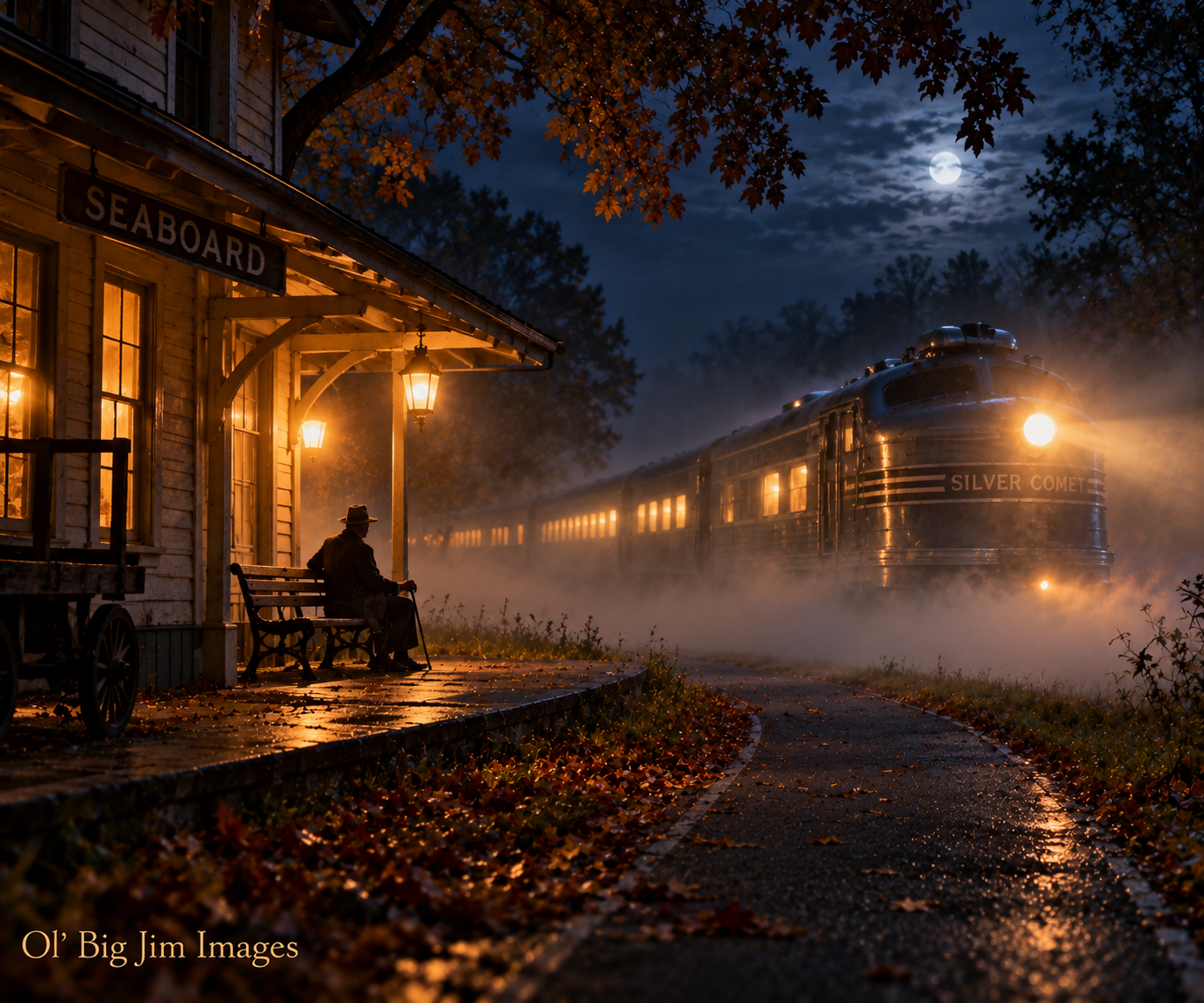
I didn’t hear the Silver Comet myself until the middle of October. I’d been sitting up late reading, which is something I do more often than is good for me. The house was quiet. Squeaky had finally decided to quit supervising my activities and gone off to sleep. And I was just about ready to turn out the light when I heard it. A whistle. Long. Low. Familiar. Now, I grew up hearing trains. I reckon I know what a train sounds like.
Anybody raised in Piedmont during those years knew the sound of a locomotive coming through town. You could tell when one was approaching long before you saw it. The rails would sing. The ground would tremble. And then the whistle would come floating over the rooftops.
This sounded exactly like that. I sat still. Listened. A moment later came the rumble of wheels. Then the brakes. A long metallic squeal that seemed to hang in the night air. And then silence. Not the ordinary quiet of a small town after midnight.
Something deeper. It was like the whole town had stopped to listen. I looked at my watch. 12:17. I remember that because I thought it was a peculiar time for a train to arrive. Then I remembered that there wasn’t supposed to be any train arriving at all.
That kinda made the timetable somewhat irrelevant.
⁂
The next morning, I went down to the Coffee Cup. Earl was already there. So was Curtis. And Miss Lorene, who appeared to have appointed herself chairman of the unofficial Silver Comet Investigation Committee.
“Well?” she asked when I sat down.
“Well, what?”
“Did you hear it?”
I nodded. “Reckon I did.”
“What’d it sound like?”
“A train.”
Curtis threw up his hands. “That’s what everybody keeps saying!”
“Well, Curtis, what would you rather everybody say? A trombone?”
Miss Lorene laughed into her coffee. Mr. Blackwelder arrived a few minutes later carrying an old railroad timetable. He spread it on the table. “Found this in a box of my daddy’s things.”
We leaned over to look. It was yellowed and brittle, with tiny printed columns listing stations and arrival times. New York. Washington. Richmond. Atlanta. Cedartown. Piedmont. Anniston. Birmingham.
Curtis ran his finger down the page. “Well, there it is.”
“What’s that?” Earl asked.
“Piedmont.”
“We know where Piedmont is, Curtis.”
“No, look at the time.”
We looked. The timetable showed when the Silver Comet was supposed to arrive in town. Not midnight. Not 12:17. Not anything close.
Curtis looked disappointed. “Well, that don’t explain much.”
Mr. Blackwelder folded the timetable. “Didn’t say it would.”
“Then why’d you bring it?”
“Thought you might like to see what an actual train schedule looks like.”
Miss Lorene nearly choked on her biscuit.
⁂
The next few nights were quiet. No whistle. No rumbling wheels. No mysterious lights. People began to lose interest. Curtis decided somebody had been playing a practical joke. Earl decided the whole business was caused by atmospheric conditions.
Miss Lorene decided Earl ought to stop using words he couldn’t explain. And I went back to my books. But then something happened that changed the conversation.
A woman who lived near the trail came into town one morning carrying a photograph. She’d taken it through her bedroom window shortly after midnight. It wasn’t a very good picture. Dark. Grainy. Mostly trees and shadows. But in the middle of it was something that looked remarkably like a railroad passenger car. Silver sides. A row of lighted windows. And what appeared to be the rounded end of an observation car.
Now, I wouldn’t swear to it. Could’ve been a reflection. Could’ve been a trick of the light. Could’ve been any number of things. But there was one detail that bothered me. In the nearest window, a woman appeared to be sitting alone. She wore a little hat. The sort of hat women used to wear when traveling.
And she was looking out. Not toward the camera. Not toward the town. Toward the station. As though she was watching for somebody.
⁂
A few nights later, I went down to the old Seaboard station myself. I didn’t go expecting to see a train. I went because curiosity has always been one of my more expensive habits. I took The Irish Blackthorn along, partly because I needed it and partly because I figured that if anything peculiar happened, I wanted something substantial in my hand.
The trail was quiet. A few leaves skittered across the pavement. Somewhere in the distance, a dog barked. I found a place to sit where I could look along the old railroad alignment. And I waited.
For a while, nothing happened. Then, shortly after midnight, I heard it. A whistle. Far away at first. Then closer. The ground beneath my feet seemed to tremble. I stood up. Looked down the trail.
And there it was. A light. Small at first. Growing brighter. Moving toward me through the darkness. Then came the sound of wheels. The clatter of rail joints. The deep, steady rumble of a locomotive pulling a long passenger train. I could see the silver cars behind it. Windows glowing. Curtains drawn in some. Open in others. And there, where the old Seaboard platform had once been, the train began to slow.
The brakes squealed. The whistle gave one short blast. And the Silver Comet stopped. Now, I know what you’re thinking. You’re thinking that a train can’t stop where there ain’t no tracks. Well, that’s what I thought too. And I was standing there looking at one. I could see the locomotive. The passenger cars. The observation car at the rear.
What I couldn’t see was the rails beneath them. Only darkness. The doors remained shut. No passengers stepped down. No conductor called out the station name. The train simply sat there. Waiting. Then, from one of the lighted windows, I saw a woman. A little hat. A pale face. She was looking toward the platform. Toward me. Or perhaps toward somebody standing somewhere behind me.
I turned around. Nobody. When I looked back, the woman had raised one hand. Not waving. Just acknowledging somebody. Then the whistle sounded. The train began to move. Slowly at first. Then faster. The cars passed one by one, their windows throwing little squares of light across the dark trail. And finally, the observation car rolled past. I watched its red marker lights disappear into the trees.
The rumble faded. The ground stopped trembling. And the night went quiet again. I stood there for a long time. Then I looked down at the pavement. No tracks. No marks. Nothing. Just the trail. And a few fallen leaves.
⁂
I didn’t tell anybody what I’d seen until the following afternoon. Not because I was afraid they wouldn’t believe me. I was afraid they would. Mr. Blackwelder listened without interrupting. Miss Lorene listened too. Curtis asked seventeen questions, none of which I could answer.
Finally, Earl said, “Well, what do you reckon it wanted?”
I shook my head. “Don’t know.”
“Maybe somebody missed their stop.”
“Maybe.”
“Maybe it was looking for somebody.”
“Could be.”
Miss Lorene stared out the window for a long moment. Then she said something peculiar. “Maybe somebody’s finally come back to get ’em.”
Nobody asked who she meant. And she didn’t volunteer.
⁂
The Silver Comet didn’t return the following night. Or the night after that. As far as I know, nobody’s heard it since. People still talk about it now and again. Curtis maintains it was some sort of optical illusion. Earl says the sounds were caused by unusual weather.
Mr. Blackwelder says he doesn’t know what happened, and he’s perfectly comfortable leaving it that way. As for me, I haven’t decided what I believe. But I did go back to the trail one morning. The sun was up. The air was cool. And everything looked perfectly ordinary. A couple of bicyclists passed. Somebody was walking a dog. And near the place where the old platform used to be, I noticed an elderly man sitting on a bench.
He wore a gray suit. A brown felt hat. And shoes polished bright enough to shave in. He was looking down the trail.
I stopped. “Morning.”
He nodded. “Morning.”
“Waiting on somebody?”
He looked at me. Then back down the trail. “Not anymore.” And he got up and walked away.
Now, I don’t know whether that was the same gentleman who used to come to the Southern Railroad depot every October. I don’t even know whether he was waiting for a train. But as he passed me, I noticed something. He was carrying a single white rose.
And I reckon that’s just about all I care to say about that.
⁂

⁂


