
A Piedmont Porchlight Story
Mr. Blackwelder had been in the hardware business long enough to know that people would come into his store looking for just about anything.
He’d sold nails to men who couldn’t drive ’em straight, paint to women who changed their minds before the first coat dried, and enough chicken wire to surround the entire state of Alabama, provided nobody insisted on closing the gate.
He’d even had a fellow come in once asking whether he carried left-handed hammers.
Blackwelder told him they were on back order.
But in all his years behind that counter, nobody had ever come in asking for his shadow.
Not until the last Sunday in October.
Now, Blackwelder’s Hardware wasn’t ordinarily open on Sundays. Mr. Blackwelder believed in observing the Sabbath, except in cases involving burst water pipes, broken window glass, or somebody whose wife had decided the kitchen needed painting before Monday.
He’d opened that afternoon to take inventory, a task he considered roughly equivalent to counting the hairs on a mule’s backside.
He was halfway through a box of ten-penny nails when the bell above the front door jingled.
Without looking up, he said, “We’re closed.”
“I ain’t here to buy anything.”
“Then we’re especially closed.”
The stranger didn’t leave.
Mr. Blackwelder raised his head.
The man standing just inside the doorway was tall and thin, dressed in a brown suit that looked as though it had been pressed sometime during the Hoover administration. He wore a narrow-brimmed hat and carried a folded paper sack in his left hand.
“Well?” Blackwelder asked.
“I come to collect something.”
“Store credit?”
“No, sir.”
“Special order?”
“No, sir.”
“Then what?”
“My shadow.”
Blackwelder set down his pencil.
“Your what?”
“My shadow. Left it here some years back.”
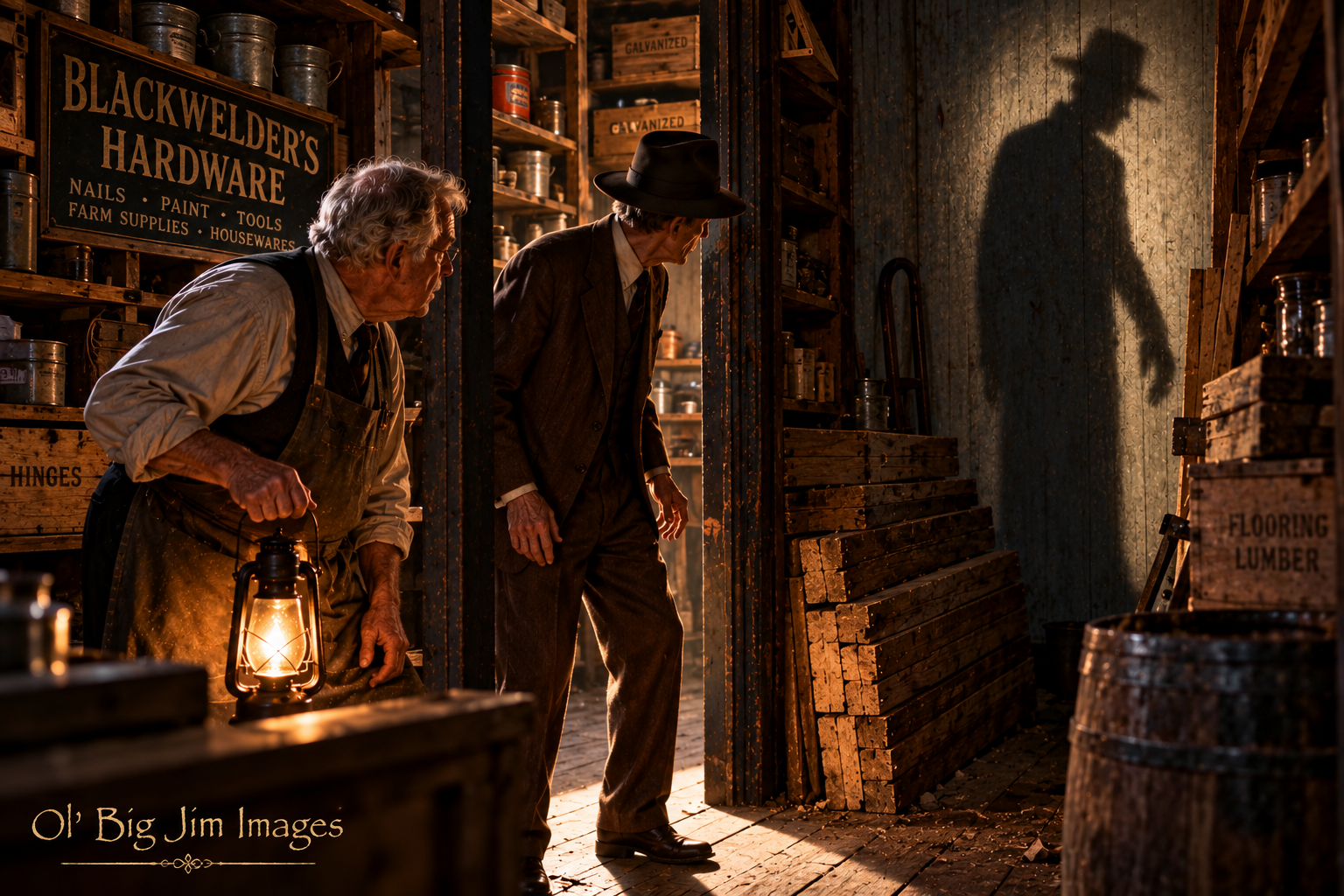
There are moments in a man’s life when the wisest thing he can do is remain silent until he has determined whether the person standing before him is drunk, dangerous, or merely peculiar.
Mr. Blackwelder had encountered all three varieties, sometimes in the same individual.
He studied the stranger. “Well, I reckon you’d better explain yourself.”
The man stepped farther into the store. “October afternoon. Must’ve been forty years ago, give or take. I was standing back yonder near the storeroom when the lights went out.”
“Lights go out all the time.”
“Not like that.”
“Electricity’s electricity.”
The stranger shook his head. “When they come back on, my shadow was gone.”
Blackwelder considered this. “Did you report it?”
“To who?”
“Well, I don’t know. Sheriff, maybe.”
The stranger looked mildly offended. “What would the sheriff do with a missing shadow?”
“About as much as I can, I expect.”
The man sighed. “I was hoping you’d kept it.”
Mr. Blackwelder leaned against the counter.
“Son, I keep bolts, screws, hinges, washers, nails, plumbing fixtures, and three different kinds of stove polish. I don’t ordinarily keep shadows.”
“Could you look?”
“Look where?”
“Where I left it.”
Blackwelder was about to suggest that the gentleman take his business elsewhere when he noticed something peculiar. The late-afternoon sun was coming through the front windows, laying long golden rectangles across the worn wooden floor.
The stranger stood directly in one of them.
His shoes were plainly visible.
So were the cuffs of his trousers.
But behind him, where his shadow ought to have stretched across the floor, there was nothing.
Not so much as a smudge.
Mr. Blackwelder looked at the man’s feet.
Then at the floor.
Then back at the man’s feet.
“Well, I’ll be damned.”
“That’s what I said when it happened.”
Blackwelder came around the counter.
“Step over there.”
The stranger obliged.
“Now, over here.”
He moved again.
“Turn sideways.”
The stranger turned.
“Other way.”
He turned the other way.
Mr. Blackwelder scratched his chin.
“You’re defective.”
“I beg your pardon?”
“Something ain’t right with you.”
“I know that. That’s why I’m here.”
Blackwelder walked to the front window and looked at the sunlight.
Then he looked at his own shadow, stretched comfortably across the floor beside a display of galvanized buckets.
He wiggled his fingers.
The shadow wiggled its fingers.
“Well, mine’s working.”
The stranger didn’t appear impressed.
“Can we go look?”
The storeroom occupied the rear of the building, behind a narrow doorway that had been painted so many times it wouldn’t close properly anymore.
Inside were shelves of old merchandise, broken tools awaiting repairs that would never happen, and enough accumulated dust to start a respectable cotton farm.
Blackwelder switched on the overhead light. The stranger stopped in the doorway.
“That’s where it happened.”
“Where?”
“Right there.”
He pointed toward a stack of lumber against the far wall.
Blackwelder frowned.
“Funny you should mention that.”
“Why?”
“Well, years ago, there was something peculiar on the floor back there.”
The stranger’s expression changed.
“What sort of peculiar?”
“Dark spot. Looked like somebody’d spilled a bucket of black paint, except it was shaped funny.”
“Shaped how?”
Blackwelder thought about it.
“Like a man laying down, near as I recall.”
The stranger took a step forward.
“Did you try to clean it?”
“Naturally. Scrubbed it with turpentine. Tried mineral spirits. Even took a scraper to it.”
“And?”
“Wouldn’t budge.”
“What happened to it?”
Blackwelder pointed at the lumber.
“Covered it up. Figured if it wasn’t hurting anything, wasn’t no sense wasting another Saturday on it.”
The stranger looked at the stack.
“Would you mind moving that?”
Mr. Blackwelder sighed.
“You’re asking a considerable favor for somebody who ain’t bought so much as a washer.”
“I’ll pay you.”
“How much?”
The stranger reached into his pocket and produced a silver dollar.
Blackwelder examined it.
It bore a date from the previous century.
“Where’d you get this?”
“Had it a while.”
“Reckon you have.”
He pocketed the coin.
“All right. Let’s see about your shadow.”
They began moving the lumber. Board by board, they carried the stack across the room until the floor beneath was exposed. There was nothing there.
Just dust, a few dead spiders, and a bent nail.
The stranger stared at the empty floor.
“It was here.”
“Well, it ain’t now.”
“It has to be.”
“Son, I’ve been looking at this floor for forty years. I reckon I know what’s on it.”
The stranger knelt and ran his fingers across the boards.
Then he looked up.
“Mr. Blackwelder?”
“Yeah?”
“Would you turn out the light?”
Blackwelder hesitated.
“Why?”
“Please.”
Now, Mr. Blackwelder was not a superstitious man. He didn’t believe in haints, hobgoblins, or people who claimed they could predict the weather by examining a persimmon seed.
But there was something about the stranger’s voice that made him reach for the switch.
The light went out.
The storeroom fell into darkness, except for a narrow strip of afternoon sunlight slipping beneath the doorway.
For several seconds, neither man spoke.
Then the stranger whispered, “There.”
Mr. Blackwelder looked toward the far wall.
Something was standing against it.
Not a man.
Not exactly.
It was a shadow.
A tall, dark outline, perfectly formed against the faded plaster.
A man’s head.
Shoulders.
Arms hanging at his sides.
And a hat.
Blackwelder swallowed.
“Well, there you go.”
The stranger said nothing.
“Found it, didn’t we?”
Still nothing.
Mr. Blackwelder turned toward him. “What’s the matter?”
The stranger was staring at the wall. His face had gone pale.
“That ain’t the one I left.”
Mr. Blackwelder had never given much thought to the possibility that shadows might belong to particular people.
As far as he was concerned, a shadow was a shadow, much like a nail was a nail, except that some nails cost more than others and none of them required sunlight.
But the stranger seemed certain. “Mine didn’t wear a hat,” he whispered.
Blackwelder looked at the man’s head. “You’re wearing one now.”
“I wasn’t then.”
“Maybe your shadow took up wearing hats.”
The stranger didn’t smile. “There’s something else.”
“What?”
“Mine was shorter.”
Blackwelder stared at the shape on the wall.
It was indeed tall.
Taller than the stranger.
Taller than Blackwelder himself.
And although neither man had moved, the shadow seemed to have shifted slightly.
Its head was turned toward them.
Mr. Blackwelder reached for the light switch.
“Reckon we’ve seen enough.”
“Don’t.”
“Why not?”
The stranger’s voice trembled.
“Because I don’t think it’s finished looking at us.”
Blackwelder froze.
On the wall, the shadow raised one arm.
Slowly.
Deliberately.
Its hand opened.
Five long fingers spread against the plaster.
Then it beckoned.
Once.
Twice.
Mr. Blackwelder turned on the light.
The shadow vanished.
He stood there breathing hard.
The stranger had backed into the doorway.
“Well,” Blackwelder said.
The stranger nodded.
“Well.”
“I believe we’ve established that whatever’s back there ain’t yours.”
“No, sir.”
“And I don’t reckon it belongs to me.”
“No, sir.”
“Then I say we leave it where it is.”
The stranger looked at the empty wall. “What about my shadow?”
Blackwelder considered the question. “Maybe it went somewhere else.”
“Where?”
“How the hell should I know? I’m a hardware merchant, not a shadow detective.”
They returned to the front of the store.
The stranger stood by the counter, looking tired and considerably older than he had when he arrived.
Mr. Blackwelder took the silver dollar from his pocket and pushed it across the counter.
“Here.”
The stranger looked at it. “What’s that for?”
“Didn’t find what you come for. Wouldn’t be right keeping your money.”
The man shook his head. “You earned it.”
“Son, I ain’t charging you for something I wish I hadn’t seen.”
The stranger picked up the coin and slipped it into his pocket. “Thank you for trying.”
He walked toward the door. Mr. Blackwelder watched him cross the sunlight. Still no shadow.
“Say,” Blackwelder called.
The stranger stopped.
“You got a name?”
The man hesitated.
“Used to.”
“Well, what is it now?”
The stranger looked back.
“That’s another thing I lost.”
Then he stepped outside.
The bell jingled.
Mr. Blackwelder hurried to the window.
The stranger was walking toward the depot, his brown suit moving through the late-afternoon sunshine.
And there, stretching across the sidewalk behind him, was a shadow.
Mr. Blackwelder blinked.
The stranger stopped walking.
His shadow didn’t.
It continued down the sidewalk, passing beneath the awning of the next building before disappearing around the corner at First National Bank.
The stranger stood motionless for a moment. Then he lowered his head and followed it.
Mr. Blackwelder closed the store early that evening. He locked the front door, checked the back entrance twice, and went home without finishing his inventory.
The following morning, he arrived before sunrise.
He told himself there was no reason to be afraid of a storeroom, particularly one he’d been entering for the better part of forty years.
He unlocked the door, switched on the lights, and walked toward the back.
The lumber was exactly where they’d left it.
The floor was bare.
And the wall was empty.
Mr. Blackwelder stood there a long time.
Then he noticed something lying near the baseboard.
A folded brown paper sack.
The same one the stranger had carried into the store.
He picked it up.
There was something inside.
Something long and narrow.
He unfolded the top and looked.
It was a blackthorn walking stick.
Dark wood.
Knotted shaft.
An angled handle polished smooth by years of use.
Mr. Blackwelder stared at it.
He knew that walking stick.
He’d seen it before.
But for the life of him, he couldn’t remember where.
Then, from somewhere behind him, came a soft scraping sound.
Like a chair being pulled across a wooden floor.
He turned.
There was nobody there.
But on the wall, just beyond the reach of the overhead light, a shadow was beginning to form.
Not the tall man in the hat.
Not the stranger in the brown suit.
Something smaller.
Bent slightly forward.
Leaning on a walking stick.
Mr. Blackwelder looked down at the blackthorn in his hand.
Then back at the wall.
The shadow raised its head.
And from somewhere that might have been the storeroom, or might have been considerably farther away, a familiar voice said:
“Reminds me of something.”
Mr. Blackwelder dropped the sack.
He backed through the doorway, turned the storeroom light off, and shut the door.
Then he fetched a hammer and nailed it closed.
Sixteen ten-penny nails.
He counted every one.
And when Curtis Pope came by later that morning asking why the storeroom was boarded up, Mr. Blackwelder told him he’d discovered a problem with the inventory.
“What kind of problem?” Curtis asked.
Mr. Blackwelder looked toward the back of the store.
“Somebody’s been leaving things here that don’t belong to ’em.”
Curtis scratched his chin.
“Well, why don’t you just throw ’em out?”
Blackwelder shook his head.
“Because I ain’t too sure they want to leave.”
And that was the end of that discussion.
At least until the following October.
⁂