
A Piedmont Porchlight Story
⁂
There are certain sounds a person grows accustomed to hearing in the South.
Rain on a tin roof. Cicadas carrying on louder than a peathrasher. A screen door slamming right after somebody’s grandma hollered, “Shut that door, boy! You tryin’ to let all the flies out?”
And rocking chairs.
Especially rocking chairs.
My grandmother used to say you could tell whether a household was happy by the sound of its porch.
If the chairs were rocking, somebody was home.
If the chairs were still, somebody was either sick, mad, or dead.
And if there weren’t any chairs at all, the people probably weren’t worth knowing.
Now, I never put much stock in that last observation. I’ve known some mighty fine people who didn’t own a rocking chair, let alone a porch to put ’em on, though I will admit I’ve always regarded them with just a smidgen of suspicion.
Reminds me of a house that used to stand out beyond Dry Creek Road, the last paved road on the Jacksonville side of Piedmont.
It belonged to two sisters, Ada and Ruth Bellamy.
Neither had ever married, though Ruth claimed she’d come close on three occasions. Ada maintained that all three men had demonstrated excellent judgment by making their escape.
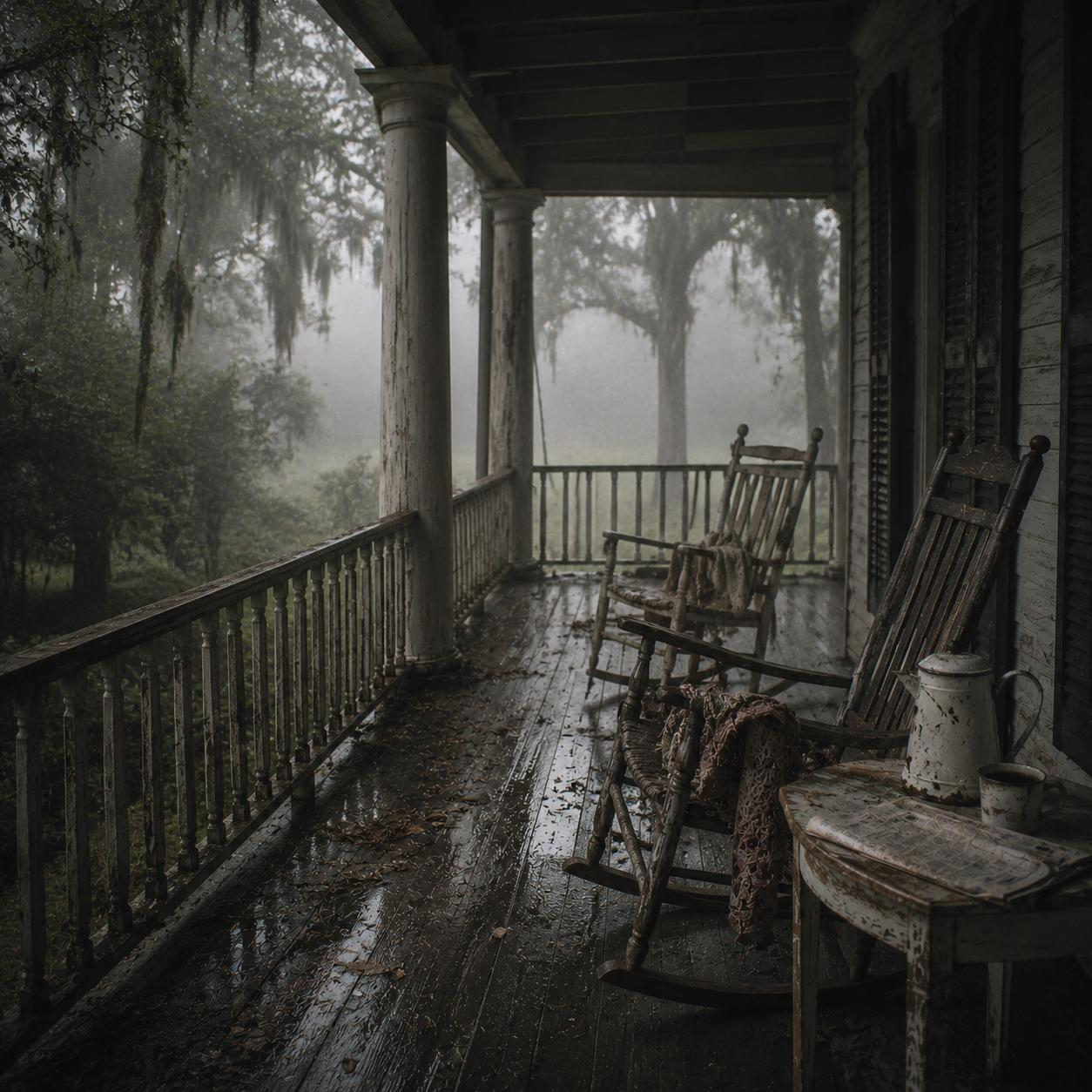
They’d lived together in that old house since their daddy died sometime before the Second World War.
The house was weathered gray, with a deep front porch and two rocking chairs that faced the road.
Every morning, weather permitting, the sisters sat there drinking coffee.
Ada occupied the chair nearest the door.
Ruth sat a little bit farther down the porch, where she could see anyone approaching from the road.
They’d been doing it so long that folks driving past could practically set their watches by them.
At seven o’clock, the chairs began rocking.
At eight, Ada went inside for another pot of coffee.
At nine, Ruth hollered something about the weather.
And by ten, they’d generally found something to disagree about.
The disagreements were seldom serious.
Ruth thought the world had gone to hell when women stopped wearing hats to church.
Ada believed it had gone considerably earlier, when people started putting mayonnaise in banana sandwiches.
I once made the mistake of expressing an opinion on the matter.
Neither sister spoke to me for a week.
But they were good women, them Bellamy sisters. They’d send preserves to anybody who was sick, feed a stray dog before feeding themselves, and tell you just exactly what they thought of your latest foolishness.
Then, one October morning, the rocking stopped.
Nobody thought much of it at first.
There’d been a storm during the night. A hard, soaking rain that left the road muddy and the creek running high.
By daylight, fog lay across the pastures and hung among the trees.
A neighbor passing the house noticed the two chairs sitting empty.
That wasn’t unusual.
What was unusual was that the chairs were wet.
Ada Bellamy would sooner have let the roof collapse than leave her good rocking chair out in the rain without covering it.
The neighbor stopped.
He called from the road.
Nobody answered.
He walked up the steps and knocked on the front door.
Still nothing.
The door was unlocked.
Inside, the house was quiet.
The kitchen stove was cold. Two cups sat on the table, washed and turned upside down on a clean dishcloth.
There was no sign of either sister.
By noon, half of Piedmont knew something was wrong.
By supper, the sheriff had been out there twice.
And by the following morning, folks had begun saying things they probably ought not to have said.
Some thought the sisters had gone to visit relatives.
Others thought they’d quarreled and gone their separate ways.
Curtis Pope suggested they’d finally gotten tired of each other’s company and run off to Florida.
Miss Lorene said that was the stupidest thing she’d heard since Curtis claimed he’d once been offered a job cutting hair for the governor.
The sheriff searched the property.
The neighbors searched the woods.
Somebody even dragged the creek, though nobody could explain why two elderly women would have gone swimming during a thunderstorm.
Nothing turned up.
The sisters were simply gone.
Now, here’s where the story gets peculiar.
Three mornings after their disappearance, the neighbor drove past the house again.
It was just after seven.
The fog was thick enough to hide the far side of the pasture.
And both rocking chairs were moving.
Not much.
Just a slow, steady motion.
Back and forth.
Back and forth.
He stopped his truck.
There wasn’t any wind.
He watched for a minute, then climbed out.
As he approached the porch, the chairs stopped.
He called the sisters’ names.
No answer.
He walked up the steps.
The chairs were empty.
But on the little table between them sat two cups of coffee.
Fresh coffee.
Steam rising from both.
The neighbor didn’t touch anything.
He backed down the steps, got into his truck, and drove straight to town.
By the time the sheriff arrived, the coffee was cold.
The chairs were still.
And the house was empty.
Again.
The sheriff took the cups away for examination, though what he expected to learn from two cups of coffee nobody ever explained.
The next morning, there were two more cups.
And the chairs were rocking.
The sheriff stationed a deputy outside the house overnight.
The deputy was a young fellow named Vernon Pike, who’d recently joined the department and was still under the impression that law enforcement involved considerably more excitement than directing traffic after football games.
Vernon parked his patrol car across the road at eleven o’clock.
At midnight, nothing happened.
At two, he drank the last of his thermos coffee.
At four, he fell asleep.
At six fifty-eight, he woke to the sound of wood creaking.
The rocking chairs were moving.
He got out of the patrol car.
The chairs slowed to a stop.
He climbed the porch steps.
Two cups of coffee sat on the table.
And from somewhere inside the house, a woman’s voice said:
“Ruth, I told you he’d fall asleep.”
Another voice answered.
“And, Ada, I told you he wasn’t worth waking up.”
Vernon Pike resigned from the sheriff’s department before lunchtime.
Said he was going into insurance.
Last I heard, he was doing quite well.
The Bellamy house stood empty for years after that.
Eventually, the county took possession of the property, and somebody suggested tearing it down.
But the workmen wouldn’t go near the place.
One claimed he’d seen two elderly women sitting on the porch at sunrise.
Another said he’d heard somebody laughing inside.
And a third said he’d found two cups of coffee on the table, though the house had been locked for months.
Eventually, the county forgot about it.
That’s one of the advantages of living in a small town. If something is sufficiently troublesome, folks will generally agree to ignore it and let somebody else inherit the problem.
The house is gone now.
A storm took the roof off one winter, and the walls collapsed a few years later.
The road has been widened, and there’s nothing much left to show where it stood.
But every now and then, somebody driving that way just after sunrise will notice something peculiar.
Two narrow tracks in the wet earth, right where the front porch used to be.
Parallel tracks, curved at the ends, as though two rocking chairs had been sitting there for years.
And the peculiar thing was, after a good rain washed those tracks away, they’d be back by the following morning.
One time, a fellow stopped his truck to investigate.
He said he heard two women arguing.
One of them was complaining about the weather.
The other was saying something about mayonnaise.
He didn’t stay long enough to hear the rest. Can’t say I blame him. But I have wondered about those sisters over the years.
Whether they ever knew what happened to them.
Whether they knew their house was gone.
And whether, wherever they are, they’re still sitting together every morning, drinking coffee and finding something to disagree about.
I rather hope so.
Because some habits ought to survive us.
And some conversations, once started, deserve never to end.
⁂