
A Piedmont Porchlight Story
If you wanted your hair cut in Piedmont, there were fancier places. Well… there was one fancier place. It had shiny floors, magazines less than six months old, and enough bottles sittin’ on the shelf to make a chemistry teacher nervous. But if you wanted a haircut, you went to Curtis Pope.
His barbershop sat just down from the Coffee Cup with a striped pole that had been spinnin’ so long I believe folks would’ve called the sheriff if it’d ever stopped.
Inside there were three barber chairs. Curtis only used one. Said keepin’ the other two polished gave people somewhere to point while they were tellin’ stories. There was always a checkerboard with a game halfway finished.
Nobody could remember who was winnin’, or who was even playing last.
There was a Coca-Cola machine that rattled louder than it cooled. The same calendar hung behind the cash register for so many years I’m convinced it had forgotten what year it belonged to.
And there was always somebody waitin’. Not because Curtis was slow. Because nobody wanted to leave.
Now, I’ve seen surgeons with slower hands than Curtis Pope.
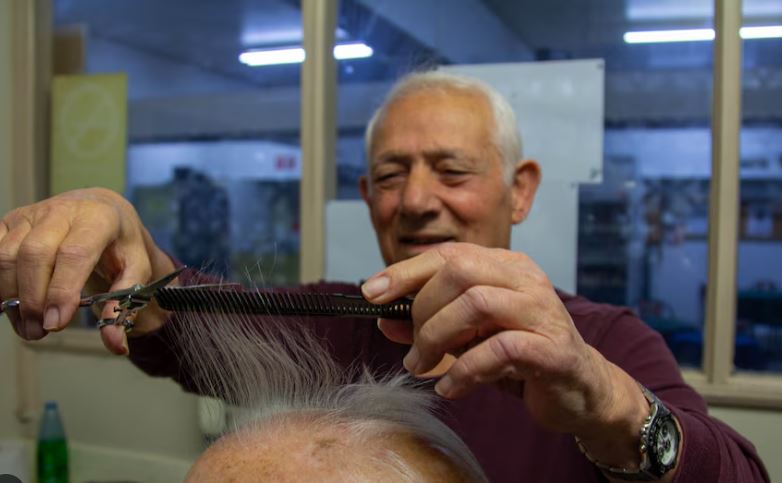
That man could drape a cape, comb your hair, ask about your mama, settle an argument over Alabama football, trim around both ears, and tell somebody to quit exaggeratin’ all before the next fellow had finished explainin’ where he caught the fish. Which was fortunate. Because fishermen have never been accused of rushin’ a story.
One Saturday mornin’ the shop was especially full. Every chair against the wall was occupied. Somebody was readin’ last week’s paper. Somebody else was asleep with his mouth open.
The smell of talcum powder mingled with bay rum and the faint scent of hair tonic that hadn’t changed since Eisenhower was in office. Curtis had old Earl Simmons in the chair.
Earl was describin’ the bass he’d almost caught over at Terrapin Creek. “I ain’t kiddin’,” Earl said. “That fish was every bit of fifteen pounds.”
Nobody looked up. Curtis snipped twice. “Mm-hmm.” “It near pulled me into the water.” Another snip.
“I reckon.”
“I fought him forty-five minutes.”
Curtis stepped back, tilted Earl’s head a little to the left, clipped one stubborn hair above his ear, and said, “Funny.”
“What is?”
“That fish gets heavier every spring.”
The shop erupted. Even Earl laughed. “Well,” he said, “I might’ve rounded up a pound or two.” Curtis dusted the loose hair off Earl’s neck. “You rounded so much you came back where you started.”
That was Curtis.
He never called anybody a liar. He just trimmed the truth until it fit. That’s an art. A little later, Clyde Jenkins came in wearin’ a brand-new cowboy hat. He stood in front of the mirror admirin’ himself before he ever took it off.
Curtis looked over the top of his glasses. “You buy that hat, or lose a bet?”
Even Clyde had to grin. Nobody escaped. Not the mayor. Not the preacher. Not the sheriff. Especially not the sheriff. Sheriff Booker once claimed he’d solved a break-in before breakfast.
Curtis kept cuttin’. “Then why’d you ask half the town who did it?” The whole shop howled. Booker just shrugged. “I like hearin’ everybody’s version.”
“You mean everybody’s lies.”
“That too.”
I used to think folks came there for haircuts. Then one rainy Tuesday I realized somethin’. Curtis hadn’t picked up his scissors for nearly twenty minutes. The chairs were all occupied. Coffee had appeared from somewhere. Three men were discussin’ whether Miss Hattie’s peach cobbler was better than her blackberry.
Someone was explainin’ why front porches made better neighbors than privacy fences. Nobody seemed the least bothered that no hair was bein’ cut. The barbershop wasn’t sellin’ haircuts. It was rentin’ fellowship by the hour. The haircut just came with it.
As the years passed, more and more folks started losin’ the hair they’d come in to have cut. Curtis charged ’em the same. Said the conversation still took just as long.
One afternoon I asked him how he’d managed to cut so many heads over the years without ever seemin’ flustered. He laid his scissors on the counter, looked out the front window for a long minute, and smiled.
“Jim,” he said, “hair always grows back.” I nodded. “It surely does.”
“But people…” He didn’t finish the sentence. He didn’t have to. I’ve thought about those two words more times than I can count.
People.
Don’t.
Not forever.
Hair will give you another chance next month. The fellow sittin’ in your barber chair might not. Maybe that’s why Curtis always looked a man in the eye before he spun the chair around. Maybe that’s why he remembered birthdays, grandchildren, surgeries, and anniversaries without ever writin’ any of ’em down.
He knew he wasn’t just cuttin’ hair. He was spendin’ twenty minutes with somebody’s life. These days, whenever I pass that old striped pole, I can almost hear the scissors.
Snip.
Another fish gets a little smaller.
Snip.
Somebody’s grandbaby takes her first steps.
Snip.
A widow laughs for the first time in months.
Snip.
Another ordinary Saturday becomes a memory nobody realizes they’re making.
Folks will tell you Curtis Pope could cut a head of hair faster than anybody could tell a lie. That’s true enough. But I always figured his real talent was a little rarer. He could make a man leave looking just a little better than when he came in.
And I’m not talking about the haircut.



It’s good to read about Curtis’ barber shop, Jim. He must be really good for so many guys to go there.
LikeLiked by 1 person
Curtis was a really wonderful guy. He was married to one of my cousins. Sweet family, altogether.
LikeLiked by 1 person
😊
LikeLiked by 1 person
I sure do miss those shops. Thanks for the memories, Jim.
LikeLiked by 1 person
I do, too, John. I went in to Curtis’ shop a year or two ago. Nice lady took it over. Just not the same atmosphere, and I was the only customer in the place. On a Saturday morning. Now, I can barely look at the shop when I drive past it.
LikeLiked by 1 person