
A Piedmont Porchlight Story
Myrtle Crabtree had been librarian of the Piedmont Public Library for twenty-three years, during which time she’d developed three firmly held opinions.
Children ought to be encouraged to read anything they could get their hands on.
People who folded down the corners of library books deserved public flogging.
And anybody who returned a book late and claimed he’d been abducted by a book club ought to be required to produce a note from the book club.
Myrtle was a small woman with a formidable bosom, steel-gray hair arranged in a bun tight enough to give somebody else a headache, and spectacles attached to a chain around her neck.
She knew every book in the library, every shelf, every crack in the plaster, and every mouse that had ever ventured into the building and subsequently regretted it.
Or so she believed.
Back in those days, the Piedmont Public Library occupied a handful of rooms on the second floor of the courthouse. It wasn’t much to look at, but Myrtle kept it as orderly as a Sunday school picnic supervised by the Lord Himself.
The books were arranged according to the Dewey Decimal System, which Myrtle considered one of civilization’s finest accomplishments, ranking somewhere between indoor plumbing and the invention of the electric fan.
The courthouse had been built in an age when architects believed a building ought to contain enough hallways to confuse a visiting Presbyterian. There were closets nobody used, staircases that didn’t seem to lead anywhere useful, and one peculiar corner where the floor sloped just enough to make a marble roll uphill.
Myrtle had never given any of that much thought.
Until one Tuesday afternoon in October.
She was moving a bookcase to retrieve a copy of The Adventures of Tom Sawyer that somebody had dropped behind it.
The bookcase was heavy, the floor was uneven, and Myrtle was not a woman accustomed to asking for assistance.
After fifteen minutes of gruntin’, groanin’, shovin’, and expressin’ several opinions that would have shocked the ladies of the Beulah Congregational Holiness Church, she finally managed to shift the thing six inches.
And there, behind it, was a door.
Not a large door.
Not even a particularly impressive one.
Just a narrow wooden door painted the same institutional green as the surrounding plaster, with a brass knob that had long since lost its shine.
Myrtle stared at it.
“Well, I’ll be dipped sorghum and rolled in Rice Krispies.”
She’d worked in that room for twenty-three years.
She’d dusted that bookcase every Thursday.
And she’d never once seen a door behind it.
Naturally, she tried the knob.
It turned.
And somewhere on the other side, somebody whispered:
“You’re late.”
Myrtle froze.
She was not a woman easily frightened. She’d once chased a possum out of the children’s reading section with a broom, and she’d faced down the mayor over a proposed reduction in the library’s magazine budget.
But a voice coming from a room that wasn’t supposed to exist was something else entirely.
“Who’s in there?” she demanded.
No answer.
Myrtle opened the door.
Beyond it lay a small room, perhaps twelve feet square, furnished with shelves on three walls, a reading table, a wooden chair, and a green-shaded lamp.
The lamp was burning.
The room smelled of old paper, furniture polish, and something faintly floral.
Everything was perfectly clean.
Not a speck of dust anywhere.
And the shelves were filled with books.
Myrtle stepped inside.
“Well, now.”
She examined the nearest shelf.
The books were bound in cloth of various colors, their titles stamped in gold.
But these weren’t ordinary titles.
They were names.
Curtis Pope.
Lorene Pritchard.
Elias Blackwelder.
Havis Albea.
Myrtle frowned.
She knew every one of those people.
She pulled out the volume bearing Curtis Pope’s name and opened it.
The first page recorded his birth, the names of his parents, and the circumstances surrounding his arrival in the world.
The second described his childhood.
By the tenth page, Myrtle was reading about the afternoon Curtis had accidentally set fire to his daddy’s woodshed while attempting to manufacture fireworks.
Myrtle remembered that incident.
Everybody in Piedmont remembered it.
What nobody knew, however, was that Curtis had blamed the fire on a lightning strike despite the weather having been perfectly clear.
Myrtle turned another page.
There were details about Curtis’s marriage, his barbershop, and the peculiar assortment of customers who’d occupied his chairs over the years.
Then she came to an entry dated the following morning.
Wednesday, October twenty-seventh.
At precisely nine minutes past eight, Curtis Pope will discover a silver dollar beneath the third chair in his barbershop. He will put it in his pocket, tell nobody, and spend the remainder of the morning wondering how it got there.
Myrtle stared at the page.
“Well, that’s ridiculous.”
She closed the book and returned it to the shelf.
Then she examined several others.
Every volume contained a life.
Every life was recorded in extraordinary detail.
And every book continued beyond the present day.
Myrtle backed toward the door.
“This is somebody’s idea of a joke.”
She stepped into the library and pulled the green door shut.
Then she pushed the bookcase back into place.
It took her another fifteen minutes, during which she expressed several additional opinions about the Lord’s intentions concerning furniture.
By closing time, she’d convinced herself she’d imagined the whole business.
Almost.
⁂
The following morning, Myrtle arrived at Curtis Pope’s barbershop at eight o’clock sharp.
Curtis was sweeping the floor.
“Morning, Miss Myrtle. Didn’t know you needed a haircut.”
“I don’t.”
“Well, that’s a relief. I ain’t never had much luck with women’s hair.”
Myrtle sat in the wooden chair near the wall.
Curtis continued sweeping.
At nine minutes past eight, his broom struck something beneath the chair.
Something metallic.
He bent down.
“Well, I’ll be.”
He picked up a silver dollar.
Myrtle’s heart gave a peculiar little thump.
Curtis examined the coin, slipped it into his pocket, and looked around as though expecting somebody to claim it.
“Find something?” Myrtle asked.
“Nothing worth mentioning.”
She rose.
“Thank you, Curtis.”
“For what?”
“Confirming something.”
She left before he could ask what.
By the time she reached the courthouse, Myrtle Crabtree was walking considerably faster than a woman of her age and disposition generally considered dignified.
⁂
The green door was still there.
So was the little room.
And the lamp was still burning.
Myrtle went straight to the shelves.
She found a book bearing her own name.
MYRTLE CRABTREE.
It was bound in dark blue cloth.
She opened it.
There was her childhood, her schooldays, her first employment, and her appointment as librarian.
There were things she’d forgotten.
Things she’d never told another living soul.
And one particularly embarrassing account of a church picnic involving a broken folding chair, a bowl of banana pudding, and the Reverend Boone’s Sunday trousers.
Myrtle blushed.
“That was an accident.”
She turned the pages more quickly.
The entries grew shorter as she approached the present.
Then she reached the final page.
October thirty-first.
There was nothing written beneath the date.
No explanation.
No description.
Just a blank space.
Myrtle counted the days.
Five.
She sat down heavily.
For the first time in twenty-three years, the Piedmont librarian found herself in possession of a book she desperately wished she hadn’t opened.
She looked around the room.
“Who writes these things?”
The lamp flickered.
Myrtle waited.
No answer came.
“Well, I reckon that figures.”
She studied the blank page.
Then, with the practical determination that had carried her through three library budget crises, two courthouse renovations, and an infestation of silverfish, Myrtle reached into her pocketbook.
She took out a pencil.
Beneath the date, she wrote:
Miss Myrtle Crabtree enjoyed a pleasant Saturday at home, ate a good supper, and went to bed in excellent health.
The words remained for a moment.
Then they faded.
Myrtle stared.
She wrote them again.
Again, they disappeared.
“Now, see here.”
She pressed harder.
The pencil lead broke.
Myrtle regarded the page with growing indignation.
“Nobody tells me what I can and cannot write in my own book.”
She tore the page out.
The lamp went dark.
Somewhere beyond the walls, a clock began striking.
Once.
Twice.
Three times.
It continued until Myrtle lost count.
Then the lamp came on again.
The room was unchanged.
Except for the books.
Myrtle opened the nearest volume.
Blank.
She opened another.
Blank.
She hurried along the shelves, pulling books at random.
Every page was empty.
Every life in Piedmont had vanished from the record.
Except one.
Her own book lay open on the reading table.
Across the first page, fresh black letters were appearing.
The librarian had always believed that every story needed an ending.
She was about to discover what happened when one didn’t.
Myrtle sank into the chair.
For a long while, she said nothing.
Then she whispered:
“Oh, Lord. What have I done?”
⁂
Myrtle was frightened, but fear had never prevented her from doing what needed doing.
She examined the shelves, the walls, and the table.
There were no instructions.
No notices.
No helpful little sign explaining what a person ought to do after accidentally erasing the history of an entire town.
Then her gaze fell on the card catalog.
It stood beneath the windowless wall, a handsome oak cabinet with dozens of narrow drawers.
Myrtle opened the drawer marked C.
She found the card almost immediately.
CRABTREE, MYRTLE
See also: Librarians, Previous.
Myrtle frowned.
She opened another drawer.
There were cards bearing names she didn’t recognize.
Agnes Whitcomb.
Eleanor Pruitt.
Sarah Bellweather.
Each card carried the same notation.
Transferred to Special Collections.
Myrtle examined the dates.
Some went back farther than the courthouse itself.
One was dated 1836.
Another had no date at all.
And beneath the cards was a small handwritten note.
Every town has its stories.
Some are remembered.
Some are forgotten.
Some have not yet been told.
The Keeper must see that none are lost.
Myrtle read it twice.
Then she noticed something written on the back.
The record may be restored, but the Keeper must remain.
She looked toward the shelves.
The books were still blank.
Somewhere downstairs, a courthouse door slammed.
A telephone rang.
Life in Piedmont continued, blissfully unaware that its entire history had just been misplaced.
Myrtle thought about the children who came to the library every Saturday.
She thought about the old men who sat on the courthouse benches telling stories nobody bothered to write down.
She thought about the women who’d raised families, buried husbands, endured hard winters, and carried whole worlds of memory inside them.
And she thought about the people whose names had been forgotten long before anybody considered putting them in a book.
Myrtle had spent her life believing that books preserved the things people ought to remember.
Perhaps she’d been right.
Perhaps she’d simply never understood just what preservation actually required.
She returned to the reading table.
Her torn page lay beside the book.
The date was still there.
October thirty-first.
Myrtle picked it up.
“I don’t reckon I’ve ever been particularly fond of unfinished business.”
She fitted the page back into the book.
The torn edges joined without a mark.
The lamp brightened.
Along the shelves, pages began turning.
Hundreds of them.
Thousands.
A soft rustling filled the room, like autumn leaves stirred by a breeze.
Myrtle watched as words returned to the books.
Names.
Dates.
Births.
Deaths.
Loves.
Regrets.
Promises kept.
Promises broken.
The whole complicated, wonderful, foolish business of being human.
When the sound stopped, Myrtle looked down.
Her book lay open to the final page.
Beneath the date, new words had appeared.
On October thirty-first, Myrtle Crabtree accepted responsibility for the stories of Piedmont. She was not seen leaving the library.
Myrtle considered that.
Then she closed the book.
“Well,” she said, “I reckon every job has its drawbacks.”
⁂
The library moved to larger quarters near the post office not long afterward.
The townspeople were delighted.
There was more room for books, better lighting, and a children’s section that didn’t require youngsters to climb two flights of courthouse stairs.
Myrtle Crabtree did not accompany the move.
Some said she’d retired.
Others believed she’d gone to live with relatives.
A few remembered that she’d mentioned taking a long-overdue vacation.
Nobody seemed particularly troubled by her absence.
The new librarian found the records in perfect order, the shelves properly labeled, and a handwritten note reminding her that the encyclopedias were not to be loaned out under any circumstances.
One bookcase remained in the old courthouse rooms.
Nobody could remember why.
It was too heavy to move, somebody said.
Or perhaps it belonged to the county.
At any rate, it stayed.
And behind it, the narrow green door waited.
⁂
Years later, Angus Mooney was sent upstairs to investigate a complaint about a light burning in an unused room.
Angus had been working at the courthouse long enough to know that unused rooms had a peculiar habit of using electricity.
He was a practical man, equipped with a ring of keys big enough to anchor a fishing boat and a firm belief that most problems could be solved with a hammer.
He followed the light to a narrow green door.
Now, Angus knew that hallway.
He’d painted it twice.
Replaced the baseboards once.
And helped move the old library shelves when the town finally gave the books a proper home.
He didn’t remember any green door.
He tried the knob.
It turned.
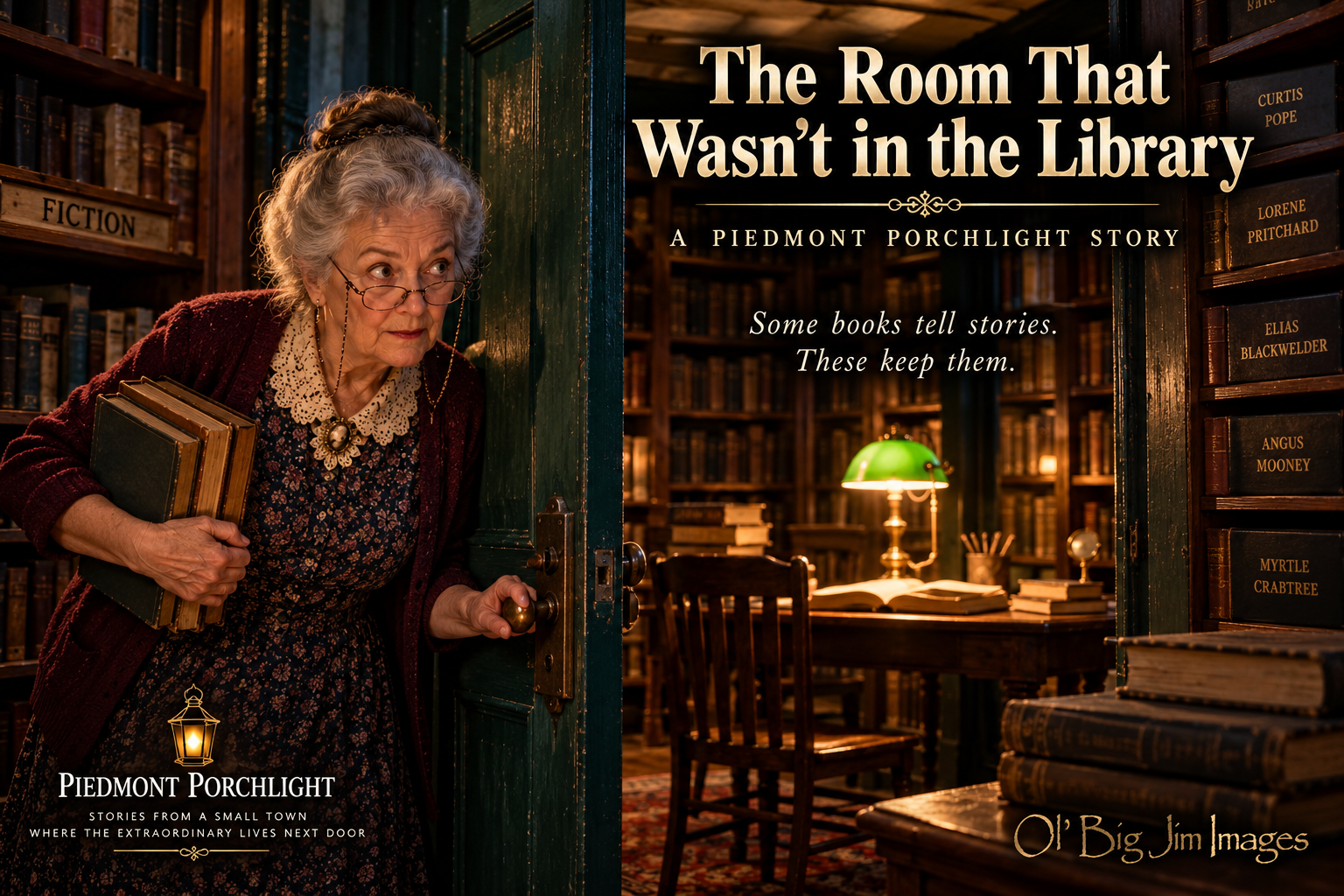
Inside, an elderly woman sat beneath a green-shaded lamp, reading a book.
She wore spectacles on a chain and had her steel-gray hair arranged in a bun.
She looked up.
“May I help you?”
Angus stared.
“Miss Myrtle?”
The woman smiled.
“Why, Angus Mooney. You’ve gotten tall.”
Angus swallowed.
“Miss Myrtle, I thought you was…”
He stopped.
“Retired?” she suggested.
“Well, yes’m. Something like that.”
Myrtle closed her book.
“Not quite, Angus. Not quite.”
He looked around the room.
There were shelves everywhere, filled with books bearing names instead of titles.
“What’s all this?”
“Special Collections.”
“Well, it ain’t supposed to be here.”
“Neither are you, Angus. Not just yet.”
He frowned.
“What do you mean?”
Myrtle glanced toward an empty space on the shelf beside her.
Then she looked at Angus.
“Tell me something, son. You still have that habit of reading the last page first?”
Angus blinked.
“How’d you know about that?”
“Because you used to do it every Saturday afternoon, and it made me want to take a switch to you.”
Angus gave a nervous little laugh.
Myrtle reached beneath the table and brought out a book.
It was bound in dark green cloth.
On the cover, stamped in gold letters, were two words.
ANGUS MOONEY
She placed it on the table.
“Well, Angus,” she said, “I believe this one’s yours.”
He reached for it.
Myrtle laid one hand across the cover.
“But I wouldn’t read the last page.”
“Why not?”
She looked at him over her spectacles.
“Because, honey, some things are considerably more pleasant when they come as a surprise.”
Angus withdrew his hand.
For a moment, neither of them spoke.
Then he looked toward the door.
“Miss Myrtle?”
“Yes, Angus?”
“Am I supposed to tell somebody about this room?”
Myrtle smiled.
“You may certainly try.”
Angus considered that.
Then he looked down at the book bearing his name.
“Reckon I’ll just go check the fuse box.”
“Probably wise.”
He turned to leave.
“Oh, and Angus?”
“Yes’m?”
“Close the door behind you. The books don’t care for drafts.”
Angus did as he was told.
When he looked back, the green door was gone.
Only the old bookcase remained, standing against a perfectly ordinary wall.
He stood there for a considerable time.
Then he reached into his pocket, took out his ring of keys, and headed downstairs.
He never mentioned the room to anybody.
Not because he was afraid they’d think he’d lost his mind.
And not because Myrtle had asked him to keep it secret.
But because, for the first time in his life, Angus Mooney had discovered a book whose ending he didn’t particularly want to know.
⁂
And if you ever find yourself in an old courthouse, wandering a hallway that seems a little longer than it ought to be, you might want to pay attention to the doors.
Especially the green ones.
And if you should happen upon a room full of books bearing people’s names, don’t be too quick to open one.
There’s a reason most folks read a story from beginning to end.
Some things simply aren’t meant to be known ahead of time.
And if an elderly woman with spectacles on a chain offers to help you find a particular volume, I’d advise you to thank her kindly and ask for something by Mark Twain instead.
Myrtle Crabtree always did have a soft spot for him.