
A Piedmont Porchlight Story
II. The Professor’s Memory
Daniel Mercer had always believed that fear announced itself with some degree of ceremony.
A sudden noise in a dark house. A rattlesnake beneath a pile of leaves. The unexpected appearance of a state trooper in the rearview mirror when one had been driving considerably faster than the law recommended.
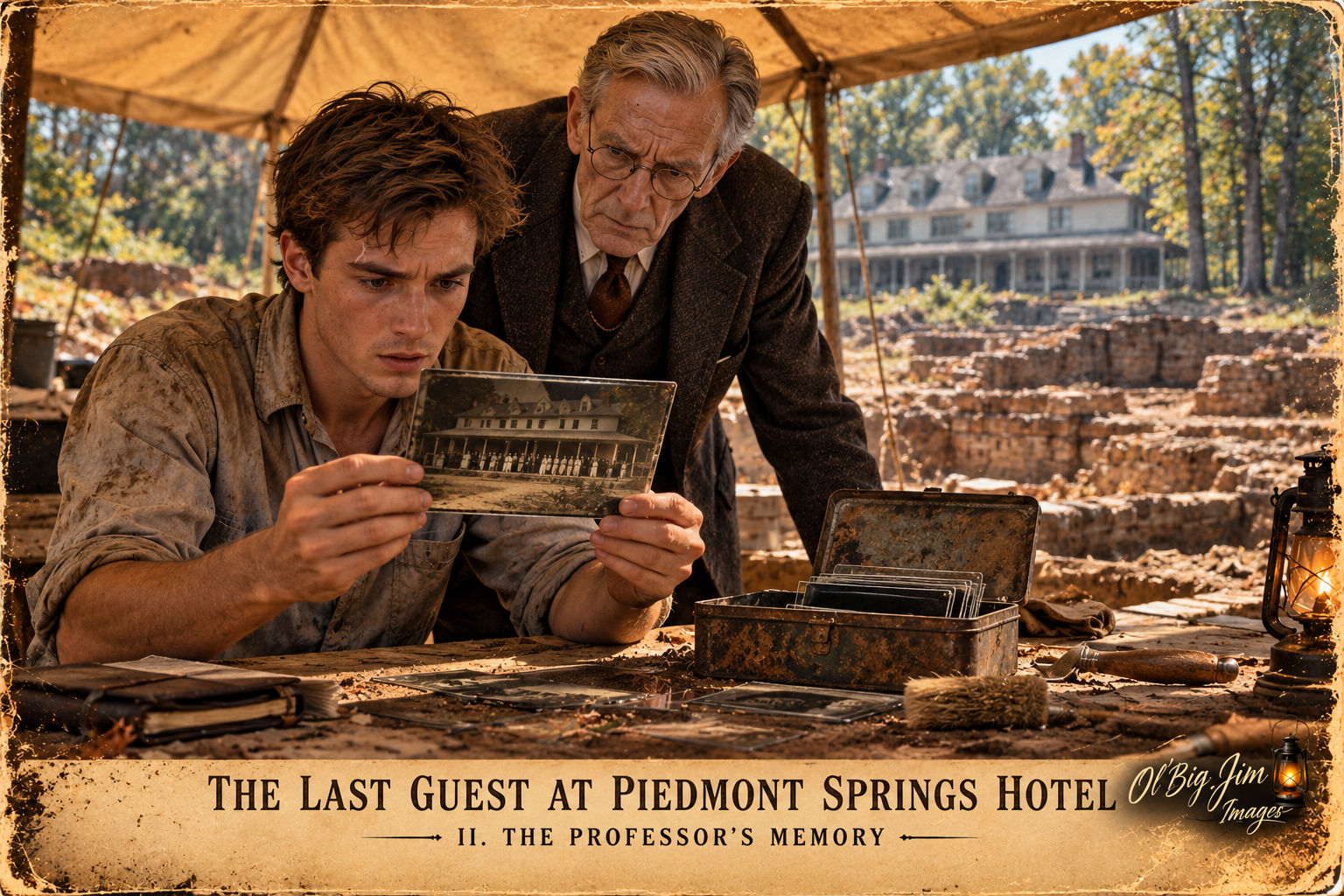
He’d never imagined genuine terror might arrive on a perfectly ordinary Tuesday morning, beneath a canvas canopy, while he held a piece of photographic glass.
Yet there it was.
His own face, staring back at him from October 17, 1893.
He turned the plate slightly, hoping the changing light might reveal some trick of perspective.
It didn’t.
The young man in the photograph had Daniel’s unruly brown hair, Daniel’s slightly crooked nose, and the little white scar above his left eyebrow.
He even stood the way Daniel stood, with his weight resting on his right leg and his left foot turned outward.
Daniel had acquired that habit after breaking his ankle playing baseball at fourteen.
He looked at Professor Whitcomb.
“That’s impossible.”
The professor said nothing.
“That man looks exactly like me.”
“I know.”
“And the man beside him looks exactly like you.”
“Yes.”
Daniel waited.
Whitcomb removed his spectacles and began polishing them with a handkerchief.
It was an ordinary gesture; one Daniel had watched a hundred times during lectures. Today, however, the professor’s hands were trembling.
“Professor, I think you’d better explain something.”
Whitcomb replaced his spectacles.
“How much of the excavation have you disturbed?”
Daniel stared at him.
“What?”
“The soil, Mr. Mercer. How much have you disturbed?”
“Maybe two feet. Why?”
“Did you find anything beneath the box?”
“No.”
“Are you certain?”
“Yes, I’m certain. What in God’s name is going on?”
Whitcomb glanced toward the excavation.
For a moment, Daniel thought the old man might simply walk away.
Instead, he pulled out a folding chair and sat down.
He looked suddenly exhausted.
“How old are you, Daniel?”
“Twenty-three.”
“And when is your birthday?”
“March nineteenth. You know that. It’s in my university records.”
“What year?”
“Two thousand three.”
Whitcomb nodded slowly.
“Yes. That’s right.”
Daniel felt a peculiar irritation rising beneath his fear.
“Professor, if this is some elaborate joke, I don’t find it particularly funny.”
“It isn’t a joke.”
“Then tell me what’s happening.”
Whitcomb folded his hands.
“Do you remember your first day in my classroom?”
“Of course.”
“What did I say to you?”
Daniel frowned.
“You told me I was late.”
“And?”
“You said punctuality was a professional obligation, not a personal preference.”
Whitcomb almost smiled.
“I’ve always been rather pleased with that observation.”
“Professor!”
“Do you remember what you said?”
Daniel thought for a moment.
“I said the parking situation was terrible.”
“No.”
“Well, something like that.”
“You told me you’d been delayed because your automobile wouldn’t start.”
Daniel stared at him.
“Oh, that’s right.”
“And I told you that time that an archaeologist who couldn’t maintain his own transportation was unlikely to maintain a proper excavation.”
Daniel remembered the exchange now.
He remembered the laughter from the other students.
He remembered how thoroughly embarrassed he’d been.
“What does that have to do with anything?”
Whitcomb looked at the photograph.
“Because the first time we met, you weren’t late.”
A breeze stirred the canvas overhead.
Somewhere beyond the excavation, a mockingbird began calling.
Daniel waited for the professor to continue.
“The first time,” Whitcomb continued, “you arrived twenty minutes early. You sat in the front row. You asked me whether I’d ever worked at an excavation where the historical evidence contradicted the archaeological record.”
Daniel shook his head.
“I never asked you that.”
“No. Not this time.”
The mockingbird stopped.
Whitcomb noticed.
Daniel could tell he noticed because the old man’s eyes moved toward the trees.
“Professor, you’re starting to scare me a little.”
“I know.”
“Then please quit talking in riddles.”
Whitcomb sighed.
“I’ve been trying to prevent you from coming here for a very long time.”
“Why?”
“Because you always find the photograph.”
Daniel looked down at the glass plate.
“Always?”
“Yes.”
“How many times?”
Whitcomb didn’t answer.
“Professor. How many times?”
The old man stared at his hands.
“Seventeen.”
Daniel laughed.
It was an unpleasant sound, even to his own ears.
“Seventeen times that I remember.”
“You’re telling me we’ve done this seventeen times?”
“No.”
Whitcomb looked up.
“I’m telling you that I’ve buried that photograph seventeen times. You’ve found it on eleven occasions. On the others, someone else discovered it.”
Daniel felt a chill despite the heat.
“What happened to those people?”
The professor looked away.
“Some of them lived.”
Daniel set the negative on the table.
Very carefully.
As though it might break if he moved too quickly.
“All right,” he said. “Suppose I believe you. Suppose this isn’t some kind of elaborate trick. What happens when somebody finds the negative?”
Whitcomb studied him for a long moment.
“Things begin to change.”
“What things?”
“Small things at first.”
“Such as?”
“Names. Dates. Places. People remember events differently.”
“People do that all the time.”
“Yes. That’s what makes it difficult to notice.”
Daniel pulled out the chair opposite him.
“Give me an example.”
Whitcomb considered the question.
“Do you remember the old stone bridge on the road coming here?”
“Sure.”
“What color was the railing?”
“Green.”
“It was white yesterday.”
Daniel frowned.
“Maybe somebody painted it.”
“Perhaps.”
“That doesn’t prove anything.”
“No.”
Whitcomb reached into the leather satchel beside his chair.
He removed a small notebook.
Its cover was cracked and worn, the leather darkened by age. A narrow elastic band held it closed.
He opened it to a page marked with a red ribbon.
“Your mother’s name is Rebecca Mercer.”
Daniel stiffened.
“Yes.”
“She was born in Anniston.”
“Yes.”
“She taught mathematics at Jacksonville State.”
“Until she retired.”
“And she died in February of last year.”
Daniel stared at him.
“My mother’s alive.”
Whitcomb closed his eyes.
For several seconds, the only sound was the rustling canvas.
Then the professor whispered, “Thank God.”
Daniel stood so abruptly that his chair fell backward.
“What did you just say?”
Whitcomb looked up.
“Daniel, please sit down.”
“My mother’s alive!”
“I believe you.”
“I talked to her yesterday!”
“Then she’s alive. And that’s a very good thing.”
Daniel grabbed his telephone.
He found his mother’s number and pressed the call button.
It rang.
Once.
Twice.
Three times.
“Hello?”
Her voice.
Perfectly ordinary.
Perfectly alive.
“Mom?”
“Daniel? Honey, what’s wrong?”
He swallowed.
“Nothing. I just wanted to hear your voice.”
“Well, that’s sweet. You sound funny. Are you getting enough sleep?”
“Yes, ma’am.”
“Have you eaten?”
Daniel almost laughed.
“Not yet.”
“Well, you ought to. You’re going to make yourself sick working out there in that heat.”
“I will.”
“All right, honey. Love you.”
“Love you, too.”
He ended the call.
Whitcomb was watching him.
“She’s alive,” Daniel said.
“Yes.”
“Why would you think otherwise?”
The professor opened the notebook again.
He turned it toward Daniel.
The page contained a single handwritten entry.
February 12, 2025. Rebecca Mercer deceased. Automobile accident on Highway 21.
Beneath it, in a different ink, someone had written:
October 27, 2026. Rebecca Mercer living. Daniel spoke with her at approximately 10:40 a.m.
Daniel looked at his telephone.
The time was 10:41.
He stared at the notebook.
“How did you write that?”
Whitcomb examined the entry.
His expression changed.
“I didn’t.”
“Then who did?”
The professor turned several pages backward.
Daniel watched the color drain from his face.
“What is it?”
Whitcomb didn’t answer.
“Professor?”
The old man slowly turned the notebook around.
There, written across an otherwise empty page in large, uneven letters, were six words.
HE FOUND IT EARLIER THIS TIME.
Daniel looked at the handwriting.
It was his own.
He knew it immediately.
The peculiar way he formed the capital H.
The backward slant of his lowercase letters.
The way his final E always looked unfinished.
He reached for the notebook.
Whitcomb caught his hand.
“Don’t touch that page.”
“Why?”
“Because I don’t know when you wrote it.”
Daniel stared at him.
“What does that mean?”
Whitcomb looked toward the excavation.
The mockingbird had begun calling again.
But something was wrong with its song.
The bird was repeating the same three notes.
Over and over.
Without variation.
As though somebody had recorded a few seconds of birdsong and neglected to let the recording finish.
Whitcomb stood.
“Daniel, listen to me very carefully.”
The young man couldn’t take his eyes off the notebook.
“There’s something I haven’t told you.”
Daniel gave a short, humorless laugh.
“Professor, I believe that just might qualify as the understatement of the century.”
Whitcomb ignored him.
“On October 17, 1893, twenty-three people were registered as guests at the Piedmont Springs Hotel.”
Daniel glanced at the photograph.
“All right.”
“By the following morning, the hotel was empty.”
“Empty?”
“Every guest. Every servant. Every member of the staff.”
“What happened to them?”
“No one knows.”
Daniel looked at the old man.
“But you were there.”
Whitcomb nodded.
“Yes.”
“Then you must know.”
The professor’s face seemed to collapse inward.
“I know what happened to twenty-two of them. The ones in the photograph.”
Daniel felt his throat tighten.
“And the twenty-third?”
Whitcomb looked directly at him.
“You.”
The mockingbird stopped again.
This time, the silence lasted considerably longer.
Daniel looked at the photograph.
The twenty-three figures stood upon the verandah beneath the afternoon sun.
He counted them.
Once.
Twice.
Twenty-three.
But something had changed.
He was certain of it.
The young man who looked like him was no longer smiling.
His mouth was open.
His face was twisted in an expression of unmistakable terror.
And Professor Whitcomb, standing beside him, had turned his head.
He was no longer looking toward the camera.
He was looking toward the young man.
Toward Daniel.
And in the photograph, his lips were moving.
Daniel leaned closer.
He couldn’t hear anything, of course.
It was a photograph.
A piece of glass.
An image captured more than a century ago.
But he could read the professor’s lips.
Three words.
Repeated again and again.
Don’t look behind you.
Daniel stood perfectly still.
He felt something move beneath the canvas canopy.
Not a breeze.
Not the shifting of a shadow.
Something that displaced the air behind him.
And then he heard a voice.
A woman’s voice.
Soft.
Familiar.
Impossible.
“Daniel, honey?”
His mother’s voice.
“Have you eaten?”