A Piedmont Porchlight Story
Today I’m gonna tell y’all a story I just happen to know about over at the Piedmont Springs Hotel. Oh, what a place that was! The healing waters, the supper tables groaning under the stupendous amounts of food, good company, beautiful music, and a body couldn’t ask for better. Now, I won’t tell you the whole story at once. Oh, no! We’ll be at the hotel for the next ten days! Oh yeah, the story’s that good! So, y’all put your knittin’ down and listen to me closely… you don’t want to miss a bit of this story!
JLW
I. The Things the Earth Keeps
The first thing Daniel Mercer learned about archaeology was that dirt didn’t give up its secrets willingly.
The second was that Alabama dirt was considerably less cooperative than the dirt he’d seen in textbooks.
By nine o’clock that Tuesday morning, he’d already ruined a perfectly good pair of jeans, scraped the skin off two knuckles, and discovered that the business end of a trowel could develop a personal grudge against the man holding it.
He was beginning to wonder whether he’d chosen the wrong profession.
“You’re digging like you’re trying to bury somebody,” Professor Elias Whitcomb observed.
Daniel looked up from the shallow excavation.
“At this point, Professor, I’m considering burying myself.”
Whitcomb didn’t smile. He seldom did.
He was a narrow, stooped man in his late seventies, with a face that looked as though somebody had carved it out of seasoned hickory and hadn’t bothered to sand the edges. His silver hair was always neatly combed, his spectacles always clean, and his clothes always looked as though he’d dressed for a funeral that had been postponed indefinitely.
He’d been teaching archaeology longer than Daniel had been alive.
Some said he’d been teaching it longer than Daniel’s father had been alive.
“Less conversation,” Whitcomb said. “More attention to the soil.”
“Yes, sir.”
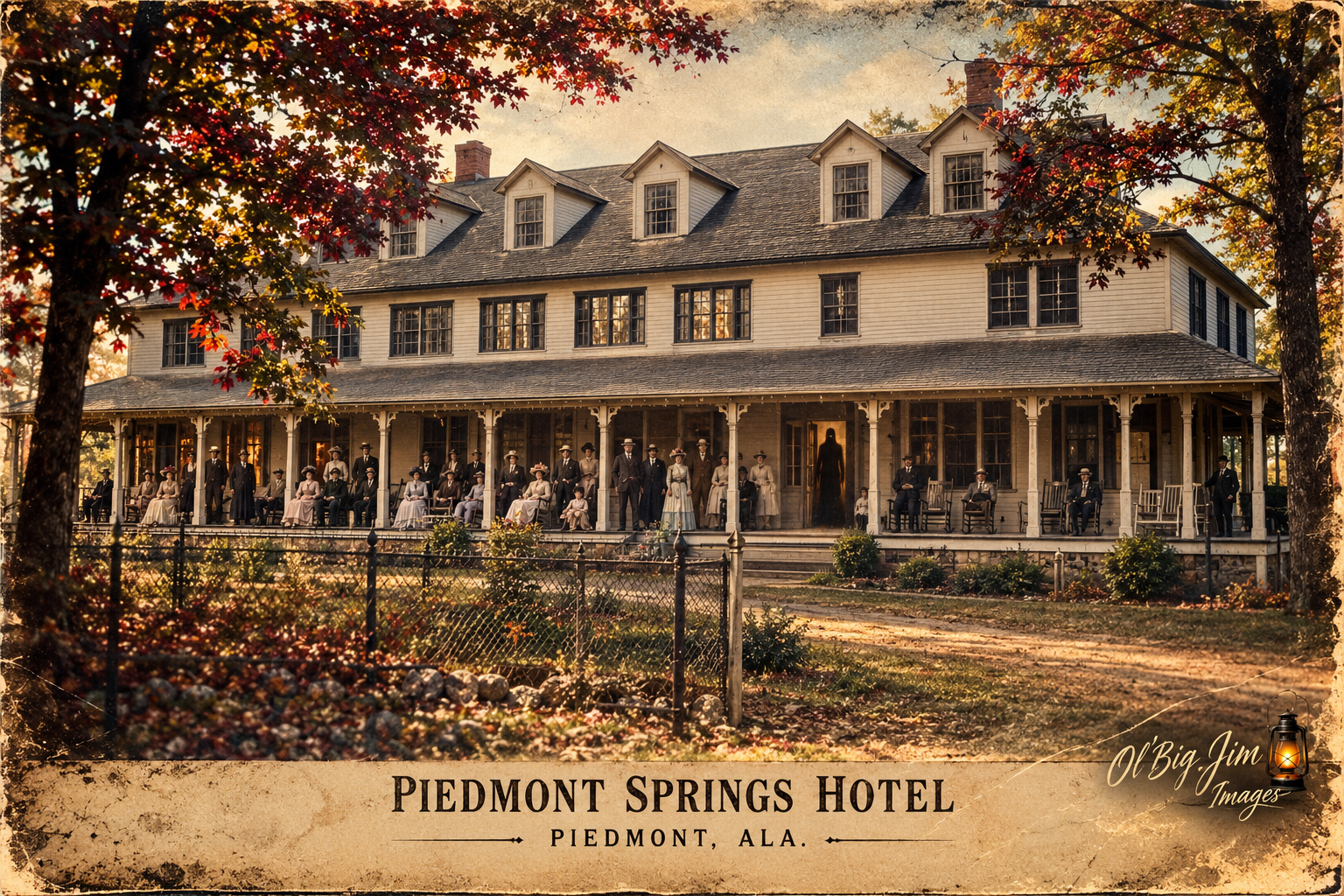
They were working among the remains of the old Piedmont Springs Hotel, a nineteenth-century resort that had once attracted visitors seeking the much-touted medicinal benefits of the local mineral waters. There wasn’t much left to suggest its former grandeur.
A few low stone walls protruded from the earth. Broken brick lay scattered among the roots of young trees. Here and there, an iron pipe emerged from the ground and disappeared again beneath decades of accumulated leaves.
The forest had been reclaiming the property for so long that it seemed faintly irritated by the interruption.
Daniel had seen an old photograph of the hotel in the university archives.
It had been a handsome place, with broad verandahs, tall windows, and enough decorative woodwork to keep a carpenter occupied until Judgment Day.
Ladies in elaborate dresses had once strolled beneath its shade trees. Gentlemen had gathered on the porch to discuss politics, business, and the shortcomings of everybody who wasn’t present.
Now the only guests were mosquitoes.
And the mosquitoes, Daniel had discovered, were considerably less particular about whom they entertained.
He returned to his digging.
His assignment was straightforward. The university had received permission to conduct a limited survey of the hotel’s foundations, and Daniel was helping document artifacts recovered from what appeared to have been a storage area near the main building.
So far, they’d found pieces of crockery, fragments of green and amber glass, several rusted nails, and a spoon that had apparently spent the better part of a century reconsidering its usefulness.
Nothing particularly remarkable.
Until his trowel struck something that didn’t sound like stone.
Clink.
Daniel stopped.
He brushed away a little dirt.
There was something metallic beneath the surface.
“Professor?”
Whitcomb was examining a pottery fragment several yards away.
“What is it?”
“I’ve found something.”
“People generally do when they dig, Mr. Mercer.”
“No, sir. I mean something interesting.”
Whitcomb sighed and made his way over.
Daniel carefully cleared the surrounding soil.
A corner of a small rectangular box emerged from the red clay.
It appeared to be made of tin, badly discolored but surprisingly intact.
Daniel worked around the edges until the box came free.
It was perhaps eight inches long and five inches wide. Its lid was secured by a narrow metal clasp, green with corrosion.
There was no writing on the outside.
No maker’s mark.
Nothing to suggest what it might contain.
“Shall I open it?” Daniel asked.
Whitcomb stared at the box.
For the first time that morning, something changed in the old man’s expression.
It was subtle.
A slight tightening around the mouth.
A momentary stillness.
“Where,” he asked quietly, “did you find that?”
Daniel pointed to the excavation.
“Right there. About eighteen inches down.”
Whitcomb looked at the exposed soil.
Then at the box.
Then back at the soil.
“That’s impossible,” he murmured.
“Sir?”
The professor seemed to recover himself.
“Nothing. Bring it over to the table.”
They carried the box to a folding worktable beneath a canvas canopy.
Whitcomb examined the clasp without touching it.
“May I?” Daniel asked.
The professor hesitated.
Then nodded.
Daniel slipped the tip of a small tool beneath the corroded fastening.
The clasp broke with a brittle snap.
He lifted the lid.
Inside, wrapped in what remained of a piece of dark cloth, were six photographic glass plates.
Daniel’s disappointment lasted only a moment.
“Well, I’ll be damned.”
“Language, Mr. Mercer.”
“Sorry, Professor.”
He lifted the first plate carefully by its edges.
The image was faint but recognizable.
A group of men and women stood on the broad front verandah of the Piedmont Springs Hotel.
The men wore dark suits and stiff collars. The women wore long dresses with high necklines and elaborate sleeves.
Behind them, the hotel’s tall windows reflected the afternoon light.
“Look at that,” Daniel whispered.
He held the plate toward the sunlight.
The second photograph showed the hotel’s dining room.
The third depicted a group of guests gathered beside the mineral spring.
The fourth showed the front entrance.
The fifth was badly damaged, its image obscured by dark stains and cracks.
Daniel reached for the sixth.
And Professor Whitcomb caught his wrist.
Not roughly.
But firmly enough to stop him.
“Don’t.”
Daniel looked up.
The professor’s face had gone pale.
“Sir?”
Whitcomb released his wrist.
For several seconds, neither man spoke.
Then the professor said, “Put it back.”
Daniel blinked.
“Back in the box?”
“Back in the ground.”
Daniel laughed, thinking he’d misunderstood.
“Professor, these could be historically significant. We ought to document them, preserve them, get them to the laboratory.”
“Put them back.”
The old man’s voice was scarcely above a whisper.
Daniel stared at him.
“Why?”
Whitcomb looked toward the trees. There was nothing there. Only the ordinary Alabama woods, quiet in the late morning heat.
“Because,” he said, “some things were buried for a reason.”
Daniel looked down at the sixth plate. It was clearer than the others. A group of perhaps twenty-three people stood on the hotel’s front verandah. Beneath them, someone had scratched a date into the glass.
October 17, 1893.
In the center of the photograph stood a tall, thin man wearing a dark suit.
He had neatly combed hair. Wire-rimmed spectacles. And a face that looked as though somebody had carved it out of seasoned hickory.
Daniel looked from the photograph to his professor. Then back again.
“Professor?”
Whitcomb closed his eyes.
“Oh, God,” he whispered.
Daniel examined the photograph more closely. Beside the thin man stood a younger fellow, perhaps twenty-two years old, wearing a light-colored shirt with the sleeves rolled up. He was smiling.
There was something familiar about that smile.
Something about the shape of the jaw.
The unruly hair.
The small scar just above the left eyebrow.
Daniel felt the blood drain from his face.
“Professor,” he said slowly, “that’s me.”
Whitcomb opened his eyes.
For a long moment, he said nothing.
Then he reached for the tin box.
“Put it back, Daniel.”
“But how can I be in a photograph taken before I was born?”
The old man looked toward the trees beyond the excavation.
His voice, when he finally answered, was almost too quiet to hear.
“Because the first time you found it, you didn’t listen to me.”