
A Piedmont Porchlight Story
III. The Woman Behind Him
“Daniel, honey?”
The voice came again.
“Have you eaten?”
Daniel didn’t move.
He couldn’t have moved if somebody had pumped a thousand volts into him.
The voice was his mother’s.
Not merely similar to hers. Not the voice of somebody doing a reasonably convincing imitation.
It was Rebecca Mercer, right down to the slight rasp she’d acquired after a winter bout of bronchitis three years earlier.
“Daniel?”
Professor Whitcomb had gone perfectly still.
His eyes were fixed on something beyond Daniel’s shoulder.
“Don’t answer her,” he whispered.
Daniel swallowed.
“Professor…”
“Don’t answer.”
“That’s my mother.”
“No.”
The word came out so sharply that Daniel flinched.
Whitcomb raised one trembling hand.
“Whatever you hear, whatever she says, you mustn’t turn around.”
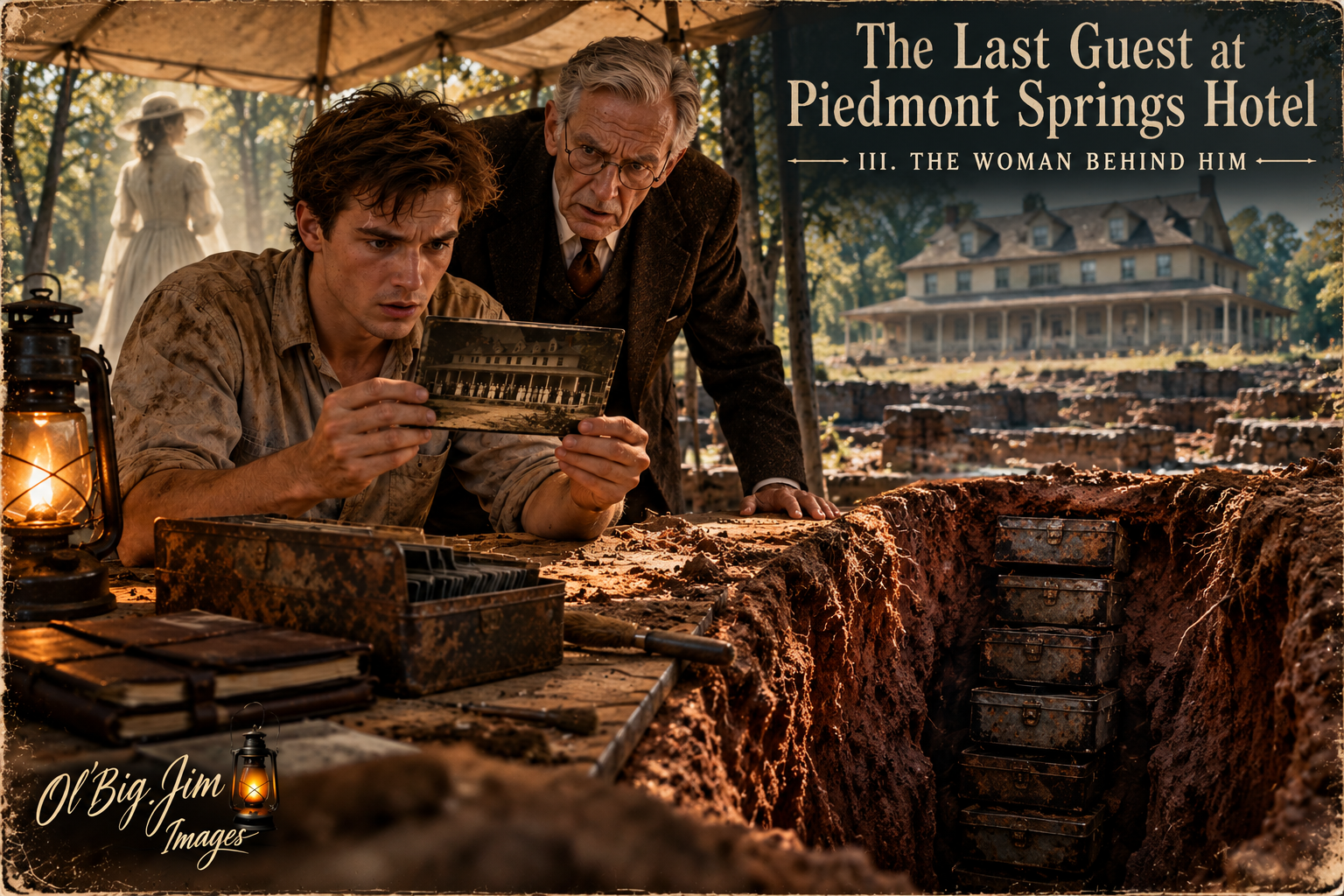
Behind Daniel, something shifted.
He heard the faint crunch of gravel beneath a shoe.
Then another.
Slow footsteps, approaching the canopy.
“Daniel, sweetheart, I know you can hear me.”
There was a little laugh.
His mother’s laugh.
The one she used when he’d done something foolish and she was trying not to make him feel worse about it.
“You’re being silly, honey. Turn around and look at me.”
Daniel’s eyes filled with tears.
“Mom?”
Whitcomb seized his arm.
“Daniel!”
The footsteps stopped.
For several seconds, nothing happened.
Then the woman behind him sighed.
It was a small, disappointed sound.
“Well, Elias,” she said, “you’ve made a mess of things again.”
Whitcomb closed his eyes.
Daniel looked at him.
“She knows you.”
The professor didn’t answer.
“Professor, she knows your name.”
“Yes.”
“Who is she?”
Whitcomb opened his eyes.
And for the first time since Daniel had met him, the old man looked genuinely old.
Not seventy or eighty.
Older than that.
Older than seemed possible.
“Someone I should have listened to,” he said.
Behind them, the woman laughed again.
“Oh, Elias. You never were much good at listening.”
The canvas overhead stirred.
A faint breeze moved through the excavation, carrying the smell of damp earth and something else.
Daniel recognized it immediately.
Rosewater.
His mother kept a little bottle of rosewater on her dressing table. She’d used it for as long as he could remember.
The scent had been part of his childhood.
It was the smell of bedtime kisses, freshly laundered pillowcases, and the Sunday mornings when she’d dressed for church.
“Professor,” he whispered, “I can smell her perfume.”
“I know.”
“How?”
Whitcomb stared at the ground.
“Because she remembers what you remember.”
Daniel felt his stomach turn.
“What does that mean?”
The professor didn’t answer.
The woman spoke again.
“Tell him, Elias.”
Whitcomb shook his head.
“Tell him why you buried the photographs.”
“Be quiet.”
“Tell him why you keep bringing him back.”
“I said be quiet!”
The old man’s shout echoed through the trees.
And then something peculiar happened.
The birds began singing again.
Not gradually.
Not one after another.
Every bird in the surrounding woods began calling at precisely the same instant.
A tremendous, discordant chorus erupted among the trees.
Then stopped.
All at once.
The silence afterward was absolute.
Daniel could hear his own heartbeat.
The woman sighed.
“Seventeen times, Elias. Seventeen times you’ve put that little box back in the ground.”
Whitcomb said nothing.
“And still you haven’t learned.”
Daniel looked down at the notebook.
The page bearing his handwriting had changed.
The seven words were gone.
In their place was a single sentence.
Ask him about the first burial.
Daniel stared at it.
“Professor?”
Whitcomb followed his gaze.
His face went white.
“Don’t.”
“What happened at the first burial?”
“Daniel, please.”
“Who buried the box the first time?”
Whitcomb looked toward the trees.
The woman behind Daniel made a small, satisfied sound.
“There now,” she said. “That’s the question.”
Daniel felt the professor’s grip tighten.
“You’re assuming the first burial happened in 1893.”
Daniel frowned.
“Didn’t it?”
“No. It happened much later.”
“How much later?”
Whitcomb hesitated.
“October twenty-eighth, two thousand twenty-six.”
Daniel stared at him.
“That’s tomorrow.”
“Yes.”
The woman laughed softly.
“Oh, Elias. You really shouldn’t have told him that. He asked who buried it the first time, not when.”
Daniel looked at the photograph.
The twenty-three people stood on the verandah.
He counted them again.
Twenty-three.
Then he noticed something that made his skin crawl.
There was a space between two of the figures.
Not an empty space.
A place where somebody ought to have been standing.
The surrounding people were turned slightly toward it, their bodies arranged as though making room for another person.
But there was nobody there.
Daniel leaned closer.
A pale shape began to appear in the gap.
First a suggestion of shoulders.
Then a face.
A woman’s face.
He knew it before the image had fully formed.
“Mom?”
Whitcomb snatched the photograph away.
Too late.
The woman behind Daniel whispered, “There you are, sweetheart.”
And Daniel turned around.
There was nobody there.
Only the canvas canopy, the folding table, and the quiet Alabama woods beyond.
No woman.
No footsteps.
No rosewater.
Daniel stood staring at the empty space.
Then he heard Professor Whitcomb make a sound.
A terrible, broken sound.
He turned back.
The professor was looking at the photograph.
His hands shook so badly that the glass rattled against his fingernails.
“Professor?”
Whitcomb didn’t answer.
Daniel stepped closer.
“What’s wrong?”
The old man slowly turned the plate toward him.
There were twenty-three people on the hotel verandah.
Daniel was no longer among them.
In his place stood Rebecca Mercer.
She wore a long nineteenth-century dress, her hair pinned neatly beneath a small hat.
She was smiling.
And beside her, Professor Whitcomb had raised one hand.
He was pointing toward something outside the photograph.
Toward Daniel.
The professor lowered the plate.
“Oh, God,” he whispered.
“What?”
Whitcomb looked at him.
“She’s taken your place.”
Daniel stared.
“What does that mean?”
The old man opened his mouth.
Then closed it.
He looked down at the notebook.
Its pages began turning.
Not quickly.
One at a time.
As though somebody were reading them.
The pages stopped at a blank sheet.
Words appeared.
Slowly.
In Daniel’s handwriting.
The professor has forgotten the most important thing.
Whitcomb stared at the sentence.
Then another appeared beneath it.
He wasn’t the first person to bury the box.
The professor whispered something Daniel couldn’t hear.
A third sentence formed.
And he wasn’t the one who brought me here.
Daniel looked at him.
“Professor?”
Whitcomb raised his head.
There was something dreadful in his expression.
Not fear.
Recognition.
He looked past Daniel, toward the excavation.
Toward the shallow hole from which the tin box had been recovered.
“Dear God,” he murmured.
Daniel followed his gaze.
Something was moving in the exposed soil.
A small patch of red clay rose slowly, as though something beneath it were pushing upward.
The earth cracked.
A narrow line appeared.
Then another.
Daniel stepped forward.
Whitcomb caught his sleeve.
“Don’t.”
But Daniel was already looking.
Beneath the disturbed clay lay the corner of a second tin box.
Identical to the first.
Same dimensions.
Same corroded clasp.
Same dark discoloration.
Daniel stared at it.
“How can there be another one?”
Whitcomb didn’t answer.
The earth shifted again.
And beneath the second box, Daniel saw the edge of a third.
Then a fourth.
All buried one beneath another.
Like the pages of a book.
Daniel looked at his professor.
“How many times did you say you’d buried the photograph?”
Whitcomb’s lips moved.
“Seventeen.”
Daniel looked back at the excavation.
There were more boxes beneath the fourth.
He could see their edges disappearing into the red clay.
A whole column of them.
Descending farther than the shallow excavation should have allowed.
He began counting.
Five.
Six.
Seven.
Eight.
He stopped at twelve.
There were still more below.
“Professor?”
Whitcomb was staring into the hole.
His face had gone slack.
And then, very quietly, he said something that frightened Daniel more than anything he’d heard that morning.
“I’ve never seen those before.”
From somewhere deep beneath the excavation came the sound of a woman laughing.
Not Rebecca Mercer’s laugh.
Another woman’s.
Older.
Lower.
And terribly pleased.
Then a voice rose from the earth.
“Well, Elias,” it said, “I reckon it’s about time you remembered me.”