
A Piedmont Porchlight Story
IV. The Woman Who Wasn’t There
Professor Elias Whitcomb had spent most of his professional life explaining to young people that archaeology was the study of what remained.
Pottery remained. Foundations remained. Bones, coins, broken dishes, and the occasional unfortunate chamber pot remained.
People, generally speaking, did not.
He had been wrong about that last part.
He’d been wrong about quite a few things.
But until that Tuesday morning, he’d never suspected just how wrong.
The voice came again from beneath the excavation. “Elias, honey, are you going to stand there all day?”
Daniel Mercer looked from the exposed boxes to his professor. “You know her?”
Whitcomb didn’t answer.
“Elias?” The old man took a step backward.
Daniel had never seen him retreat from anything. Not an angry department chairman, not a rattlesnake they’d encountered during a field survey, and certainly not a question from an undergraduate.
Now he looked ready to run.
“Professor?”
Whitcomb’s mouth worked silently. At last, he whispered, “Mrs. Bellweather.”
The earth beneath the excavation settled. For a moment, nothing moved. Then the voice laughed.
“Well, I swanee. You do remember.”
Daniel looked into the hole.
“Mrs. Bellweather?”
“Don’t speak to her,” Whitcomb said.
“Why?”
“Because she answers.”
Daniel stared at him.
“Well, that’s generally how conversation works.”
“Not with her.”
From beneath the red clay came a sound like somebody drawing a fingernail along the teeth of a comb.
“Still frightenin’ the children, Elias? You never did have much faith in their judgment.”
Whitcomb knelt beside the excavation.
“Agnes.”
“That’s better.”
“Leave him alone.”
“Now, why would I do that?”
“He’s done nothing to you.”
There was a long silence.
Then the voice said, almost tenderly, “Oh, Elias. He hasn’t done it yet.”
Daniel felt a coldness move through him.
He looked down at the boxes. “Who is she?”
Whitcomb remained on his knees. “Agnes Bellweather was the proprietor of the Piedmont Springs Hotel.”
“Was?”
“Yes.”
“When?”
“1893.”
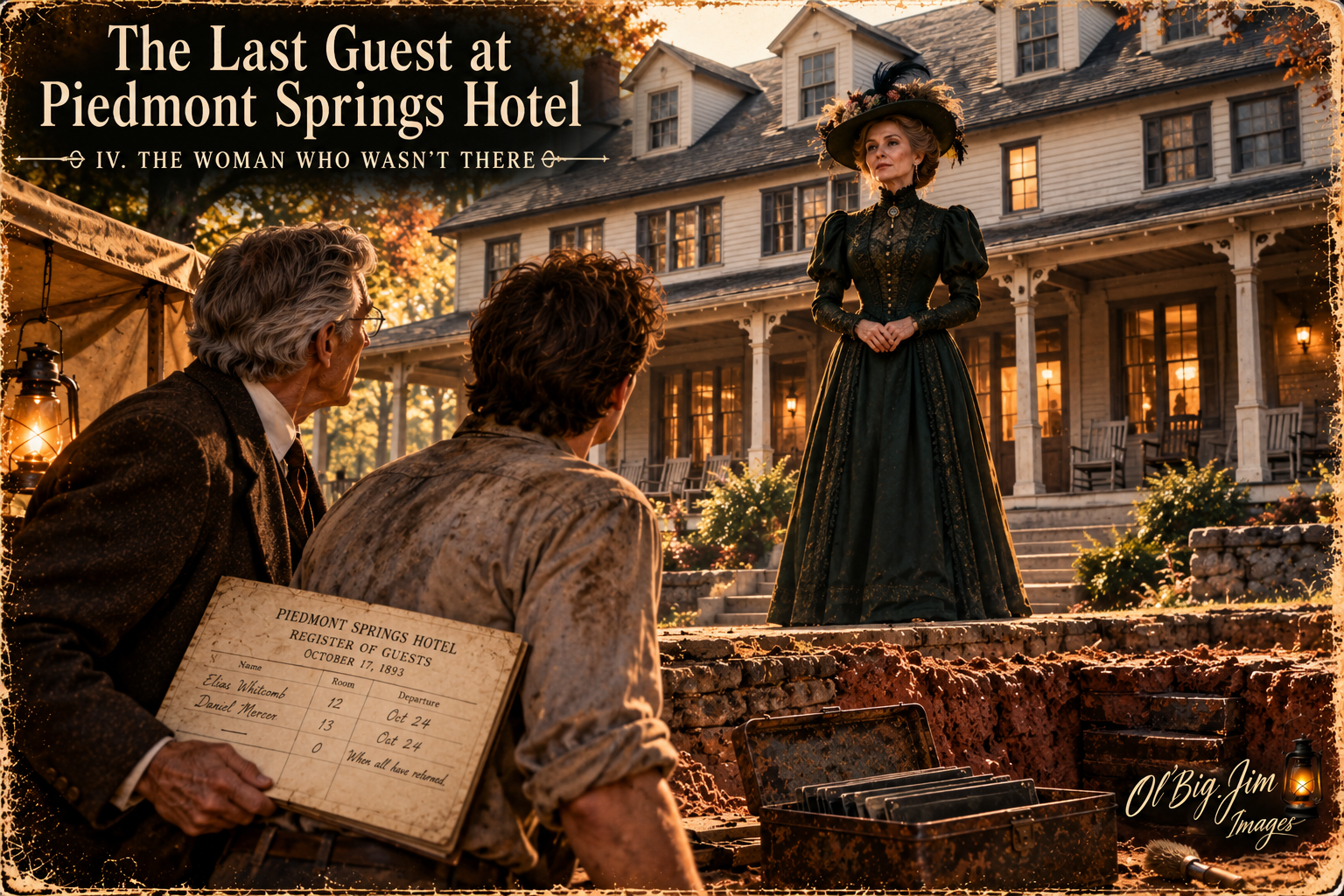
Daniel looked at the ground. “Then she’d be…”
“Dead?” the woman supplied.
She laughed again. “Everybody keeps coming back to that little detail.”
Whitcomb closed his eyes. “Agnes, please.”
“Don’t you Agnes-please me. I’ve been under this miserable patch of Alabama clay long enough to hear the worms complain about the accommodations.”
Daniel looked at his professor. “If she’s the hotel proprietor, why isn’t she in the photograph?”
Whitcomb’s eyes opened. The woman stopped laughing. For several seconds, the entire excavation seemed to listen.
Then Agnes Bellweather said, “Well, now. There’s a clever boy.”
Whitcomb seized Daniel’s wrist. “Don’t ask her anything else.”
“Professor, I have a right to know what’s happening!”
“No, Daniel. That’s precisely what you don’t have.”
The words hung between them. Whitcomb seemed immediately to regret them. Daniel pulled his hand free.
“What do you mean?”
The professor looked toward the trees. “I mean there are things a man can learn that he cannot afterward unknow.”
“That’s a rather convenient argument coming from an archaeology professor.”
“Yes,” Whitcomb said. “It is.”
Beneath them, Agnes chuckled.
“I always did like the clever ones.”
Something shifted in the excavation. A little mound of clay rose beside the uppermost box. Then another. Daniel stepped backward. The earth began arranging itself into a narrow ridge, perhaps three feet long, with a rounded swelling at one end. It looked unpleasantly like a body beneath a blanket.
Whitcomb stood. “Agnes, don’t.”
The clay cracked. A pale shape emerged. Not a hand. Not a face. A folded piece of paper. It rose slowly from the soil, perfectly clean despite the surrounding dirt.
Daniel stared.
“Good Lord.”
The paper unfolded itself. There were words written across it in a flowing nineteenth-century hand.
Piedmont Springs Hotel
Register of Guests
October 17, 1893
Below the heading were twenty-three names followed by one final entry without a name.
Daniel recognized two immediately.
Elias Whitcomb.
Daniel Mercer.
Beside each name was a room number. Whitcomb occupied Room 12. Daniel occupied Room 13. But the last entry was different.
There was no name.
Only a room number.
Room 0.
And beside it, in a column headed Departure, someone had written:
When all have returned.
Daniel looked at the professor.
“What is Room Zero?”
Whitcomb said nothing.
Agnes answered. “The room that was never built.”
Daniel frowned. “That doesn’t make sense.”
“Most things don’t, sweetheart, until you’ve seen ’em from the proper side.”
The paper turned over. On the reverse was a drawing of the hotel. Not the familiar front elevation Daniel had seen in the archives, but a floor plan. He recognized the dining room, the verandah, the long central corridor, and the guest chambers arranged along either side. There were twelve rooms on the first floor. Twelve on the second.
And one more.
A small square drawn beneath the main staircase.
Room 0.
Daniel leaned closer. “Professor, this isn’t on the original plans.”
“I know.”
“Was it a cellar?”
“No.”
“A storage room?”
“No.”
“Then what was it?”
Whitcomb looked at the drawing. His expression had changed. The fear was still there, but something else had joined it. Grief.
“An invitation,” he said.
Agnes Bellweather made a sound that might have been a sigh.
“Oh, Elias. You do remember more than you think.”
Daniel had never been particularly religious.
He’d attended church as a boy because his mother believed a young man ought to receive at least a nodding acquaintance with the Almighty before deciding whether the relationship was worth maintaining.
He’d enjoyed the singing.
He’d disliked the sermons.
And he’d never been entirely convinced that the preacher knew any more about eternity than the fellow who repaired the church air conditioner.
But standing beside that excavation, watching a piece of paper suspend itself in the still Alabama air, Daniel found himself reconsidering several theological questions.
“Professor,” he said, “I want to leave.”
Whitcomb nodded. “That’s sensible.”
“I mean right now.”
“Yes.”
Daniel gathered his notebook and telephone. He didn’t bother with the trowel. The university could buy another. He turned toward the path leading to the parking area.
And stopped.
The path was gone.
Not overgrown.
Not obscured.
Gone.
Where a narrow trail had led through the trees that morning, there now stood a low stone wall.
It was old.
Very old.
Moss covered the mortar.
Young trees had grown against it.
A thick root had split one corner.
Daniel stared. “That wasn’t there.”
“No,” Whitcomb said.
Daniel walked toward the wall. Beyond it, the woods looked unfamiliar. The slope of the land was wrong. The trees were larger. And somewhere in the distance, he heard the unmistakable whistle of a steam locomotive.
He turned. “Professor?”
Whitcomb was staring at the wall.
Agnes spoke from the ground. “Oh, don’t look so surprised, Elias. You knew the grounds were going to change.”
Whitcomb shook his head. “Not yet.”
“Well, somebody’s been in a hurry.”
Daniel looked back toward the excavation. The paper had disappeared. So had the boxes. The shallow trench was empty. He walked toward it. There was nothing beneath the clay except ordinary earth.
He looked at his professor. “Where did they go?”
Whitcomb approached slowly.
He knelt and touched the soil.
Then he stood.
“Somebody’s closed the excavation.”
“Who?”
The professor looked toward the hotel ruins. Or rather, toward where the ruins had been. Daniel followed his gaze. And felt his knees weaken.
The Piedmont Springs Hotel stood among the trees.
Not a ruin.
Not a reconstruction.
A hotel.
Its broad verandah stretched across the front. Tall windows gleamed in the afternoon light. Square, white porch posts supported the roof, and decorative wooden trim ran along the eaves.
Smoke rose from a chimney.
A horse stood tethered near the entrance.
And from somewhere inside came the faint sound of a piano.
Daniel stared. “That’s impossible.”
Whitcomb said nothing.
A woman in a long blue dress stepped onto the verandah. She carried a folded cloth over one arm. Her dark hair was arranged beneath a small white cap.
She looked toward the two men.
Then raised one hand.
“Professor Whitcomb!” she called.
The old man didn’t move.
“Professor! Mrs. Bellweather says you’re late!”
Daniel looked at him. “Who is that?”
Whitcomb’s voice was barely audible. “Clara.”
“Clara who?”
“Clara Jennings. She worked at the hotel.”
“Worked?”
Whitcomb nodded. “She disappeared with the others.”
Daniel stared at the woman. “Then how can she be standing there?”
Whitcomb watched Clara turn and disappear into the hotel. “Because,” he said, “we haven’t reached the night she disappeared.”
Daniel looked at his telephone.
The screen was black.
He pressed the power button.
Nothing.
He held it down.
Still nothing.
Then, slowly, pale letters appeared across the glass.
Not the familiar startup screen.
Not a notification.
A date.
October 17, 1893.
Beneath it was a single sentence.
Welcome back, Mr. Mercer.
The front doors of the hotel opened.
A tall woman stepped onto the verandah.
She wore a dark green dress with a high collar and narrow sleeves. Her hair was pinned neatly at the back of her head, and a small cameo rested at her throat.
She was perhaps fifty years old.
Maybe sixty.
There was something difficult to determine about her age.
Her face was handsome without being particularly beautiful, and her expression suggested the sort of woman who could manage a hotel full of demanding guests, settle an argument between two drunken legislators, and supervise the preparation of supper without once raising her voice.
She looked directly at Daniel.
Then smiled.
“Well, there you are.”
Whitcomb took a step backward.
“Agnes.”
The woman descended the verandah steps.
“Don’t look so miserable, Elias. You’ve come home.”
Daniel stared at her. “Mrs. Bellweather?”
“That’s right, sweetheart.”
He glanced toward the excavation. “But you were…”
“Under the ground?”
She smiled. “Well, I couldn’t very well come out until you found me, could I?”
Daniel looked at Whitcomb.
The professor’s face had gone gray.
Agnes approached them.
She stopped a few feet away.
For the first time, Daniel noticed something peculiar about her shadow.
The afternoon sun stood behind her, yet her shadow stretched toward the hotel rather than away from it.
And it didn’t resemble a woman.
It was long and narrow.
Far too long.
Its edges shifted across the grass like the legs of some enormous insect.
Daniel blinked.
The shadow became ordinary.
Agnes watched him. “Something troubling you, Mr. Mercer?”
He swallowed. “No, ma’am.”
“Good. We don’t encourage unpleasantness at Piedmont Springs.”
She turned to Whitcomb. “Now, Elias, I believe you owe me an apology.”
The professor stared at her. “For what?”
Agnes’s smile faded. “For telling that boy I owned this hotel.”
Daniel frowned.
Whitcomb said nothing.
Agnes looked back at Daniel. “I’ve never owned a hotel in my life, sweetheart.”
“Then who are you?”
She considered the question.
For the first time, her expression seemed genuinely uncertain.
“That’s rather difficult to explain.”
She glanced toward the open doors. “Perhaps you’d better come inside.”
Whitcomb caught Daniel’s arm. “No.”
Agnes looked at him. “Still giving orders, Elias?”
“He isn’t going inside.”
“Well, of course he is.”
“No.”
Agnes sighed. “You’re making this unnecessarily difficult.”
Whitcomb stepped between her and Daniel. “You’ve had him seventeen times. Isn’t that enough?”
Agnes regarded him with something approaching pity. “Oh, Elias.”
She shook her head.
“You still think those were the same boy.”
Whitcomb went perfectly still.
Daniel looked from one to the other.
“What does she mean?”
Agnes stepped closer.
Her voice softened. “Professor Whitcomb has been trying to save you for a very long time, Daniel.”
“I know.”
“No, sweetheart. You don’t.”
She reached into a pocket of her dress.
From it she withdrew a small brass key.
A black enamel tag hung from the ring.
13.
Daniel stared at it.
Agnes held it out.
“Your room is ready.”
Whitcomb made a strangled sound.
“Agnes, please.”
She ignored him.
Daniel looked at the key.
“Why would I need a room?”
Agnes smiled.
“Because you’ve been expected.”
“By whom?”
She looked toward the hotel.
For a moment, something moved behind one of the upstairs windows.
A pale face.
Then another.
Then several.
All watching.
Agnes lowered her voice. “By the others.”
Daniel felt a coldness settle over him. “What others?”
Agnes looked at Whitcomb. “Tell him, Elias.”
The professor shook his head.
“Tell him what you’ve been digging up all these years,” she continued.
Whitcomb’s lips trembled.
Agnes’s expression hardened. “Tell him what was in those boxes.”
Daniel turned toward his professor. “Photographs.”
Whitcomb said nothing.
“Professor?”
The old man looked at the hotel.
Then at Daniel.
His eyes filled with tears. “No, son.”
He swallowed. “They weren’t photographs.”
Daniel stared at him. “What?”
Whitcomb closed his eyes. “They were records.”
“Records of what?”
The professor opened his eyes.
And Agnes Bellweather answered for him. “Of all the Daniels who came before you.”
She held out the key again. “And all the ones who never got to leave.”
Somewhere inside the hotel, the piano stopped playing.
A door slammed upstairs.
Then another.
Agnes glanced toward the building. “Well,” she said, “it looks like supper’s nearly ready.”
Daniel looked at the brass key.
Then at the professor.
“How many?”
Whitcomb didn’t answer.
“How many Daniels?” Daniel pressed.
The old man stared at the ground.
“Seventeen?”
Then he shook his head.
Daniel felt his stomach turn. “More?”
The professor looked up. “I don’t know.”
Agnes smiled. “Oh, I do.”
Daniel turned toward her.
She slipped the key back into her pocket.
“Seventeen is how many times Elias has remembered.”
She looked toward the excavation.
“Before that, he was rather forgetful.”
Whitcomb made a small, broken sound.
Agnes regarded him for a moment.
Then she said something that seemed to trouble even her.
“Although I must confess, Elias, there’s one thing I don’t understand.”
Whitcomb looked up. “What?”
Agnes turned toward Daniel. “Every time we begin again, you’re supposed to arrive alone.”
Daniel stared at her. “And?”
She looked beyond him.
Toward the trees.
Her smile disappeared. “Someone has come with you.”
Daniel turned.
At the edge of the woods stood a woman.
She wore jeans and a pale blue blouse.
Her brown hair was pulled back in a loose ponytail.
In one hand she carried a handbag.
In the other, a mobile telephone.
Daniel knew her immediately.
“Mom?”
Rebecca Mercer stood motionless beneath the trees.
Her expression was frightened.
But she wasn’t looking at Daniel.
She was looking at Agnes Bellweather.
And when she spoke, her voice was very different from the gentle, familiar voice Daniel had heard earlier.
“Get away from my son.”
Agnes stared at her.
For the first time, the woman in the green dress looked genuinely afraid.
“Rebecca?”
Daniel’s mother took one step forward.
“That’s right.”
Agnes retreated.
Only a step.
But Daniel saw it.
So did Whitcomb.
Rebecca raised her telephone.
Its screen glowed with a pale blue light.
“Now,” she said, “I believe you have something that belongs to me.”
Agnes’s expression changed.
The pleasant hotel proprietor vanished.
Something ancient looked out through her eyes.
Something that had never been human.
Something that had worn humanity like a borrowed coat for so long that it had almost forgotten the garment wasn’t its own.
“You,” Agnes whispered.
Rebecca smiled.
Not kindly.
Not pleasantly.
But with the grim satisfaction of a woman who had finally found the person responsible for a very old grievance.
“Yes,” she said.
“Me.”
And from somewhere deep beneath the Piedmont Springs Hotel came a sound like a thousand people drawing breath at once.