
A Piedmont Porchlight Story
VII. The Children Who Never Came Home
The first thing Daniel Mercer noticed was that the screaming had stopped.
The second was that the silence was considerably worse.
The thing emerging from the hotel filled the doorway without appearing to possess any particular shape. It seemed to be composed of people standing behind other people, with still more people standing behind them, extending backward into a distance that could not possibly exist inside the building.
Faces appeared and vanished.
A little girl with yellow ribbons.
An elderly man wearing a railroad conductor’s cap.
A young soldier with blood on his collar.
A woman holding an infant.
They looked out at Daniel with expressions that ranged from bewilderment to terror.
And every one of them seemed to be trying to say something.
The keeper stood at the foot of the verandah steps, its long arms raised.
“Remain where you are.”
The thing in the doorway moved.
A thousand voices whispered at once.
Home.
Daniel felt the word rather than heard it.
It passed through his chest like a cold wind.
Home.
Rebecca Mercer gripped his hand.
“Don’t listen.”
Daniel looked at her.
“They’re asking to go home.”
“I know.”
“Then why can’t they?”
Rebecca’s expression crumpled.
“Because some of their homes don’t exist anymore.”
The keeper lowered one hand.
The mass in the doorway pressed forward.
The verandah boards bowed beneath a weight that seemed to increase with every passing second.
“Agnes,” the keeper said.
The woman in green looked up.
“Yes?”
“Close the doors.”
Agnes stared.
“I can’t.”
“You must.”
“I haven’t got the key.”
The keeper turned its impossible face toward her.
For a moment, even the whispering stopped.
“Where is it?”
Agnes began trembling.
“The key to Room Zero?”
The keeper’s impossible face turned toward her.
“What other key would I mean?”
Agnes glanced at Daniel.
“The key I showed him was for Room Thirteen. I still have that one.”
“Then where is the other?”
Her voice dropped to a whisper.
“I gave it away.”
Professor Whitcomb looked at her.
“Agnes?”
She shook her head.
“I didn’t know what would happen.”
The keeper took one step toward her.
“To whom?”
Agnes looked at Daniel.
And that was when he remembered the little brass key she’d offered him.
Room 13.
The key she had slipped back into her pocket.
He stared at her.
“Who has it?”
Agnes’s eyes filled with tears.
“A boy.”
“What boy?”
She looked toward the hotel.
“A boy who was tired of waiting.”
The figure in the doorway moved again.
This time, a child stepped out of it.
He was perhaps ten years old, with dark hair, a narrow face, and a faded red sweater.
He looked perfectly ordinary.
Except for his eyes.
They were the eyes of somebody who had watched too many years pass.
He descended the steps.
The keeper raised one hand.
“Stop.”
The boy stopped.
Then smiled.
“Hello.”
His voice was clear and pleasant.
Daniel felt an immediate and terrible familiarity.
“Who are you?”
The boy looked at him.
“You know.”
Daniel shook his head.
“No.”
The boy sighed.
“You always say that.”
Rebecca moved in front of Daniel.
“Go back inside.”
The boy looked at her.
“Hello, Mama.”
Rebecca went white.
Daniel stared.
“Mom?”
The boy smiled.
“Don’t worry. She doesn’t remember me either.”
He looked toward Whitcomb.
“Do you, Professor?”
The old man began shaking.
“No.”
The boy nodded.
“That’s all right.”
He glanced toward the hotel.
“Most people forget the ones who don’t work out.”
Daniel felt sick.
“What does that mean?”
The boy looked at him.
“Sometimes you don’t grow up.”
Daniel stared.
The boy touched his chest.
“Sometimes you don’t even get to be born.”
Rebecca made a strangled sound.
The boy continued.
“Sometimes Mama changes her mind. Sometimes Daddy never comes home. Sometimes the doctors say there’s nothing they can do.”
He looked at Daniel.
“And sometimes the world decides there isn’t room for you.”
The keeper spoke.
“You must return.”
The boy turned.
“Why?”
“Because you belong to a history that was not chosen.”
The boy’s smile disappeared.
“That’s a dreadful thing to tell a child.”
The keeper lowered its head.
“I know.”
For a moment, Daniel thought he heard genuine sorrow in its voice.
The boy looked back at him.
“Do you know what it’s like in there?”
Daniel shook his head.
“No.”
“It’s not terrible all the time.”
He glanced toward the windows.
“Sometimes we play. Sometimes we tell stories. Sometimes we remember our mothers.”
His expression changed.
“But we can’t grow up.”
Daniel felt a coldness settle over him.
“Why not?”
“Because our stories have already ended.”
The boy looked down at his hands.
“And there’s only so much remembering a person can do before he starts forgetting what it felt like to be alive.”
Rebecca stepped toward him.
“Sweetheart…”
The boy looked up.
For the first time, his expression softened.
“Mama.”
She held out her arms.
He hesitated.
Then took one step toward her.
The keeper moved.
“Rebecca, no.”
She ignored it.
“Come here, baby.”
The boy began to cry.
Daniel watched his mother kneel.
He watched the child approach her.
And for one extraordinary moment, the world seemed almost ordinary.
A mother.
A little boy.
A reunion that should never have been necessary.
Rebecca embraced him.
The boy buried his face against her shoulder.
“Oh, Mama,” he whispered.
She held him tightly.
“I’m here.”
He began sobbing.
“I waited so long.”
“I know, sweetheart.”
“I thought you’d forgotten me.”
Rebecca closed her eyes.
“Never.”
The boy drew back.
“Promise?”
She kissed his forehead.
“I promise.”
The keeper made a sound Daniel had never heard before.
A low, terrible groan.
The ground trembled.
“Rebecca.”
She looked up.
The keeper’s arms were shaking.
“Do not make another promise.”
The boy smiled.
And Daniel saw it.
Just for an instant.
Something moved behind the child’s eyes.
Not a reflection.
Not a shadow.
Something that had been waiting.
The boy whispered, “Too late.”
Rebecca stiffened.
The child stepped backward.
His smile widened.
And the hotel doors flew open.
The sound that came from the building wasn’t a scream.
It was a thousand voices drawing breath.
The rest of the windows shattered.
The verandah split.
And the thing in the doorway surged forward.
Rebecca stumbled.
Daniel caught her.
The boy stood perfectly still.
His red sweater fluttered in a wind that touched nothing else.
The keeper raised both hands.
“YOU HAVE NO RIGHT.”
The boy looked at it.
“Neither did you.”
The keeper’s long fingers trembled.
“I was given a duty.”
“And I was given a life.”
The boy’s voice changed.
It became deeper.
Older.
Then younger again.
“I was given a life that nobody wanted.”
Rebecca stared at him.
“That’s not true.”
He turned toward her.
“Oh, Mama.”
His expression was almost tender.
“You wanted Daniel.”
He looked at the young man beside her.
“That Daniel.”
Then he touched his own chest.
“But what about me?”
Rebecca couldn’t answer.
The boy smiled sadly.
“What about all of us?”
Daniel stepped forward.
“Who are you?”
The boy looked at him.
And for the first time, Daniel understood why the face had seemed familiar.
It wasn’t his face.
Not exactly.
It was the face Daniel might have had.
The eyes were slightly different.
The jaw narrower.
The hair darker.
A possibility.
A life that had never quite become his own.
The boy held out one hand.
In his palm lay a brass key.
It looked remarkably like the one Agnes had shown Daniel earlier, but its black enamel tag bore a single number.
0.
Agnes Bellweather began weeping.
“Oh, Lord.”
Whitcomb stared at the key.
“Room Zero.”
The boy nodded.
“Yes.”
Daniel looked toward the hotel.
“The room that was never built.”
The boy smiled.
“Because it doesn’t need walls.”
He raised the key.
The ticking began again.
But this time, Daniel heard something beneath it.
A heartbeat.
Slow.
Enormous.
Coming from somewhere beneath the ground.
The boy looked at the keeper.
“You’ve spent so long collecting the lives that weren’t allowed to happen.”
The keeper stood motionless.
The boy’s smile vanished.
“Did you ever wonder what would happen if they stopped wanting to be collected?”
The keeper lowered its head.
“Yes.”
The boy looked surprised.
For the first time, his confidence faltered.
“You did?”
“Every day.”
The boy stared.
The keeper continued.
“Every day since the first door opened.”
The wind stopped.
The hotel became still.
And in the silence, Daniel heard the keeper say something almost too softly to understand.
“I have wanted to let you go.”
The boy looked down at the key.
“Then why didn’t you?”
The keeper’s answer came slowly.
“Because I was afraid.”
Daniel stared.
The boy looked up.
“Afraid of what?”
“That you would cease to exist.”
The keeper turned toward the hotel.
“That all of you would disappear.”
The boy’s face twisted.
“So, you kept us prisoners.”
“Yes.”
The word seemed to cost the keeper something.
“I did.”
Rebecca began crying.
Agnes lowered her head.
Professor Whitcomb removed his spectacles.
For a moment, nobody spoke.
Then Daniel stepped forward.
“There’s something I don’t understand.”
The keeper turned toward him.
“Ask.”
“If those lives weren’t chosen, why do they remember being alive?”
The keeper hesitated.
“Because they were.”
Daniel frowned.
“But you said…”
“Every possibility is real while it is possible.”
The keeper looked toward the hotel.
“When a choice is made, most possibilities fade. They leave no memory, no grief, no trace.”
“And these didn’t?”
“No.”
“Why?”
The keeper looked toward Whitcomb.
“Because your professor opened a door that should have remained closed.”
Whitcomb lowered his head.
The keeper continued.
“After that, the discarded possibilities could no longer fade.”
Daniel stared at the hotel.
“So, they’ve been trapped.”
“Yes.”
“For 133 years?”
The keeper said nothing.
Daniel looked at the boy.
“And he found a way to open the rooms.”
The boy nodded.
“I found the key.”
“Where?”
The boy glanced toward Agnes.
“She gave it to me.”
Agnes began sobbing.
“I only wanted Eleanor to come home.”
The boy looked at her.
“I know.”
He turned back to Daniel.
“But the key doesn’t open just one room.”
The ground trembled.
The hotel windows darkened.
The boy raised the key.
“It opens every room.”
Daniel looked toward the keeper.
“And what happens if he uses it?”
The keeper’s voice was barely audible.
“Every history will return.”
Daniel frowned.
“All of them?”
“Yes.”
“Every possibility?”
“Yes.”
Daniel looked toward the hotel.
The faces were gathering again.
Children.
Adults.
People who had lived.
People who had died.
People who had never been born.
All waiting.
He looked at the boy.
“What would happen to the world?”
The boy hesitated.
For the first time, he looked uncertain.
“I don’t know.”
The keeper answered.
“There cannot be a thousand different yesterdays in the same tomorrow.”
Daniel felt his throat tighten.
“Then what happens?”
The keeper lowered its head.
“Everything becomes true.”
Daniel stood in the grass, trying to imagine what that meant.
Every choice.
Every accident.
Every death prevented.
Every life restored.
Every road taken and every road abandoned.
All of them existing at once.
He thought of his mother.
Of his father.
Of the little boy who had drowned in the creek.
Of the old man he’d seen in the window.
Of all the Daniels who had lived and died.
Then he looked at the child holding the key.
“What’s your name?”
The boy blinked.
“What?”
“Your name.”
He looked down.
“I don’t have one.”
Daniel felt something twist inside him.
“Everybody has a name.”
“Not everybody.”
“Then what do they call you?”
The boy glanced toward the hotel.
“Thirteen.”
Daniel frowned.
“Thirteen?”
The boy nodded.
“That’s the room where I was kept.”
Daniel looked at him for a long moment.
Then said, “That’s not a name.”
The boy shrugged.
“It’s all I’ve got.”
Daniel knelt.
He looked directly into the child’s eyes.
“Then we’ll have to find you a better one.”
The boy stared.
“Why?”
“Because you’re somebody.”
The child said nothing.
Daniel continued.
“You’re not a mistake. You’re not a discarded possibility. You’re a person.”
The boy’s eyes filled with tears.
“Am I?”
Daniel nodded.
“Yes.”
The child looked toward Rebecca.
She was crying.
Then toward the keeper.
Its long arms hung motionless.
The boy looked back at Daniel.
“Nobody ever told me that.”
Daniel swallowed.
“Well, somebody should have.”
The child stared at him.
Then slowly closed his fingers around the key.
For a moment, Daniel thought he might hand it over.
But then the boy looked toward the hotel.
And his expression changed.
“There’s something you ought to know.”
Daniel waited.
“The keeper didn’t tell you everything.”
The keeper raised its head.
“Child…”
The boy shook his head.
“No. He deserves to know.”
Daniel looked from one to the other.
“Know what?”
The boy glanced toward Rebecca.
Then toward Whitcomb.
And finally, back at Daniel.
“Your mother didn’t make the first bargain.”
Daniel felt the cold return.
“What?”
The boy looked toward the hotel.
“The first bargain was made in 1893.”
Whitcomb went perfectly still.
Agnes Bellweather covered her mouth.
Rebecca stared at the child.
Daniel swallowed.
“Who made it?”
The boy looked at Professor Whitcomb.
Then he said:
“You did.”
Whitcomb staggered backward.
“No.”
The boy nodded.
“Yes.”
“I only wanted to save Eleanor.”
“That’s what you remember.”
Whitcomb shook his head.
“No.”
The boy looked at the keeper.
“Tell him.”
The keeper remained silent.
“Tell him what he asked for.”
Whitcomb stared.
The keeper lowered its head.
At last, it spoke.
“Professor Whitcomb asked that no child should ever die before its time.”
Daniel felt his heart begin to pound.
Whitcomb whispered, “That’s not…”
The keeper continued.
“And when I asked him who would decide when a child’s time had come…”
It paused.
Whitcomb covered his face.
The keeper’s voice softened.
“He said he would.”
A long silence followed.
Then the boy looked at Daniel.
“Your mother didn’t create the problem.”
He glanced toward Rebecca.
“She inherited it.”
Daniel stared at Whitcomb.
The professor was weeping.
And suddenly, something about the old man’s appearance changed.
His shoulders straightened.
His face grew younger.
The deep lines around his eyes softened.
His silver hair darkened.
For one terrible instant, he looked like a man of thirty.
Then twenty.
Then a boy.
Then an old man again.
The keeper raised one hand.
“Elias.”
Whitcomb fell to his knees.
“I remember.”
The boy stepped toward him.
“What do you remember?”
Whitcomb looked up.
His face was wet with tears.
“The first child.”
Agnes whispered, “Eleanor?”
Whitcomb shook his head.
“No.”
He looked at Daniel.
“The first child wasn’t Eleanor.”
Daniel felt the ground shift beneath him.
Whitcomb swallowed.
“It was a boy.”
The keeper lowered its head.
Whitcomb continued.
“A boy who came to the spring with his mother. He was terribly ill. She begged me to help him.”
Daniel stared.
“And?”
Whitcomb began trembling.
“I promised her I would.”
The boy holding the key stood perfectly still.
Whitcomb looked at him.
And something like recognition passed across his face.
“Oh, God.”
The child smiled sadly.
“Hello, Professor.”
Whitcomb covered his mouth.
The boy’s eyes filled with tears.
“You remember me now.”
The professor reached toward him.
“Thomas?”
The boy nodded.
“Yes.”
Whitcomb began sobbing.
“Oh, Thomas.”
The child looked at Daniel.
“That’s my name.”
Daniel nodded.
“Thomas.”
The boy smiled.
For the first time, it was the smile of an ordinary child.
And then the keeper spoke.
“Thomas.”
The boy turned.
“Yes?”
The keeper lowered itself to one knee.
Its impossible face bent toward the child.
“May I ask you something?”
Thomas hesitated.
“All right.”
The keeper’s voice trembled.
“Will you forgive me?”
Thomas looked at it.
For a long moment, he said nothing.
Then he asked:
“Will you open the doors?”
The keeper lowered its head.
“I cannot.”
Thomas’s smile vanished.
“Then no.”
And the ticking began again.
Daniel looked toward the hotel.
The faces were waiting.
He looked at Thomas.
At Rebecca.
At Whitcomb.
At Agnes.
Then at the keeper.
And for the first time since he’d uncovered the tin box, he stopped being afraid of what might happen to him.
He was afraid of what might happen to everybody else.
“There’s got to be another way.”
The keeper turned toward him.
“There is no other way.”
Daniel shook his head.
“That’s what everybody keeps saying.”
He looked at Whitcomb.
“You tried to save a child.”
The professor nodded.
“And you made a mistake.”
“Yes.”
Daniel turned toward Rebecca.
“You tried to save me.”
She began crying.
“Yes.”
“And you made a mistake.”
She lowered her head.
“Yes.”
Daniel looked at the keeper.
“And you’ve been trying to keep everybody safe.”
The creature said nothing.
“But you’ve made a mistake, too.”
The keeper stood motionless.
Daniel took a breath.
“Maybe the problem isn’t that everybody keeps making mistakes.”
He looked toward the hotel.
“Maybe the problem is that nobody’s willing to let a mistake stay made.”
Thomas stared at him.
The keeper slowly raised its head.
Daniel continued.
“Every time somebody dies, you try to undo it. Every time somebody suffers, you try to change it. Every time somebody makes a choice, you try to make a better one.”
He swallowed.
“But you can’t keep rewriting yesterday without destroying tomorrow.”
The keeper said nothing.
Daniel looked at Thomas.
“Give me the key.”
The boy hesitated.
“Why?”
“Because I think I know what Room Zero is.”
Whitcomb stared.
“Daniel…”
The young man held out his hand.
Thomas looked at the key.
Then at Daniel.
And slowly placed it in his palm.
The brass was warm.
Almost hot.
Daniel looked toward the hotel.
“Room Zero isn’t where the discarded lives are kept.”
The keeper went still.
Daniel continued.
“It’s where the first choice was made.”
The creature lowered its head.
“Yes.”
Daniel felt his heart pounding.
“And if I go there…”
Rebecca seized his arm.
“No.”
He looked at her.
“Mom.”
“No, Daniel.”
“I have to.”
“You don’t understand what you’re doing.”
He smiled sadly.
“Neither did you.”
Rebecca began sobbing.
Daniel kissed her forehead.
“I love you.”
She clung to him.
“Don’t leave me.”
He held her tightly.
Then whispered:
“Mom, everybody leaves someday.”
She shook her head.
“No.”
He kissed her again.
“And that’s why we have to love them while they’re here.”
The keeper stepped aside.
The hotel doors opened.
Beyond them lay a long corridor.
At its far end stood a single door.
Black.
Unmarked.
Except for a small brass plate.
0.
Daniel looked at Thomas.
“Will you come with me?”
The boy hesitated.
Then nodded.
“Yes.”
They walked toward the hotel.
Behind them, Rebecca began to cry.
Whitcomb called Daniel’s name.
Agnes Bellweather whispered a prayer.
The keeper stood motionless.
And as Daniel reached the verandah steps, the creature spoke.
“Daniel Mercer.”
He turned.
“Yes?”
The keeper hesitated.
Then said something that sounded almost like gratitude.
“Thank you.”
Daniel nodded.
Then took Thomas’s hand.
Together, they entered the hotel.
And the doors closed behind them.
The corridor was longer than the hotel.
Daniel knew that immediately.
It stretched ahead through a darkness that seemed to have no end.
Doors lined both sides.
Hundreds.
Thousands.
Each bearing a number.
Behind them, he heard voices.
Laughter.
Crying.
The ordinary sounds of ordinary lives.
A baby fussing.
A woman singing.
A man calling for his dog.
Thomas held his hand tightly.
“Are you scared?”
Daniel looked down.
“Terrified.”
Thomas nodded.
“Me, too.”
They continued walking.
After a while, Thomas asked, “Do you think we’ll get out?”
Daniel considered lying.
He decided against it.
“I don’t know.”
Thomas was quiet for several steps.
Then he said, “That’s all right.”
Daniel looked at him.
“Is it?”
The boy nodded.
“At least I’m not alone.”
Daniel squeezed his hand.
They walked on.
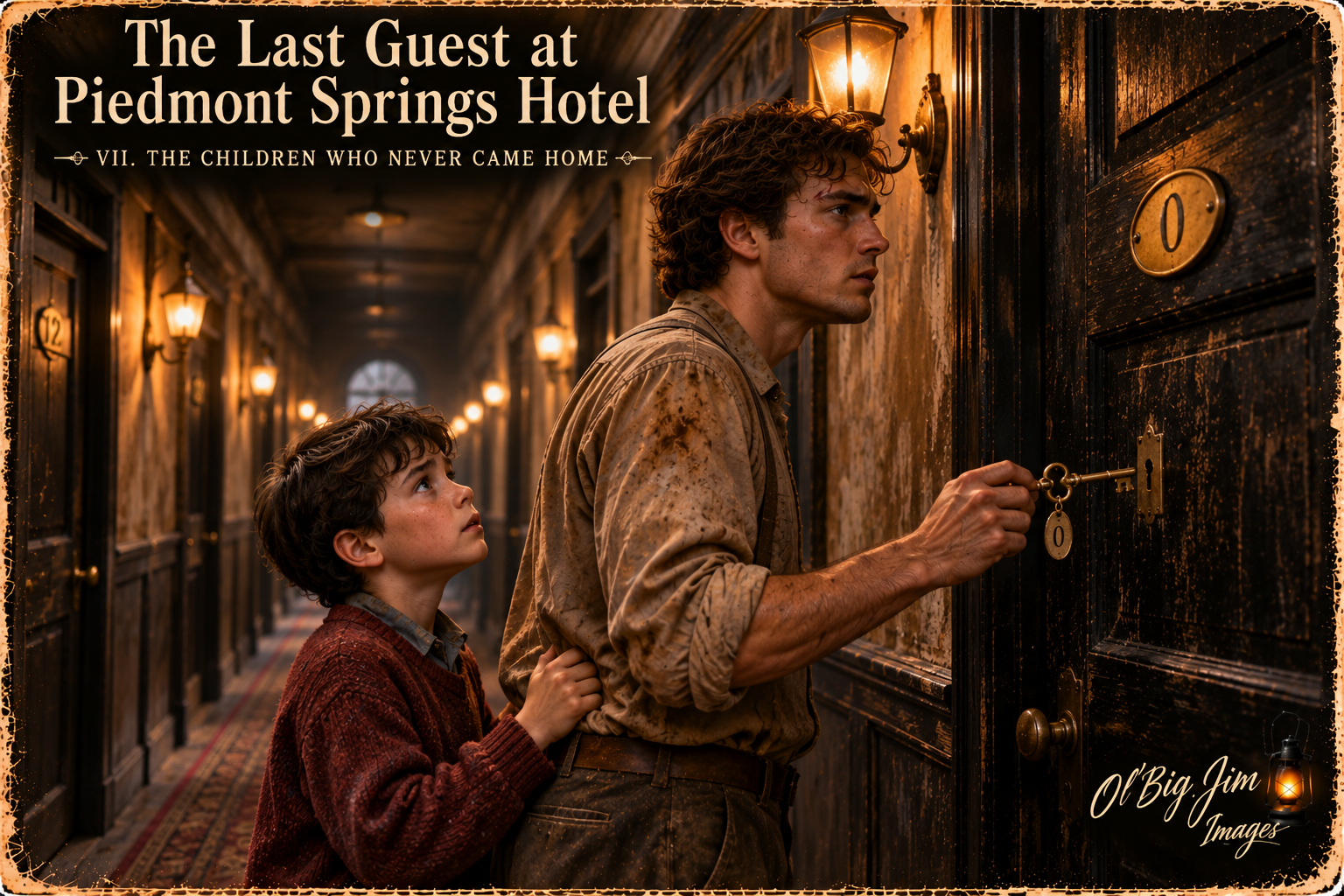
At last, they reached the black door.
Room Zero.
Daniel raised the key.
But before he could insert it, he heard something from the other side.
A voice.
A man’s voice.
Familiar.
Warm.
A voice he hadn’t heard since he was six years old.
“Daniel?”
He froze.
Thomas looked up.
The voice came again.
“Son?”
Daniel felt tears fill his eyes.
“Daddy?”
A pause.
Then the voice said:
“I’ve been waiting for you.”
Daniel stared at the door.
His hand began trembling.
Thomas squeezed his fingers.
“Who is it?”
Daniel swallowed.
“My father.”
The boy looked at the door.
Then at Daniel.
“Are you going to open it?”
Daniel stared at the key.
For the first time, he understood why Professor Whitcomb had spent 133 years making the same mistake.
Because when somebody you love is standing on the other side of a door, it’s the hardest thing in the world not to open it.
He raised the key.
And from behind the door, his father’s voice whispered:
“Please, son.”
Daniel closed his eyes.
Then asked the one question nobody at Piedmont Springs had thought to ask.
“Daddy?”
“Yes, son?”
“If you’re really my father…”
He swallowed.
“Why do you need me to open the door?”
Silence.
A long, terrible silence.
Then the voice on the other side changed.
Not much.
Just enough.
And something answered:
“Because, Daniel…”
The key grew hot in his hand.
“…I can’t open it from here.”