
A Piedmont Porchlight Story
VIII. The Man on the Other Side
Daniel Mercer had heard his father’s voice in dreams.
Not often. Not anymore.
Time had a cruel way of wearing the edges off memory, and after seventeen years, the sound of Christopher Mercer’s laughter had become something Daniel could recall only with considerable effort.
But he remembered certain things perfectly.
His father calling him Buddy Boy.
His father singing badly while washing the automobile.
His father whispering, “Don’t tell your mama,” whenever they stopped for ice cream before supper.
And he remembered the last thing his father had said to him.
Be good for your mama, son.
It had seemed an ordinary instruction at the time.
Now Daniel stood before a black door in a hotel that existed in several centuries at once, listening to that same voice asking to be let out.
“Daniel?”
The voice came again.
“Son, please.”
Thomas tightened his grip on Daniel’s hand.
“Don’t open it.”
Daniel looked down.
“Why?”
The boy stared at the door.
“Because it knows your name.”
Daniel swallowed.
“Lots of people know my name.”
Thomas shook his head.
“No. I mean it knows the name you haven’t told anybody.”
Daniel frowned.
“What name?”
The boy looked frightened.
“The one you call yourself when you’re dreaming.”
Daniel felt a sudden coldness.
He remembered a dream he’d had repeatedly as a child.
A dark room.
A window overlooking a garden.
A man sitting beside his bed.
The man would ask him a question.
What’s your name?
And Daniel would answer.
Not Daniel.
Not Mercer.
Something else.
A word he could never remember upon waking.
From behind the door came a soft chuckle.
“He’s a clever little fellow, isn’t he?”
Daniel stepped backward.
The voice was still his father’s.
But something about it had changed.
It sounded amused.
Not kindly amused.
Interested.
Like a man watching a beetle struggle beneath an overturned drinking glass.
“Who are you?” Daniel asked.
Silence.
Then the voice answered.
“Your father.”
“No.”
A pause.
“Would you prefer your grandfather?”
Daniel felt the hair rise on his arms.
The voice changed.
It became deeper.
Rougher.
An elderly man’s voice with a familiar Southern drawl.
“Daniel, boy, you come open this door.”
Daniel had heard that voice before.
In an old family recording.
His grandfather Aaron.
The man had died before Daniel was born.
Thomas began trembling.
“Don’t listen.”
The voice changed again.
A woman now.
Gentle.
Musical.
“Daniel, honey?”
His mother’s voice.
“Have you eaten?”
Daniel closed his eyes.
“No.”
The voice laughed.
“Well, somebody’s getting particular.”
Then it changed again.
This time, it was Daniel’s own voice.
“Open the door.”
Daniel stared at the black wood.
His own voice continued.
“You know you want to.”
Thomas pulled him away.
“Come on.”
“Where?”
“Anywhere but here.”
They turned toward the corridor.
And stopped.
The hallway was gone.
In its place stretched a broad expanse of still water.
Black.
Perfectly smooth.
It extended farther than Daniel could see.
Hundreds of doors stood upright in the water, their frames unsupported, their brass numbers reflecting in the dark surface.
Some were open.
Behind them lay bedrooms, hospital wards, schoolrooms, kitchens, and streets.
Others were closed.
From behind one came the sound of a baby crying.
From another, a woman laughing.
From a third, the unmistakable crash of an automobile accident.
Daniel stared.
“What happened to the hotel?”
Thomas shook his head.
“We’re underneath it.”
Daniel looked down.
His shoes stood on dry wooden floorboards.
A few inches beyond his toes, the boards ended.
The black water began.
He couldn’t see a bottom.
“Is that the spring?”
Thomas nodded.
“Sort of.”
“What do you mean, sort of?”
The boy looked toward the water.
“It’s what the spring remembers being.”
Daniel stared at him.
“Before it was a spring?”
Thomas nodded.
“Before there was a town. Before there was a mountain.”
The water moved.
A small ripple crossed its surface.
Then another.
Something enormous passed beneath it.
Daniel stepped backward.
“What’s down there?”
Thomas looked toward the black door.
“What’s on the other side.”
Daniel felt his stomach tighten.
“But the door’s behind us.”
Thomas nodded.
“Yes.”
Daniel looked at the water.
Then at the door.
And suddenly he understood something dreadful.
The door wasn’t keeping the thing in.
It was keeping the water out.
A soft tapping came from the other side.
Three knocks.
Polite.
Almost apologetic.
“Daniel?”
His father’s voice again.
“Son, I know you’re frightened.”
Daniel said nothing.
“I would be, too.”
Thomas backed away.
The voice continued.
“But you need to understand something. The keeper has lied to you.”
Daniel glanced at the boy.
Thomas shook his head.
“Don’t answer.”
“The keeper told you that the discarded lives were trapped here because of Professor Whitcomb’s mistake.”
Daniel remained silent.
“That’s only partly true.”
The tapping came again.
Three knocks.
“The professor opened the first door. But he didn’t create what was behind it.”
Daniel stared at the wood.
The voice softened.
“Would you like to know what he found?”
Daniel swallowed.
“Tell me.”
Thomas squeezed his eyes shut.
The thing behind the door seemed pleased.
“Very well.”
The black water began to move.
Images formed beneath its surface.
A forest.
An ancient forest.
Trees so enormous that their trunks resembled cathedral columns.
A narrow stream wound through them.
Beside the stream stood a woman.
She wore clothing Daniel couldn’t place.
Neither modern nor nineteenth-century.
Something much older.
She knelt beside the water.
And in her arms, she held a child.
The child wasn’t moving.
Daniel felt a terrible sadness.
The woman lowered the child into the stream.
Then raised her hands toward the sky.
She spoke.
Daniel couldn’t understand the words.
But he understood the pleading.
The grief.
The impossible desire to make death reconsider its decision.
The water darkened.
Something moved beneath it.
The woman leaned forward.
And a voice rose from the stream.
Daniel heard it clearly.
What will you give?
The woman answered.
Again, Daniel couldn’t understand the language.
But the water translated her meaning.
Anything.
Thomas began crying.
Daniel looked at him.
“What’s wrong?”
The boy shook his head.
“That’s how it starts.”
The image changed.
The child opened its eyes.
The woman screamed with joy.
She lifted the child from the water.
Held it against her breast.
Kissed its face.
And for one beautiful moment, the world seemed merciful.
Then the child began to change.
Its face grew older.
Then younger.
Then older again.
Its body shifted.
A thousand possible children flickered through its form.
The woman screamed.
The water rose.
And something reached out.
Not to take the child.
To take the promise.
The image vanished.
Daniel stared at the black surface.
“What happened to her?”
The voice behind the door answered.
“She became the first keeper.”
Daniel felt cold.
“The keeper outside?”
“No.”
The voice seemed almost amused.
“That one came much later.”
Thomas looked at Daniel.
His eyes were wide with terror.
“Don’t ask any more.”
But Daniel had already begun to understand.
The keeper wasn’t a single creature.
It was a position.
A duty.
A sentence.
Somebody had to remain behind and tend the lives that could not be allowed to disappear.
“How many keepers have there been?” Daniel whispered.
The voice behind the door laughed softly.
“Would you like to count them?”
The black water stirred.
Faces appeared beneath the surface.
Thousands.
Millions.
Some human.
Some not.
Some so ancient that Daniel couldn’t bear to look at them.
Then the water became still.
The voice spoke again.
“Every bargain requires a keeper.”
“Then who changed my mother’s bargain?” Daniel asked. “She wanted to protect me. Somehow it became a promise to protect every child.”
The voice behind the door was silent for a moment.
“Thomas opened the rooms. He didn’t change the bargain.”
“Then who did?”
“Your professor.”
Daniel stared at the black door.
“Whitcomb?”
“He believed that if one child could be saved, no child should be left behind. He asked the keeper to extend the promise.”
“And the keeper agreed?”
“The keeper did what it had always done. It remembered the words. It did not understand what they would cost.”
Daniel stared at the door.
“And what happens to the person who makes the bargain?”
A pause.
Then the voice answered.
“Eventually, they become one.”
Daniel thought of Rebecca.
Of her tears.
Of her desperate wish that he should never die.
He thought of Professor Whitcomb and the little boy named Thomas.
Of Agnes Bellweather and Eleanor.
Whitcomb had first tried to save Thomas, and in doing so had discovered that the spring could be persuaded to change what had already happened.
Later, when Eleanor Bellweather fell ill, he’d tried again.
But the second bargain hadn’t undone the first.
It had merely given the spring another promise to remember.
All of them had tried to save somebody.
All of them had made promises.
And all of them had become prisoners of those promises.
Daniel looked at the black door.
“What do you want from me?”
The voice hesitated.
For the first time, it seemed uncertain.
“Want?”
“Yes.”
A long silence followed.
Then the thing answered.
“I want to stop.”
Daniel frowned.
“Stop what?”
“Remembering.”
The water shuddered.
The voice changed.
It became deeper.
Older.
A sound like stones grinding beneath the earth.
“I remember every child who died before its mother. Every mother who died before her child. Every husband who buried his wife. Every wife who buried her husband.”
The water trembled.
“I remember every life that might have been. Every accident that might have been prevented. Every word that might have been spoken.”
The voice grew louder.
“I remember every road not taken.”
Thomas covered his ears.
Daniel stood motionless.
“And I cannot forget.”
The voice fell to a whisper.
“Not one.”
Daniel looked toward the water.
The faces were returning.
Countless faces.
All watching.
All waiting.
“Then why don’t you let them go?”
The thing behind the door made a sound that might have been laughter.
Or weeping.
“Because I don’t know how.”
Daniel stared at the key in his hand.
Room Zero.
The first choice.
The first bargain.
The first impossible wish.
He looked at Thomas.
“Do you remember what you said outside?”
The boy nodded.
“About the rooms?”
“No.”
Daniel knelt beside him.
“You said nobody ever told you that you were somebody.”
Thomas looked down.
“Yes.”
Daniel touched his shoulder.
“Do you believe it now?”
The boy hesitated.
Then nodded.
“A little.”
Daniel smiled.
“That’s enough to start with.”
He stood.
Then turned toward the door.
“Listen to me.”
The thing behind it became quiet.
“You’ve been keeping all these lives because you’re afraid they’ll disappear.”
“Yes.”
“But they’re not yours.”
Silence.
“They belong to the people who lived them.”
The water began to ripple.
Daniel continued.
“Thomas belongs to Thomas. Eleanor belongs to Eleanor. And all those other Daniels belong to themselves.”
The voice answered.
“They will die.”
Daniel swallowed.
“Yes.”
“They will be forgotten.”
“Some of them.”
“They will cease to exist.”
Daniel looked toward the black water.
Then back at the door.
“Maybe.”
The thing seemed to draw breath.
“Then why would you release them?”
Daniel thought of his father.
Of the day he’d died.
Of all the years Daniel had wished for one more conversation.
One more afternoon.
One more chance to hear him laugh.
He thought of Rebecca.
Of the terrible bargain she’d made because she couldn’t bear the thought of losing him.
Then he answered.
“Because a life isn’t a prison sentence.”
The water became still.
Daniel continued.
“And love isn’t supposed to be one, either.”
For a long moment, nothing happened.
Then the voice behind the door whispered:
“I don’t understand.”
Daniel nodded.
“I know.”
He looked at the key.
“But I think I do.”
The brass key had grown almost unbearably hot.
Daniel turned it over in his palm.
On one side was the number zero.
On the other, something he’d never noticed.
A word.
Small.
Nearly worn away.
He held it toward the faint light.
Consent.
Daniel stared.
Thomas leaned closer.
“What does it say?”
Daniel swallowed.
“Consent.”
The boy frowned.
“What’s that mean?”
“It means nobody gets to decide for you.”
Thomas looked toward the door.
“Not even Mama?”
Daniel shook his head.
“Not even Mama.”
The water stirred.
The thing behind the door spoke.
“Every bargain was made willingly.”
Daniel looked up.
“No.”
A pause.
“Explain.”
“Rebecca agreed because she was grieving. Whitcomb agreed because he was desperate. That woman beside the ancient stream agreed because she’d lost her child.”
Daniel held up the key.
“None of them knew what they were agreeing to.”
Silence.
“That’s not a bargain. That’s a trap.”
The door shuddered.
The black water rose slightly.
The voice became harsh.
“They said yes.”
Daniel felt his heart pounding.
“They didn’t know what yes meant.”
The water surged.
Thomas cried out.
The door rattled in its frame.
The voice thundered.
“THEY AGREED.”
Daniel stood his ground.
“Then ask them again.”
Silence.
The water stopped moving.
The thing behind the door seemed to hesitate.
“What?”
Daniel swallowed.
“Ask them again. Tell them the truth. Tell them what happens. Tell them what it’ll cost.”
He held up the key.
“And let them choose.”
For a long moment, nothing happened.
Then the voice whispered:
“They may refuse.”
Daniel nodded.
“Yes.”
“They may choose death.”
“Yes.”
“They may choose to be forgotten.”
Daniel felt tears fill his eyes.
“Yes.”
The thing behind the door made a low, terrible sound.
“And what if they all refuse?”
Daniel looked at Thomas.
Then toward the countless doors standing in the black water.
He thought of the children.
The old people.
The lost lives.
The impossible histories.
And he answered:
“Then you let them go.”
The black door began to change.
Its surface softened.
The wood grain shifted.
The brass plate bearing the number zero fell away.
Beneath it appeared another word.
Choice.
Thomas stared.
“Daniel?”
The key cooled in his hand.
The water began to recede.
One by one, the distant doors opened.
Not violently.
Not with screams.
Quietly.
Like doors opening on an ordinary morning.
From behind them came voices.
Not frightened now.
Curious.
Hopeful.
A woman laughing.
A man calling for his dog.
A child asking whether supper was ready.
Daniel felt the air grow warmer.
The thing behind the door whispered:
“I have never asked them.”
Daniel closed his eyes.
“Then it’s time.”
The voice trembled.
“Will you help me?”
Daniel looked at Thomas.
The boy nodded.
Then Daniel turned back toward the door.
“Yes.”
A pause.
Then the voice asked:
“Do you understand what that means?”
Daniel stared at the key.
He thought of Rebecca.
Of the promises she’d made.
Of the terrible price of agreeing to something without understanding it.
And for the first time, he did not answer immediately.
“No,” he said.
The water became still.
The thing behind the door seemed to wait.
Daniel continued.
“Not yet.”
A long silence followed.
Then the voice answered.
“Good.”
The door opened.
Not inward.
Not outward.
It simply ceased to be.
Beyond it stood a room.
Small.
Plain.
A wooden table.
Two chairs.
A window overlooking a garden.
And sitting at the table was a man.
He appeared to be in his fifties.
His hair was gray at the temples.
His face was ordinary.
Tired.
Kind.
He wore a dark suit and held a cup of coffee between his hands.
Daniel stared.
“Who are you?”
The man looked up.
For a moment, his expression was terribly sad.
Then he smiled.
“Somebody who made a promise a very long time ago.”
Daniel stepped inside.
Thomas followed.
The man gestured toward the chairs.
“Please. Sit down.”
Daniel hesitated.
“Are you the thing that was behind the door?”
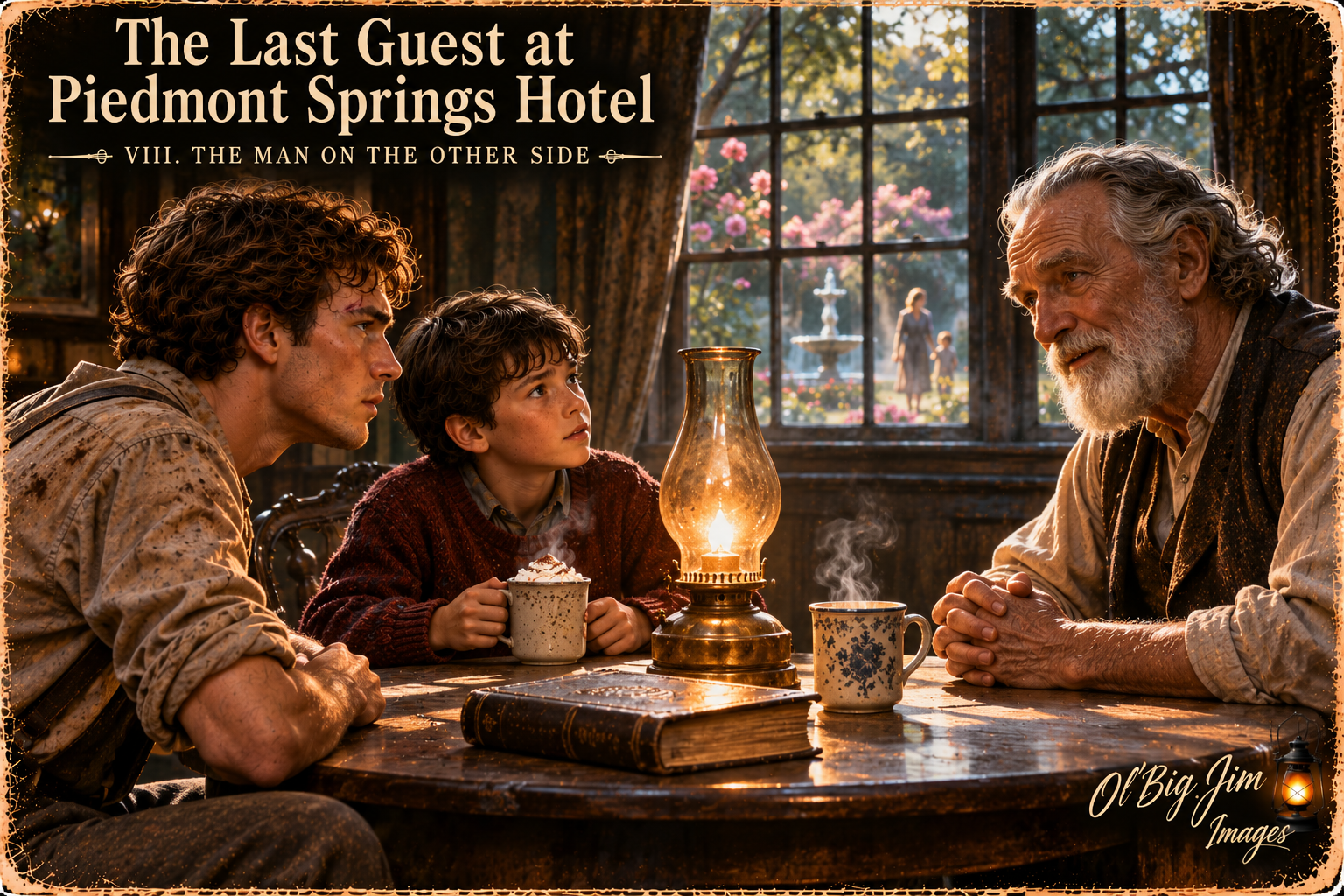
The man nodded.
“Yes.”
Daniel stared.
“But you look…”
“Human?”
“Yes.”
The man smiled faintly.
“I used to be.”
Thomas looked at him.
“Are you the first keeper?”
The man shook his head.
“No.”
“Then who are you?”
He looked toward the window.
Beyond it, the garden stretched beneath a pale afternoon sky.
A woman stood among the flowers.
She held a small child in her arms.
The man watched her for a long moment.
Then said:
“I’m the last one.”
Daniel felt a chill.
“The last keeper?”
The man nodded.
“Yes.”
“How?”
The man looked back at him.
“Because the others are gone.”
Thomas frowned.
“Gone where?”
The man smiled sadly.
“They chose.”
Daniel stared.
“Then why are you still here?”
The man looked at the empty chair opposite him.
For a long moment, he said nothing.
Then he whispered:
“Because nobody ever asked me.”
Daniel sat down.
Thomas climbed into the chair beside him.
The man poured three cups of coffee.
Thomas looked at his cup.
“I don’t like coffee.”
The man smiled.
“Neither did I when I was your age.”
He snapped his fingers.
The coffee became hot chocolate.
Thomas grinned.
“Thank you.”
The man nodded.
“You’re welcome.”
Daniel watched him.
“What’s your name?”
The man hesitated.
For a moment, he seemed unable to remember.
Then he looked toward the garden.
“Samuel.”
“Samuel what?”
The man smiled sadly.
“I don’t remember.”
Daniel nodded.
“Samuel will do.”
The man looked at him.
Something changed in his expression.
Surprise.
Then gratitude.
“Thank you.”
“Are you the same keeper we saw outside the hotel?” Daniel asked.
Samuel shook his head.
“No. He guards the lives that have already been changed. I guard the promises that changed them.”
“Then there are two of you?”
“There are as many keepers as there are promises. But I’m the last one who remembers how it began.”
Daniel leaned forward.
“Samuel, I need to ask you something.”
“Of course.”
“Can you release the others?”
Samuel looked toward the window.
“Yes.”
Daniel felt hope rise.
“Then why haven’t you?”
Samuel’s smile vanished.
“Because I don’t know what happens afterward.”
Daniel stared.
“To them?”
Samuel shook his head.
“To me.”
Silence.
Thomas looked at him.
“Are you afraid?”
Samuel nodded.
“Very.”
The boy considered that.
Then reached across the table and took his hand.
“Me, too.”
Samuel looked down at the small fingers wrapped around his own.
His eyes filled with tears.
For a long moment, nobody spoke.
Then Daniel asked:
“What would happen if you let them choose?”
Samuel looked toward the window.
“The rooms would empty.”
“And the hotel?”
“It would disappear.”
“And the spring?”
“It would become ordinary water.”
Daniel swallowed.
“And you?”
Samuel looked at him.
For the first time, his face seemed genuinely old.
“I don’t know.”
Thomas squeezed his hand.
“Maybe you could come with us.”
Samuel smiled.
“Perhaps.”
Daniel looked at the window.
The woman in the garden was watching them.
She held the child close.
“Who’s that?”
Samuel followed his gaze.
His expression changed.
“Oh.”
Daniel waited.
“That’s my wife.”
Thomas looked toward the garden.
“And the baby?”
Samuel began crying.
“My daughter.”
Daniel felt his throat tighten.
“Are they…”
Samuel nodded.
“They died a very long time ago.”
The woman raised one hand.
Samuel raised his own.
Daniel looked at him.
“Have you been keeping them here?”
Samuel shook his head.
“No.”
“Then why can you see them?”
Samuel looked toward the window.
And whispered:
“Because I never stopped wishing I could.”
The garden began to fade.
The woman disappeared.
Then the child.
Samuel lowered his hand.
For a long moment, he sat motionless.
Then he looked at Daniel.
“Do you think they’ll be there?”
Daniel swallowed.
“Where?”
Samuel looked toward the empty window.
“Wherever I go.”
Daniel thought of his father.
Of Rebecca.
Of all the people who’d loved somebody they couldn’t keep.
Then he answered.
“I don’t know.”
Samuel nodded.
A tear ran down his cheek.
Daniel continued.
“But I think you’ve waited long enough to find out.”
Samuel looked at Thomas.
Then at Daniel.
At last, he stood.
“All right.”
The room trembled.
The window brightened.
The distant sound of doors opening filled the air.
Samuel raised one hand.
And somewhere beyond the walls, a thousand voices began speaking.
Not all at once.
One by one.
Each voice asking a question.
Each voice receiving an answer.
Each voice making a choice.
Daniel heard laughter.
Crying.
Anger.
Relief.
Some voices faded.
Others grew stronger.
The room began to change.
The walls became translucent.
The floor softened beneath their feet.
Thomas looked frightened.
“Daniel?”
He took the boy’s hand.
“I’m here.”
Samuel stood beside the window.
His face was peaceful.
For the first time, he looked like a man who might actually be allowed to rest.
Then he turned.
“Daniel.”
“Yes?”
“There’s one more thing.”
Daniel felt a chill.
“What?”
Samuel looked toward the garden.
“Your mother.”
Daniel swallowed.
“What about her?”
Samuel hesitated.
“She made a bargain.”
“I know.”
“But she wasn’t the only one.”
Daniel stared.
“What do you mean?”
Samuel looked at him.
“Your father made one, too.”
Daniel felt the world go still.
“My father?”
Samuel nodded.
“Yes.”
“What did he ask for?”
Samuel’s expression changed.
He looked terribly sad.
“He asked that you should always remember him.”
Daniel stared.
For a moment, he couldn’t speak.
Then he whispered:
“But I don’t.”
Samuel looked at him.
“No.”
Daniel felt tears fill his eyes.
“I’ve forgotten his voice. I remember things he said. But, I can’t remember what his voice really sounded like.”
Samuel nodded.
“Yes.”
“I’ve forgotten the way he laughed.”
“Yes.”
Daniel swallowed.
“Then the bargain didn’t work.”
Samuel looked toward the fading room.
And answered:
“It did.”
Daniel stared.
“How?”
Samuel looked directly at him.
“Because every time you forget him, Daniel…”
The room began to dissolve.
“…he comes back to remind you.”
Daniel felt the key grow warm in his hand. He didn’t even remember Thomas giving it to him.
And from somewhere beyond the fading walls came three soft knocks.
Polite.
Almost apologetic.
Then a familiar voice.
“Buddy Boy?”
Daniel closed his eyes.
His father’s voice.
“Don’t tell your mama.”
And somewhere in the distance, a man began to laugh.