A Piedmont Porchlight Story
IX. The Tomorrow That Wasn’t Promised
The first thing Daniel Mercer lost was the scar above his left eyebrow.
He didn’t notice it immediately.
There were considerably more pressing matters to occupy his attention, including the fact that the walls of Room Zero were disappearing, the floor had become transparent, and somewhere beyond the window a man who sounded exactly like his father was laughing.
But Thomas noticed.
“Daniel?”
“What?”
“Your face.”
Daniel touched his forehead.
The familiar little ridge of scar tissue was gone.
He ran his fingers over the skin again.
Smooth.
Unbroken.
He remembered falling from his bicycle at eleven, remembered the blood running into his eye, remembered his mother pressing a dishcloth against the wound while his father searched frantically for the automobile keys.
But there was no scar.
“Samuel?”
The man beside the window turned.
“Yes?”
“What’s happening to me?”
Samuel looked at his forehead.
His expression darkened.
“The bargains are beginning to loosen.”
Daniel felt cold.
“Am I disappearing?”
Samuel hesitated.
“Not necessarily.”
“That’s not a particularly comforting answer.”
“No,” Samuel admitted. “I don’t reckon it is.”
Thomas squeezed Daniel’s hand.
“Maybe the scar belonged to one of the other Daniels.”
Daniel looked down.
“What?”
The boy shrugged.
“Maybe you’re remembering something that happened to him.”
Daniel considered that.
Then something else occurred to him.
He remembered his father searching for the automobile keys after the bicycle accident.
But his father had died when Daniel was six.
The accident had happened when he was eleven.
Daniel stood perfectly still.
“Oh, God.”
Samuel watched him.
“What is it?”
“My father.”
“Yes?”
“He was there when I hurt my head.”
Samuel nodded.
“In one of your lives.”
Daniel closed his eyes.
The memory remained.
His father’s worried expression.
The dishcloth.
The hurried drive to the hospital.
All of it as clear as yesterday.
And yet it had never happened to the Daniel who stood in Room Zero.
“Then how do I know what’s real?”
Samuel looked at him for a long moment.
“Does it matter?”
Daniel opened his eyes.
“Of course it matters!”
“Why?”
“Because I want to know which life is mine!”
Samuel nodded slowly.
“Then perhaps that’s the first thing you must decide.”
Beyond the disappearing walls, doors continued opening.
Some revealed ordinary rooms.
Others opened onto landscapes Daniel couldn’t recognize.
A city beneath a purple sky.
A farmhouse standing in a field of snow.
A hospital corridor crowded with people wearing clothing from different centuries.
And behind one door stood a little girl in a yellow dress.
She held a rag doll.
Her dark hair fell in loose curls around her face.
Thomas stopped.
“Eleanor.”
The girl looked up.
“Thomas?”
He released Daniel’s hand.
For a moment, the two children simply stared at one another.
Then Eleanor ran toward him.
They embraced.
Daniel watched them with a sudden ache in his chest.
“Is that Agnes’s daughter?”
Samuel nodded.
“Yes.”
“Will she be able to leave?”
“If she chooses.”
Daniel looked at the little girl.
“Does she know what happened?”
Samuel’s expression softened.
“She knows she was loved.”
Eleanor drew back from Thomas.
“Is Mama here?”
Thomas nodded.
“Outside.”
The girl’s face brightened.
“Can I see her?”
Samuel approached.
“You may.”
Eleanor looked up at him.
“Will I have to go back to my room?”
“No.”
“Ever?”
“No.”
The little girl stared.
Then she began to cry.
Not because she was frightened.
Because, for the first time in more than a century, somebody had told her she could leave.
Thomas took her hand.
“Come on.”
They started toward the opening where the corridor had once been.
But Eleanor stopped.
She looked back at Daniel.
“Are you coming?”
He smiled sadly.
“Not yet.”
“Why?”
Daniel glanced toward Samuel.
“There’s something I have to finish.”
Eleanor considered that.
Then she nodded with the solemn understanding children sometimes possess when adults are discussing matters too large for them.
“All right.”
She reached into the pocket of her dress.
From it she withdrew a small white stone.
She held it out.
“For luck.”
Daniel took it.
The stone was smooth and warm.
“Thank you.”
Eleanor smiled.
Then she and Thomas disappeared through the opening.
Daniel watched them go.
For the first time since he’d uncovered the tin box, he felt something that wasn’t fear.
Hope.
Samuel returned to the table.
The coffee was gone.
So were the cups.
The window now looked out upon an empty field.
Daniel sat opposite him.
“Tell me what happens when all the bargains are released.”
Samuel folded his hands.
“The hotel will cease to exist.”
“And the other lives?”
“They will be free to choose their endings.”
“Does that mean they’ll die?”
“Some will.”
“And the others?”
Samuel hesitated.
“Some may find a place in the world.”
Daniel frowned.
“How?”
“Not every discarded life was impossible. Some were merely abandoned.”
Daniel thought of Thomas.
Of Eleanor.
Of the old man he’d seen behind the glass.
“Then they might live?”
“Yes.”
“Ordinary lives?”
“As ordinary as any life can be.”
Daniel smiled faintly.
“That’s not saying much.”
Samuel almost laughed.
“No. I suppose it isn’t.”
Daniel looked down at his hands.
They were beginning to change.
Not dramatically.
The fingers seemed slightly longer.
A small mole appeared near his thumb.
Then vanished.
He remembered having that mole as a child.
Or perhaps another Daniel had.
He looked at Samuel.
“And me?”
Samuel’s expression grew grave.
“Your life is different.”
Daniel swallowed.
“Because I was made by a bargain.”
“Yes.”
“Then when the bargain ends…”
Samuel said nothing.
Daniel stared.
“I disappear.”
“Perhaps.”
Daniel stood.
“Perhaps?”
Samuel rose with him.
“Daniel, listen to me. Your mother asked for a son. The bargain created the circumstances that allowed you to exist.”
“Created me.”
“Not exactly.”
Daniel frowned.
Samuel continued.
“It created a world in which you could be born.”
Daniel stared at him.
“What?”
“Your mother carried you. She gave birth to you. She raised you. Every ordinary thing that happened afterward was real.”
Daniel felt his heart pounding.
“Then I’m real.”
“Yes.”
“Even without the bargain?”
Samuel hesitated.
“That’s what we have to find out.”
Daniel looked toward the empty field beyond the window.
“And how do we do that?”
Samuel pointed toward the far wall.
A door had appeared.
Plain wood.
No number.
No brass plate.
Only a small glass window.
Beyond it stood a familiar Alabama road.
Daniel recognized it immediately.
The road leading toward Piedmont.
The road he’d driven that morning.
“What’s that?”
Samuel smiled sadly.
“Tomorrow.”
Daniel stared.
“Tomorrow?”
“Yes.”
“October twenty-eighth?”
Samuel nodded.
“The first day that hasn’t already been written.”
Daniel approached the door.
Through the glass, he could see trees moving in a gentle breeze.
A pickup truck passed along the road.
Somewhere a dog barked.
Everything looked ordinary.
Terribly, beautifully ordinary.
He reached for the handle.
Samuel spoke.
“Daniel.”
He turned.
“Yes?”
“Before you open that door, you must understand something.”
Daniel waited.
“The world beyond it will not be the world you remember.”
He felt cold.
“Why not?”
“Because the bargains have changed too much.”
Daniel looked through the glass.
The road was familiar.
The trees.
The telephone poles.
The little white church beyond the bend.
“What will be different?”
Samuel shook his head.
“I don’t know.”
“Will my mother be there?”
“Perhaps.”
Daniel closed his eyes.
“Will she remember me?”
Samuel said nothing.
Daniel turned.
“Samuel.”
The man looked at him.
“I can’t promise you that.”
Daniel felt tears fill his eyes.
He thought of Rebecca holding him as a child.
Of her voice on the telephone.
Of the countless ordinary mornings when she’d asked whether he’d eaten.
He thought of the way she’d stood between him and Agnes Bellweather.
Of the terror in her face when she’d realized what might happen.
“Then I might lose her.”
Samuel nodded.
“Yes.”
Daniel swallowed.
“And she might lose me.”
“Yes.”
For a long moment, he couldn’t speak.
Then he looked at the door.
“That’s what she was afraid of.”
Samuel said nothing.
“That’s what started all this.”
“Yes.”
Daniel wiped his eyes.
“And if I refuse to open it?”
Samuel looked toward the fading room.
“Then the bargains remain.”
Daniel stared.
“The hotel stays?”
“Yes.”
“The children stay trapped?”
“Yes.”
“And the keeper?”
Samuel lowered his head.
“I remain.”
Daniel looked toward the door.
Then back at Samuel.
“That’s not much of a choice.”
Samuel smiled sadly.
“No.”
Daniel considered that.
Then said something that surprised even himself.
“But it’s still mine.”
The room began to tremble.
The floor softened.
Beyond the window, the empty field darkened.
Samuel looked toward the ceiling.
“It’s nearly time.”
Daniel approached the door.
He placed his hand on the knob.
Then stopped.
“Samuel?”
“Yes?”
“Can I ask one more question?”
“Of course.”
Daniel swallowed.
“Was my father real?”
Samuel looked at him.
“Yes.”
“Did he love me?”
“Very much.”
Daniel closed his eyes.
“Then why did he make a bargain?”
Samuel approached.
“Because he was dying.”
Daniel turned.
“What?”
“Christopher Mercer knew he wouldn’t live to see you grow up. He was afraid you’d forget him.”
Daniel felt tears fill his eyes.
“So, he asked…”
“That you should always remember.”
Daniel looked toward the fading room.
“But I did forget.”
Samuel nodded.
“Yes.”
“Then why did he keep coming back?”
Samuel’s expression softened.
“Because the bargain was trying to restore what time had taken.”
Daniel thought of the voice behind the door.
The laughter.
The familiar words.
Buddy Boy.
Don’t tell your mama.
He looked at Samuel.
“Was that really him?”
Samuel hesitated.
“Sometimes.”
Daniel felt cold.
“Sometimes?”
“Sometimes it was a memory. Sometimes it was a possibility. Sometimes it was the bargain trying to give you what you wanted.”
Daniel stared.
“And sometimes?”
Samuel looked toward the door.
“Sometimes, Daniel, it was your father.”
A tear ran down Daniel’s cheek.
“How do I know which?”
Samuel smiled sadly.
“You don’t.”
Daniel lowered his head.
Then Samuel placed one hand on his shoulder.
“But perhaps you don’t need to.”
Daniel looked up.
“Why?”
“Because love doesn’t become less real when memory fades.”
For a long moment, neither spoke.
Then Daniel nodded.
“Thank you.”
Samuel smiled.
“You’re welcome.”
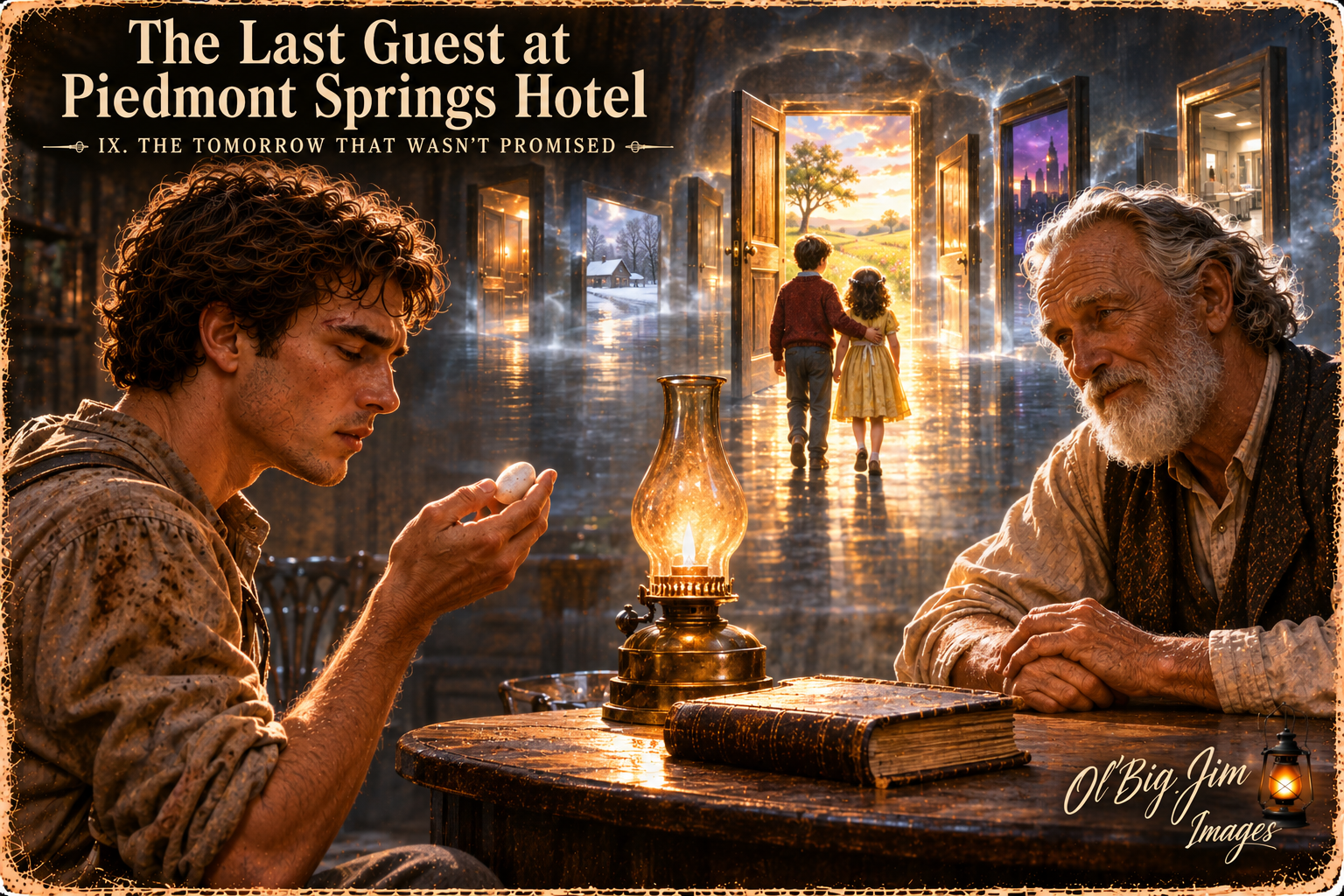
Daniel turned the knob.
The door opened.
Warm Alabama air washed over him.
He smelled pine needles.
Red clay.
The faint sweetness of honeysuckle.
Somewhere a mockingbird sang.
Not three repeated notes.
A proper mockingbird song, full of interruptions and unnecessary flourishes, as though the bird had been given an audience and intended to make the most of it.
Daniel laughed.
He couldn’t help himself.
He stepped through.
And the world changed.
He stood beside a narrow country road.
The sun was low.
Late afternoon.
A few cars passed in the distance.
He looked down at himself.
His clothes were ordinary.
Jeans.
Work boots.
A faded university T-shirt.
His telephone was in his pocket.
He took it out.
The screen lit immediately.
Wednesday, October 28, 2026.
Daniel stared.
Tomorrow.
He’d made it.
He looked toward the trees.
There was no hotel.
No verandah.
No broken foundations.
Only woods.
And somewhere beyond them, the faint sound of running water.
He walked toward the old excavation site.
The path was overgrown.
He pushed through the underbrush.
At last, he reached the clearing.
Nothing.
No trenches.
No canvas canopy.
No folding tables.
No professor.
Only a shallow depression in the earth where rainwater had collected.
Daniel knelt.
He touched the red clay.
Ordinary dirt.
Nothing more.
He began to cry.
Not loudly.
Just a quiet, exhausted weeping.
He’d survived.
He’d escaped.
And he had no idea whether anybody he loved still existed.
His telephone rang.
Daniel nearly dropped it.
He stared at the screen.
Mom.
For several seconds, he couldn’t move.
Then he answered.
“Hello?”
“Daniel?”
Her voice.
Rebecca.
Perfectly ordinary.
Perfectly alive.
He closed his eyes.
“Mom?”
“Well, who else would it be? You’ve got my number saved, haven’t you?”
Daniel laughed through his tears.
“Yes, ma’am.”
“Where are you?”
He looked toward the empty clearing.
“Out near Piedmont Springs.”
A pause.
“Piedmont Springs?”
“Yes.”
“Why on earth would you be out there?”
Daniel swallowed.
“Archaeology.”
His mother sighed.
“Lord have mercy. You’re still digging around in the dirt?”
He laughed again.
“Yes, ma’am.”
“Well, you ought to come home. I’ve made chicken and dumplings.”
Daniel closed his eyes.
For a moment, he couldn’t speak.
“Daniel?”
“I’m here.”
“Are you all right, honey?”
He swallowed.
“Yes.”
“Well, you sound funny.”
He laughed.
“I’ve had a long day.”
“Then come eat.”
He wiped his eyes.
“I will.”
“And Daniel?”
“Yes, ma’am?”
“Have you eaten?”
Daniel began crying again.
His mother waited.
Then said gently:
“Oh, sweetheart. Whatever’s happened, you can tell me when you get here.”
Daniel nodded.
Even though she couldn’t see him.
“Okay, Mom.”
“Love you.”
“Love you, too.”
He ended the call.
Then sat quietly beneath the trees.
For a long time.
At last Daniel stood.
He brushed the clay from his jeans.
He looked toward the clearing one final time.
And noticed something.
A small white stone lay beside the shallow depression.
Smooth.
Warm.
He picked it up.
Eleanor’s stone.
Daniel smiled.
He slipped it into his pocket.
Then began walking toward the road.
He’d almost reached the trees when he heard a voice.
“Daniel?”
He stopped.
It was a child’s voice.
A boy.
He turned.
Thomas stood at the edge of the clearing.
He wore jeans, sneakers, and a red sweater.
But he looked different.
Healthier.
His cheeks were fuller.
His eyes were bright.
And he was smiling.
Daniel stared.
“Thomas?”
The boy nodded.
“Yes.”
Daniel hurried toward him.
“You’re here!”
Thomas laughed.
“Yes!”
Daniel knelt and embraced him.
For a moment, neither spoke.
Then Daniel drew back.
“Where are you going?”
Thomas looked toward the road.
“Home.”
Daniel felt his throat tighten.
“Home?”
The boy nodded.
“I’ve got a family.”
Daniel stared.
“What?”
“A mama and daddy.”
Thomas smiled.
“And a dog.”
Daniel began laughing.
“A dog?”
“Yes. His name’s Biscuit.”
Daniel wiped his eyes.
“That’s a fine name for a dog.”
Thomas nodded solemnly.
“He’s a very fine dog.”
Daniel looked at him.
“Do you remember the hotel?”
Thomas hesitated.
Then shook his head.
“Not really.”
Daniel felt a pang.
“Nothing?”
The boy thought for a moment.
“I remember being afraid.”
Daniel nodded.
“And I remember somebody telling me I was somebody.”
Daniel’s eyes filled with tears.
Thomas smiled.
“Was that you?”
Daniel swallowed.
“Yes.”
The boy nodded.
“Thank you.”
Then he turned and ran toward the road.
A blue pickup truck waited beside the shoulder.
A man stood beside it.
A woman leaned from the passenger window.
“Thomas!” she called.
The boy waved.
“Coming, Mama!”
Daniel watched him climb into the truck.
The man closed the door.
The woman waved toward Daniel.
He waved back.
Then the truck drove away.
Daniel stood alone in the clearing.
Smiling.
Crying.
And feeling, for the first time in his life, that tomorrow might be something worth trusting.
He returned to his automobile.
It stood exactly where he’d left it.
He climbed inside.
Started the engine.
Then glanced at the rearview mirror.
For a moment, he thought he saw somebody sitting in the back seat.
An elderly man.
Silver hair.
Wire-rimmed spectacles.
Professor Whitcomb.
Daniel turned.
The seat was empty.
He looked back at the mirror.
Nothing.
He sat quietly.
Then smiled.
“Goodbye, Professor.”
He put the automobile in gear.
And drove toward home.
That evening, Rebecca Mercer set a bowl of chicken and dumplings before her son.
He ate two helpings.
She watched him with the peculiar satisfaction mothers experience when their children eat something that didn’t arrive in a cardboard box.
“My goodness,” she said, “you must’ve been hungry.”
Daniel smiled.
“Yes, ma’am.”
She sat opposite him.
For a while, they talked about ordinary things.
The weather.
His classes.
A neighbor’s troublesome dog.
The price of groceries.
Then Rebecca looked at him.
“Daniel?”
“Yes?”
“Did you find anything interesting out there?”
He paused.
Then smiled.
“Yes.”
“What?”
He considered the question.
“A few things.”
“Like what?”
Daniel looked at his mother.
At her familiar face.
At the kitchen he’d known all his life.
At the ordinary evening settling beyond the windows.
Then he answered:
“Mostly, I learned that some things ought to stay buried.”
Rebecca nodded.
“Well, that’s probably true.”
She reached for her coffee.
Then stopped.
Her expression changed.
Only slightly.
But Daniel noticed.
“What is it?”
She looked at him.
“Nothing.”
“Mom?”
Rebecca smiled.
“It’s just…”
She hesitated.
“Something you said reminded me of a dream.”
Daniel felt cold.
“What dream?”
She looked toward the window.
“I dreamed about an old hotel.”
He stopped breathing.
Rebecca continued.
“It was a beautiful place. Big verandah. White columns. Lots of people coming and going.”
Daniel stared.
“And?”
She frowned.
“There was a man there.”
“What man?”
“An older gentleman. Very polite. He wore glasses.”
Daniel felt his heart pounding.
“What did he say?”
Rebecca considered.
“He asked me whether I was happy.”
Daniel swallowed.
“And what did you tell him?”
She smiled.
“I told him I was.”
Daniel felt tears fill his eyes.
Rebecca reached across the table and touched his hand.
“Then he asked me something peculiar.”
Daniel stared.
“What?”
She looked at him.
“He asked whether I would make the same choice again.”
The room seemed to grow very still.
Daniel swallowed.
“And what did you say?”
Rebecca smiled.
“Well, I told him I didn’t know what choice he meant.”
Daniel waited.
She squeezed his hand.
“But I told him that if it meant having you for my son…”
Her eyes filled with tears.
“…I’d choose you every time.”
Daniel began crying.
Rebecca looked alarmed.
“Oh, honey!”
She rose and came around the table.
She embraced him.
He held her tightly.
And for a long time, neither spoke.
Later that night, Daniel lay in bed.
The house was quiet.
A gentle rain had begun falling.
He listened to it tapping against the windows.
He thought of Thomas.
Of Eleanor.
Of Agnes Bellweather.
Of Professor Whitcomb.
And of Samuel, the last keeper.
He wondered where they were.
He wondered whether they remembered him.
Then he reached into his pocket.
The small white stone was still there.
He placed it on his bedside table.
Beside a framed photograph of his father.
He looked at the picture.
Christopher Mercer smiled back at him.
Daniel studied the familiar face.
Then whispered:
“Goodnight, Daddy.”
The rain continued.
The house settled.
Somewhere in the distance, a dog barked.
And Daniel closed his eyes.
For the first time in many years, he dreamed of nothing at all.
At the old Piedmont Springs site, the rain fell gently upon the red clay.
The woods were quiet.
The spring ran clear.
And beneath the earth, where the hotel had once stood, a small tin box rested eighteen inches below the surface.
Its clasp was corroded.
Its corners were dark with age.
Inside lay six photographic glass plates.
The first five showed ordinary scenes from a nineteenth-century resort.
The sixth bore a handwritten date.
October 17, 1893.
Twenty-three people stood upon the verandah.
In the center was a young man.
Brown hair.
Slightly crooked nose.
A small white scar above his left eyebrow.
Beside him stood an elderly gentleman with silver hair and wire-rimmed spectacles.
And behind them, in the open doorway, stood a tall figure whose face could not quite be seen.
The young man was smiling.
The professor was not.
And on the back of the plate, in handwriting that hadn’t been there before, someone had written:
SOME DOORS ARE NOT MEANT TO STAY CLOSED.