
A Piedmont Porchlight Story
There are certain things a person expects to see after dark in Piedmont. Streetlights. Headlights. The occasional flashlight bobbing around somebody’s backyard because their dog has once again decided that coming when called is an unreasonable infringement on his personal liberties.
And porch lights.
Lord knows, we’ve got some porch lights.
Some folks leave theirs burning all night. Others turn them off at bedtime, figuring anybody who needs to visit after ten o’clock probably ought to reconsider the urgency of his business. But there’s one porch light I remember that was different from all the others.
It burned blue. Not a little blue. Not one of those modern bulbs that changes colors depending on what button you push. A deep, steady blue, the color of a summer evening just before the last daylight gives up and goes home. And the peculiar thing was, nobody could remember when it had been any other color.
⁂
The house belonged to Miss Evelyn Pritchard. It stood on a quiet street a few blocks from downtown, a modest white clapboard place with green shutters, a narrow front porch, and a pair of old rocking chairs that hadn’t rocked together in years.
Miss Evelyn was a widow. Her husband, Thomas, had died sometime in the early 1970s, and she’d lived alone ever since.
She was a small woman, straight-backed and particular, who wore her hair in a neat silver bun. She had a way of looking at you over her glasses that could make a grown man feel he’d tracked mud across her clean kitchen floor.
She kept her yard tidy. Her hedges trimmed. Her windows washed. And her porch light burning blue every night.
Folks asked about it, naturally. Piedmont being Piedmont, you couldn’t paint your mailbox without three people wanting to know whether you were expecting company.
Miss Evelyn always gave the same answer. “It helps folks find their way.” Now, that seemed reasonable enough. Except nobody knew which folks she meant.
⁂
Curtis Pope claimed the light had something to do with her late husband.
The way he told it, Thomas Pritchard had worked nights at the mill and Miss Evelyn kept the light burning so he’d know which house was his when he came home. Miss Lorene said that was the stupidest thing she’d heard all week.
“Thomas lived in that house twenty-eight years. I reckon he knew where it was.”
Curtis said a man could get turned around after working a double shift. Miss Lorene said if a man couldn’t find his own front porch after twenty-eight years, he probably oughtn’t be operating mill machinery.
Mr. Blackwelder, who’d been listening to the discussion over breakfast at the Coffee Cup, offered his own opinion.
“Could be she just likes blue.”
Curtis frowned. “Well, that ain’t much of an explanation.”
“Didn’t say it was.” And Mr. Blackwelder went back to his eggs.
⁂
Now, I’d passed Miss Evelyn’s house a hundred times over the years. The blue light never bothered me. It was just one of those peculiar little details that made Piedmont what it was. Like the fellow who painted his front steps every Easter whether they needed it or not. Or the woman who kept a plastic goose on her porch and dressed it according to the weather.
Or Curtis Pope’s conviction that Elvis Presley had once stopped for a haircut.
Some things you simply accepted. Then, one October evening, I noticed something I hadn’t noticed before. The blue light wasn’t shining on the porch. It was shining on the road. Now, that might not sound particularly remarkable.
Light travels, after all. But this was different. The porch itself was dim. The front steps were dark. Even the rocking chairs sat in shadow. Yet a narrow patch of blue light lay across the street, stretching from Miss Evelyn’s house toward the opposite sidewalk. As though somebody had laid a strip of blue cloth across the pavement.
I stopped and looked at it. Then I looked up at the porch light. It was burning steadily. Nothing unusual. I figured my eyes were playing tricks on me. At my age, that’s an explanation that covers a considerable amount of territory. So I went on home.
⁂
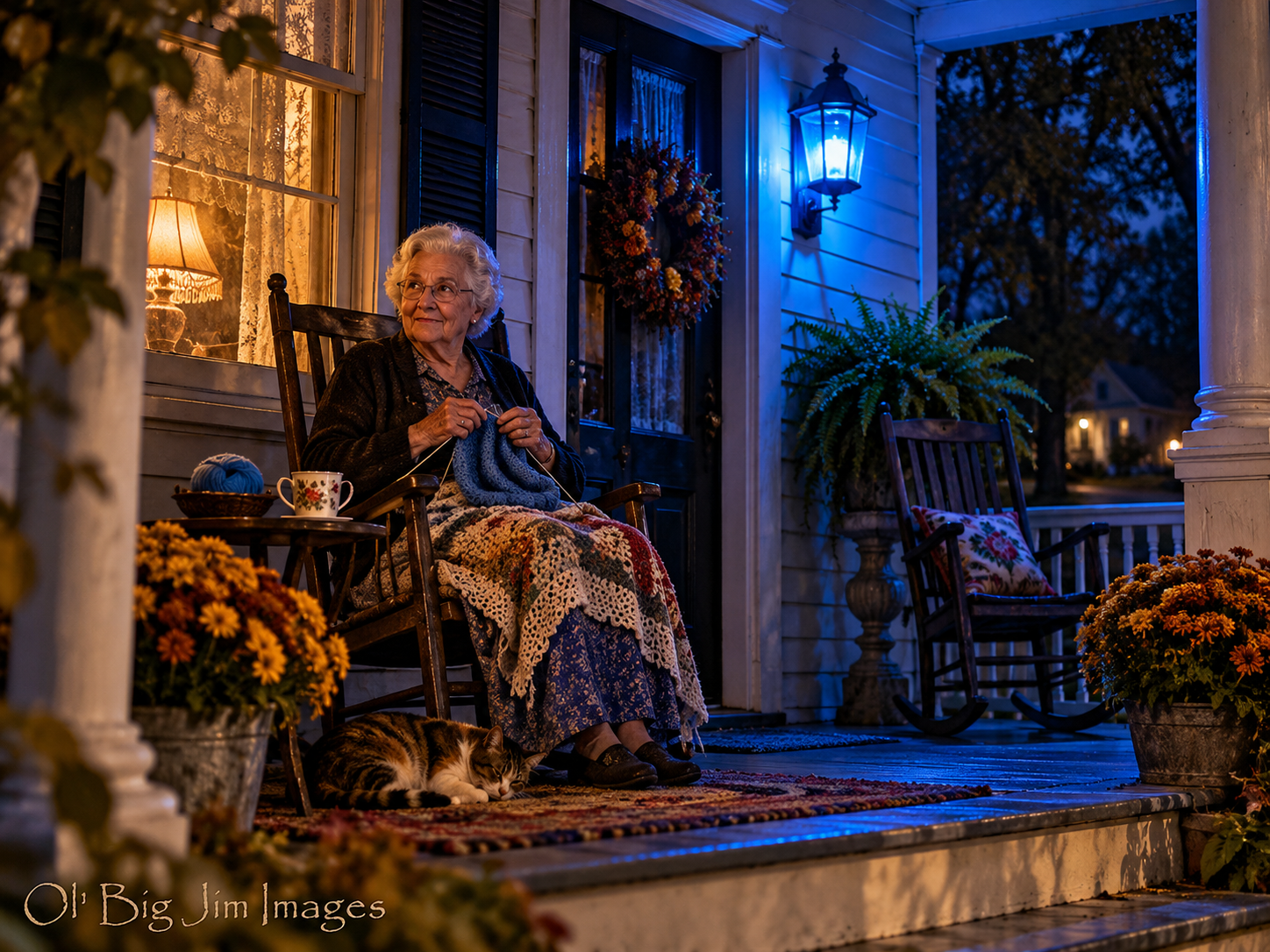
The following evening, the blue light had moved. Not much. Maybe ten feet farther down the street. I noticed it because I was walking that way with my Irish Blackthorn, enjoying the cool air and trying to convince my back that a little exercise wouldn’t kill either one of us.
The light stretched across the road at an angle now. Miss Evelyn was sitting on her porch. I stopped at the gate.
“Evening, Miss Evelyn.”
“Evening, Jim.”
“That’s an unusual light you’ve got.”
She glanced up. “Always has been.”
“Seems like it’s shining a little farther down the street tonight.”
She looked toward the pavement. Then she nodded. “Yes.”
I waited. She didn’t elaborate. “Something wrong with the bulb?”
“No.”
“Electrical problem?” “No.”
“Well, what makes it do that?” Miss Evelyn looked at me over her glasses.
“Somebody’s getting close.” Now, that’s the sort of answer that ought to come with a little more explanation.
But Miss Evelyn had already returned to her knitting. I stood there a moment. Then decided that whatever somebody was getting close to was probably none of my business. Which, as it turned out, was a mistake.
⁂
The first strange thing happened to Earl. He was driving home from a church supper when his car stalled near Miss Evelyn’s house. Just quit. No sputtering. No warning. The engine stopped as neatly as if somebody had turned the key. Earl coasted to the curb. Tried the ignition. Nothing.
He got out, raised the hood, and looked at the engine with the solemn expression of a man who knew considerably less about automobiles than he wanted anybody to suspect. Then he noticed the blue light. It was shining directly across his windshield. Earl said it was so bright he could barely see through it.
He stepped away from the car. The light shifted. Not toward him. Away. Down the street. And then he heard something.
A little voice. “Not that way.”
Earl turned around. Nobody there. “Who’s that?”
No answer. He looked toward Miss Evelyn’s porch. She was standing beside the railing.
“Evening, Earl.”
“Miss Evelyn, did you say something?”
“No.”
“Well, somebody did.”
She looked down the street. “Best listen, then.”
Earl decided he’d had enough excitement for one evening. He got back in his car. Turned the key. And the engine started immediately. He drove home by a different route. Which was fortunate.
Because the next morning, a large oak tree was found lying across the road he’d ordinarily have taken. It had fallen sometime during the night. And according to the fellow who cleared it away, the trunk was big enough to have crushed a pickup truck. Earl told everybody the blue light had saved his life.
Miss Lorene said it might also have been the first time in thirty years he’d taken directions from a woman.
⁂
After that, people began to pay attention. A delivery driver said the blue light had shone across an intersection just before a car ran the stop sign. A young mother said she’d seen it reflected in her kitchen window one night, even though Miss Evelyn’s house was three streets away. She’d gone upstairs to check on her baby and found the little girl tangled in her blanket, crying so hard she could barely catch her breath.
A fellow walking home from the Coffee Cup claimed the light followed him for nearly half a block. He said it disappeared the moment he turned toward his house.
Curtis Pope said the whole business was getting out of hand. Miss Lorene asked whether he’d prefer folks got run over and babies choked. Curtis said that wasn’t what he meant. She said it was hard to tell what he meant most of the time.
And that pretty much settled that.
⁂
I went back to see Miss Evelyn on a Thursday afternoon. She was sitting on the porch with a cup of tea. The blue light was off. In daylight, it looked like an ordinary porch fixture. White glass shade. Brass mounting. Nothing unusual.
Miss Evelyn invited me to sit. I took the other rocking chair. For a while, we talked about the weather. Then about the price of groceries. Then about how nobody seemed capable of making decent cornbread anymore without putting sugar in it.
Finally, I asked her about the light. “Miss Evelyn, how long have you had that blue bulb?”
She smiled faintly. “Since Thomas died.”
“Your husband?” She nodded.
“He put it up hisself.”
I waited. She looked toward the street.
“Thomas worked nights at the mill. Sometimes he’d come home so tired he could hardly stand. Said that little light was the prettiest thing he’d ever seen after twelve hours of listening to machinery.”
“Why blue?”
“He said it reminded him of the sky just before sunrise.”
She was quiet for a moment. “Then one winter night, he didn’t come home.”
I looked at her. “Something happened at the mill?”
“No. He left work early. Wasn’t feeling well.” She folded her hands in her lap. “They found him beside the road the next morning. Heart gave out, the doctor said.”
“I’m sorry.”
“Thank you.”
She looked toward the light. “I’d left it burning for him. Just like always.”
“Of course.”
“But he never made it home.”
The afternoon seemed suddenly quieter. Miss Evelyn rocked gently. “That night after the funeral, I turned the light off.”
She paused. “And it came back on.”
I looked at her. “By itself?”
“Yes.”
“Electrical short?”
“That’s what I thought.” She smiled.
“Had an electrician come look at it. He said everything was fine.”
“What happened?”
“The next night, I turned it off again.”
“And?”
“Came back on.”
She looked at me. “After a while, I quit arguing with it.”
⁂
Now, that would’ve been a perfectly satisfactory ghost story all by itself. A widow. A porch light. A husband who never made it home.
But Miss Evelyn wasn’t finished.
“Something happened about six months later,” she said.
“A little boy got lost coming home from his grandmother’s house. Wandered into the woods out past the old Vigo road.”
She looked down at her hands. “They searched all evening. Couldn’t find him.”
“What happened?” “His mama came by here asking if I’d seen him.”
Miss Evelyn’s voice softened. “I told her no. Then I looked at the light.”
She pointed toward the fixture. “It was shining down the road.”
“Toward the mill?” She nodded. “Not straight down the street. More like a path.” I remembered the blue strip I’d seen across the pavement.
“Did they follow it?”
“They did.”
“And?”
“Found that little boy sitting beside a ditch, crying for his mama.”
Miss Evelyn smiled. “Not a scratch on him.”
I sat quietly.
“Ever since then,” she continued, “the light does what it pleases.”
“Does it happen often?”
“Not every night.”
“Can you tell when it’s going to?”
She shook her head. “But I can tell when somebody needs it.”
“How?”
Miss Evelyn looked at me. “Because it gets brighter.”
⁂
I left Miss Evelyn’s house feeling considerably less certain about the world than I had when I arrived. And that’s saying something. Over the next few weeks, I paid more attention to the blue light. Sometimes it shone straight down the steps. Sometimes across the road. Sometimes toward a neighboring house. Once, it seemed to point directly at a stray dog sleeping beneath a parked truck. The dog got up and wandered away.
A few minutes later, the truck’s owner came out, started the engine, and backed into the street without looking beneath it. Now, you can call that coincidence. And maybe it was. But there were an awful lot of coincidences collecting around Miss Evelyn’s porch.
⁂
Then came the night the light went out. It was late October. Cold for the time of year. A wind had come down off Dugger Mountain, carrying that damp smell that usually means rain before morning.
I was driving home from the Coffee Cup when I passed Miss Evelyn’s house. The porch was dark. Completely dark. I slowed down. The blue light had been burning every night for more than fifty years. And now it was out. I pulled over. Walked up the front path.
Knocked. No answer. Knocked again. Nothing. I tried the door. Locked. I was about to go find a neighbor when I noticed something.
A faint blue glow. Not from the porch fixture. From beneath the front door. I stepped back. The glow grew brighter. Then it moved. Slowly. Across the porch floor. Down the steps. And stopped at my feet.
I looked down. The blue light lay across my shoes like a ribbon. Then it turned. Pointed toward the side of the house. I followed it. Around the corner. Past the hydrangeas. Toward the little back porch.
There, lying beside the steps, was Miss Evelyn. She’d apparently gone outside to bring in a flowerpot before the rain. The pot lay broken beside her. She was breathing. But barely. I called an ambulance. Stayed with her until it came. And watched as the blue light returned to the front porch fixture.
Burning steadily. As though nothing unusual had happened.
⁂
Miss Evelyn spent eleven days in the hospital. The doctors said she’d suffered a stroke. They also said that if she hadn’t been found when she was, she probably wouldn’t have survived the night. When she came home, I went to see her. She was sitting in her rocking chair, wrapped in a quilt. The blue light was burning above her. Even though it was only four in the afternoon.
“Well,” she said when she saw me, “I reckon Thomas finally got tired of waiting for me to ask for help.”
I sat down. “Miss Evelyn, do you really believe that’s him?”
She looked toward the light. “I don’t know.”
“Then why do you call it Thomas?”
She smiled. “Because if it ain’t him, I reckon whoever it is won’t mind.”
⁂
Now, Miss Evelyn lived another seven years after that. And the blue light kept burning. Sometimes it pointed down the street. Sometimes across the road. Sometimes toward somebody who didn’t yet know he needed help.
Folks quit asking questions. They just paid attention. And when Miss Evelyn finally passed away, the whole town turned out for her funeral.
The house stood empty afterward. Her niece inherited it. For a while, nobody lived there. But the blue light kept burning. The electric company said the service had been disconnected.
Mr. Blackwelder said there were probably a dozen explanations. Curtis asked him to name one. Mr. Blackwelder said he’d have to think about it. And for once, Curtis didn’t have anything to say.
⁂
A young couple eventually bought the house. Painted the shutters. Fixed the porch steps. Put fresh flowers in the beds. And replaced the old blue bulb with a modern white one.
The new light worked perfectly. For three nights. On the fourth, it burned blue. The husband climbed up and changed the bulb again.
White. Next evening, blue.
He tried a different fixture. Same thing. Finally, his wife told him to leave it alone. “Maybe the house likes blue,” she said. And that was the end of that.
⁂
I passed the place one evening not long afterward. The blue light was burning as usual. But something about it caught my attention. It wasn’t shining toward the street. Or the neighboring houses. Or the sidewalk. It was shining toward me.
A narrow ribbon of blue stretched across the pavement and stopped beside my car. I pulled over. Got out. Looked around. Nothing. The street was quiet. The porch was empty. The light burned steadily.
Then I heard a voice. Not loud. Not frightening. Just a man’s voice, somewhere behind me.
“Evening, Jim.”
I turned. Nobody there. But I recognized the voice.
Thomas Pritchard.
I’d known him years ago. He’d had a deep, easy voice, the kind that always sounded as though he was smiling. I stood there for a moment. Then I looked toward the porch.
“Evening, Thomas.”
The blue light flickered. Just once. And went back to burning steadily. I got into my car. Started the engine. And drove home. I didn’t tell anybody about it.
Not Curtis. Not Miss Lorene. Not even Mr. Blackwelder. Some things don’t need explaining.
And some folks, it seems, never stop making sure everybody gets home safely.
⁂